Scholarship vs Fellowship: What Sets Them Apart

A scholarship pays for your education so you can earn a qualification. A fellowship pays for you to do work, usually research or professional development, over a set period. The two overlap a lot in South Africa, where funders use the words loosely. So the label on the advert matters less than what the award covers, who selects you and what you owe in return.
This guide sets the two side by side, uses real South African examples, and explains where bursaries and learnerships fit in. It also gives you a checklist to run through before you accept any award.
TL;DR
- A scholarship usually funds study towards a degree, often tuition and related costs. A fellowship usually funds a person for a defined term of research or professional work, often with a stipend.
- Fellowships tend to sit at postgraduate and postdoctoral level. Scholarships run from undergraduate to PhD.
- Fellowships often carry duties, such as a share of your time on a funder’s project. Scholarships more often carry academic conditions, such as minimum marks.
- In South Africa, a bursary is usually need-based funding from a company or government body, and a learnership is a structured work-and-study programme. Neither is a scholarship or a fellowship, though people mix them up.
- Read the funder’s own terms. Names are inconsistent, and the terms decide what you get.
Table of Contents
- The core difference in plain words
- What each one pays for in South Africa
- Who qualifies and how you are selected
- Duties: what you owe the funder
- Is a fellowship a stipend?
- Tax and fine print to check before you accept
- Where bursaries and learnerships fit
- Our perspective
- Find funded options that match you
- How to choose and apply
- FAQ
- Sources
The core difference in plain words
One US graduate school puts it simply. Fellowships are usually merit-based awards for doctoral research in specialised areas, generally not need-based, and often include a discretionary stipend. Scholarships, by contrast, are usually merit-based and sometimes need-based, and are typically applied to tuition and related expenses without a stipend.
That gives you a workable rule:
- Scholarship: you are funded to study. The money mostly goes to the institution or to defined study costs.
- Fellowship: you are funded to do something, such as research, a project or a leadership programme. The money often goes partly to you as living support.
The rule is a tendency, not a law. South African funders use both words for awards that look very similar, and a few call a postgraduate award a scholarship even when it includes living costs. Treat the table below as a map, then check the details.
| Scholarship | Fellowship | |
|---|---|---|
| Main purpose | Fund your studies towards a qualification | Fund a period of research, work or professional development |
| Typical level | Undergraduate to doctoral | Mostly honours, master’s, doctoral and postdoctoral, plus some leadership programmes |
| What it usually covers | Tuition, registration, books, sometimes accommodation | Tuition and/or a stipend, research costs, sometimes equipment and support |
| Selection | Merit, sometimes need, sometimes both | Merit, research potential or leadership, rarely need alone |
| What you give back | Usually minimum marks and progress | Often time on a project, reports, or programme activities |
| Who pays | Universities, foundations, companies, government agencies | Universities, research councils, foundations, some corporates |
What each one pays for in South Africa
The best way to see the difference is to look at what South African funders actually put on the table.
Scholarship examples
The National Research Foundation (NRF) funds postgraduate students through scholarships. Its 2026 framework sets annual values by level. For doctoral students, the annual scholarship value is R195 725 for Full Cost of Study awards and R138 225 for Partial Cost of Study awards. The same framework also lists a once-off electronic study device allowance of R10 000, and an assistive technology allowance of up to R20 000 for students with disabilities.

The Mandela Rhodes Scholarship is another example. It covers tuition and registration, with allowances for study materials, research, medical aid, accommodation and meals, and it includes a compulsory Leadership Development Programme. That compulsory programme is a good reminder that the labels blur: it is a scholarship by name, with a development component that looks fellowship-like.
On our database you can see further scholarships that fund study, such as the SANRAL scholarships and the Moshal Scholarship Program, and the Fasken Scholarship.
Fellowship examples
The Absa Fellowship Programme shows how broad a fellowship can be. According to its FAQ, it covers tuition, meals, university-approved accommodation, a laptop, books, education equipment, monthly data and a stipend, and it adds emotional-wellness support and academic tutoring. Here the word “fellowship” describes a full package around the student, not only a fee payment.
At the research end, the CAPSI-Mastercard Foundation PhD Fellowship offered support of up to $30 000 per year for doctoral students across 17 African countries, including South Africa, in its 2024 call. Calls like this one open and close on their own schedules, so check the funder’s page for the current round.
Postdoctoral fellowships are the clearest case. They fund a researcher who already holds a doctorate. If that is your stage, the University of the Free State postdoctoral research listing is a good example to read.
Who qualifies and how you are selected
Scholarships
Scholarship selection leans on marks, but it is rarely marks alone. The NRF decides between full and partial cost awards using financial need, academic achievement, disability and citizenship status. So even a merit-led scholarship can have a need element, and your household situation can change how much you receive.
For undergraduate funding, requirements are often simpler: a minimum average, proof of citizenship, proof of acceptance or intention to study, and sometimes a household income limit. Our guide to bursary requirements in South Africa walks through the documents most funders ask for, and most of that list applies to scholarships too.
Fellowships
Fellowship selection looks forward. Panels want to know what you will do with the support: your research proposal, your supervisor or host, your leadership record or your fit with the funder’s focus area. Marks matter, but a strong transcript with a vague plan loses to a good transcript with a sharp plan.
Expect these elements:
- A research proposal or statement of purpose.
- Academic references, often from a supervisor.
- Evidence of a qualification at the right level (honours, master’s, PhD).
- Sometimes an interview.
Fellowships are rarely need-based alone. If your main barrier is household income, look first at need-based routes, covered below.
Duties: what you owe the funder
This is where the two types diverge most, and where applicants get surprised.
A scholarship normally asks you to stay registered, pass, and keep a minimum average. A fellowship can ask for time. The South African Medical Research Council’s RCDI-Nested Postdoctoral Fellowship provides R350 000 per year and requires fellows to spend 80% of their time on the RCDI project and 20% on career development. That is a defined working arrangement, not just a payment.
Universities handle the line carefully. The University of Cape Town’s guidelines describe postdoctoral research fellowships as experiential learning in research under a Principal Investigator’s supervision, not a salary, and not something that should imply a requirement for service. The same guidelines allow fellows part-time employment of no more than 12 hours per week. Rules at other institutions differ, so ask your host university for its policy before you plan on outside income.
Is a fellowship a stipend?
Not exactly. A stipend is a payment to support your living costs. A fellowship is the award, and a stipend is often one part of it. The Georgia Tech FAQ notes that fellowships often come with a stipend that awardees generally use at their own discretion to support themselves during graduate study.
How the money reaches you matters too. For NRF awards, the payment goes to the university, which then pays you. A funding guide from an earlier NRF cycle says payments are made by the NRF to the university, which pays the student monthly or quarterly depending on the institution. Budget for that gap between the start of the year and your first payment.
Tax and fine print to check before you accept
South African postdoctoral fellowships have a specific tax angle. UCT states that postdoctoral fellowships administered by South African universities must comply with the 2020 SARS Binding Class Ruling and section 78(2) of the Tax Administration Act to be exempt from taxation. If your award does not fit that structure, it could be treated differently. Ask your host university’s research office, or a registered tax practitioner, how your specific award is treated.
For any scholarship or fellowship, read the offer letter for:
- What is included. The Department of Higher Education and Training says international scholarships can cover registration, tuition, accommodation, travel, meals, textbooks and medical insurance, but students must verify what their specific offer includes. Do not assume.
- Who receives the money. You, the university, or both.
- Duties and hours. Project time, reporting, compulsory programmes.
- Conditions for renewal. Minimum marks, progress reports, time limits.
- Work-back or repayment terms. Some funders require you to work for them or repay if you drop out.
- Outside work limits. Especially for postdoctoral fellows.
Where bursaries and learnerships fit
In South Africa, most students will meet a third word before they meet “fellowship”: bursary. A bursary is typically funding for study from a company, government department or foundation, and it is often aimed at students with financial need and decent marks. Some come with work-back obligations; others do not.
NSFAS is the best-known public example. It states that all South African citizens and permanent residents planning to study at a public university or TVET college can apply, with a bursary income threshold of R350 000 or less per year for non-SASSA applicants. Private and corporate bursaries usually set their own limits, and employers often fund part-time study too. See our piece on employer funding first for part-time bursaries if you already work.
A learnership is different again. It combines a workplace and a structured qualification, so you earn experience while you study. It is not a payment for school fees. Our Municipal Infrastructure Support Agent learnership listing shows how a real one is laid out.
A quick way to sort them:
| You are… | Look at |
|---|---|
| A school leaver with limited family income | Bursaries, including government and corporate ones |
| A strong student with leadership or talent | Scholarships |
| An honours, master’s or PhD student with a research plan | Fellowships and postgraduate scholarships |
| A graduate who already holds a PhD | Postdoctoral fellowships |
| A school leaver or graduate who wants paid work experience | Learnerships and internships |
Our perspective
We see the same mistake every year: students rule out an award because of its label. Someone reads “fellowship” and decides it is only for academics. Someone else reads “bursary” and assumes it is lesser than a scholarship. Neither is true. The label tells you little. The offer terms tell you everything.

What we do about it is simple. Every listing on BursaryZA shows an eligibility checklist, closing dates, document needs and a direct link to the official application page. We never charge a fee and we never collect applications. That setup exists because a wasted application costs you time you could spend on one you can win.
Our advice: pick by what you need funded, then by what you can give back. If you need tuition and living costs, filter for those. If you can commit 80% of your time to a funder’s research project, a fellowship may suit you. If you cannot, a scholarship will. Then apply to several, because selection is competitive whatever the name.
— Nkosi
Find funded options that match you
Our database lists verified bursaries, scholarships, internships and learnerships for South Africa. Each listing shows eligibility, closing dates, provider details and a direct application link, and the matching tool filters by field, study level and location.
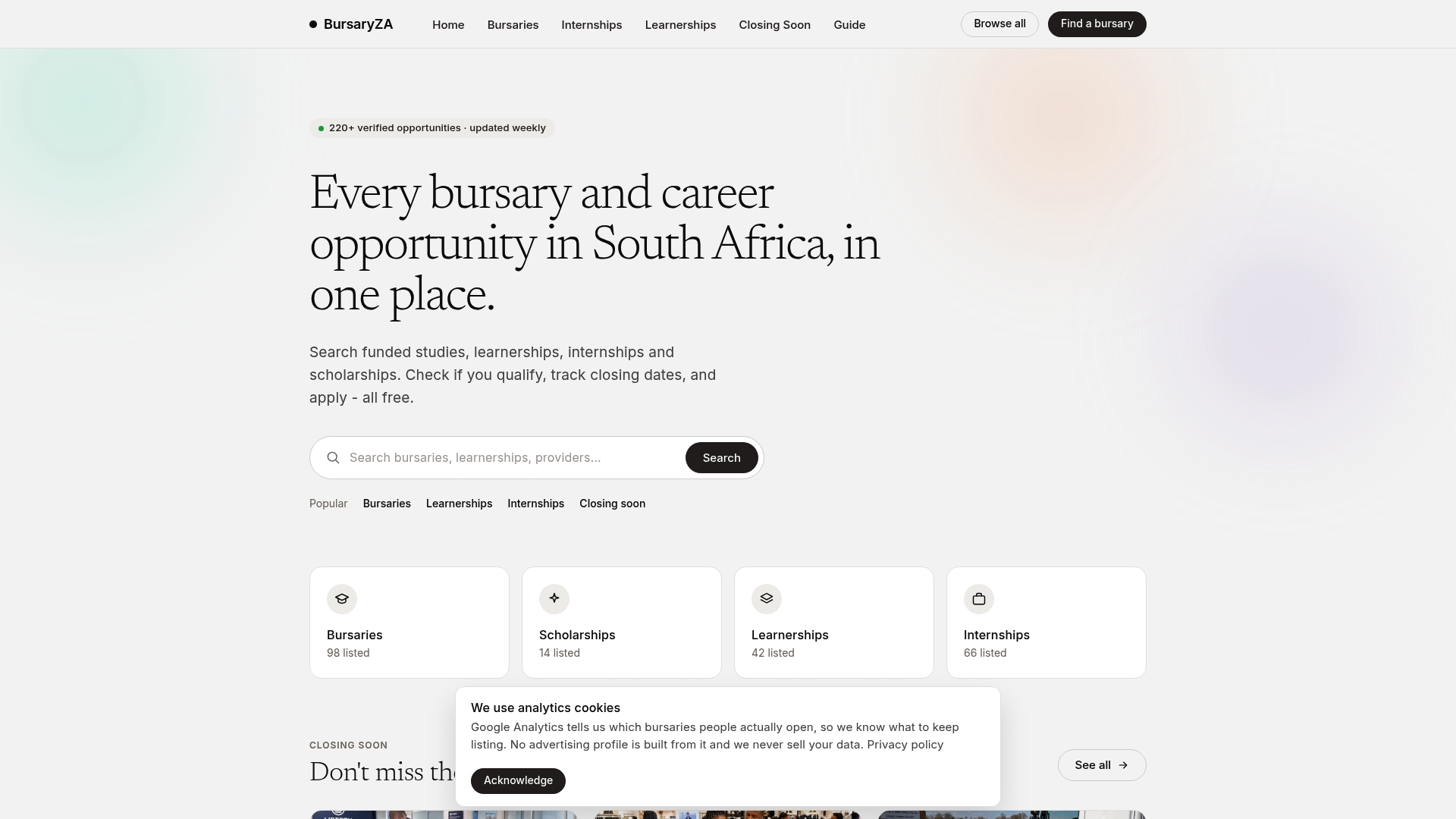
Start on the BursaryZA home page and filter by your study level. If you are a postgraduate, search for scholarships and internships at that level. If you are earlier in your studies, try the Sappi bursary listing as an example of how a corporate award is laid out.
How to choose and apply
- Define what you need paid. Tuition only, or tuition plus accommodation, food and data.
- Match your level. Undergraduate students should focus on scholarships and bursaries. Postgraduates should add fellowships.
- Check duties. Count the hours a fellowship expects from you and compare with your timetable.
- Collect documents early. ID, academic record, proof of income if needed, references and a proposal for research awards.
- Read the closing date and the renewal terms. Many funders open on a yearly cycle, so check the official page for the current round.
- Apply only on the official page. Never pay anyone to submit an application.
FAQ
Is a fellowship better than a scholarship?
Neither is better in general. A fellowship often pays more and includes a stipend, but it can also ask for project time and is mostly available at postgraduate level. A scholarship is usually easier to combine with full-time study and is open at more levels.
Who qualifies for a fellowship?
Usually postgraduate or postdoctoral candidates with strong academic records and a clear research or development plan. Some corporate fellowships, such as the Absa programme, are aimed at students earlier in their degrees, so read each funder’s eligibility section.
Do scholarships and fellowships have to be paid back?
Usually not, but some funders attach work-back or repayment conditions if you withdraw or fail to meet the terms. Look for these in the offer letter before you sign. If a clause is unclear, ask the funder in writing.
Is a fellowship the same as a bursary?
No. A bursary in South Africa is typically need-based study funding from a company or government body. A fellowship funds a defined term of research or professional development, and is usually merit-based.
Can I hold a scholarship and a fellowship at the same time?
Only if both funders allow it. Many awards forbid double funding for the same costs, so disclose any other funding when you apply and check each set of terms.
Sources
- Georgia Tech Graduate Studies: Fellowship vs Scholarship
- DSTI-NRF Postgraduate Scholarship Framework for 2026 Funding
- The Mandela Rhodes Scholarship
- Absa Fellowship Programme FAQ
- CAPSI-Mastercard Foundation PhD Fellowship call
- SAMRC RCDI-Nested Postdoctoral Fellowship
- UCT Guidelines for Postdoctoral Research Fellowships
- NRF Postgraduate Student Application and Funding Guide
- DHET International Scholarships FAQ
- NSFAS frequently asked questions