Employer Funding First for Part Time Bursaries in South Africa

Usually not from NSFAS. State funding leans heavily toward full-time enrollment, so if you’re studying part-time or working while you study, your realistic routes are employer sponsorship, sector grants, and select private trusts. Start today by checking your employer’s study policy, your university’s financial aid office, and BursaryZA’s bursary listings.
TL;DR:
- Employer sponsorship, sector grants, and certain private trusts offer more accessible funding options for part-time students than NSFAS or state bursaries.
- Many corporate and trust bursaries open between June and October, making early application and setting reminders crucial to secure funds.
- NSFAS only funds full-time students at public institutions with household income caps of R350,000, and does not support part-time enrollment or progress-based funding.
- ISFAP targets middle-income households and may support part-time students if income criteria are met, but primarily favors full-time undergraduates.
- Building a strong, tailored application package and applying directly to funders who accept part-time or working students increases chances of success.
Table of Contents
- Where To Find Part-Time Bursaries And Funding
- How NSFAS And ISFAP Treat Part-Time Study
- Getting Your Employer To Pay For Part-Time Study
- How To Apply: Your Step-By-Step Checklist
- Understanding Bursary Terms: Income Caps, Progression, And Work-Back
- Funders Worth Checking Right Now
- Prioritizing Your Search: An Adviser’s Take
- Search Smarter, Not Harder, With BursaryZA
- Sources
Where To Find Part-Time Bursaries And Funding
Finding money for part-time study is less about luck and more about knowing which doors to knock on. Most bursary hunters waste weeks scrolling generic “bursary lists” that quietly assume you’re a full-time, unemployed 19 year old. Part-time students need a different map.
Six categories of funders are worth chasing, in rough order of your odds:
- Employer study assistance — internal HR policies that pay tuition for staff studying part-time, often tied to your role.
- Professional bodies and SETAs — sector-specific grants tied to occupational qualifications (SAICA, ECSA, SAIT, and similar bodies often run their own funds).
- Corporate bursaries — company-run schemes that sometimes accept working or part-time applicants, especially in scarce-skills fields like engineering, IT, and finance.
- Private trusts and foundations — smaller funds with narrower criteria that occasionally state “part-time” or “distance learning” eligibility explicitly.
- University financial aid offices — internal bursaries and hardship funds that don’t always appear on public bursary lists.
- State and quasi-state bursaries — mostly full-time focused, but worth checking case by case rather than assuming exclusion.
The search itself needs structure. Your university’s financial aid office keeps a list of donor-funded bursaries that never make it onto public search engines, so book a ten-minute appointment before you do anything else. If you’re employed, your HR or learning-and-development team almost certainly administers a study assistance policy that most staff never ask about. Professional bodies publish grant windows on their own websites rather than bursary aggregators, so check the specific body tied to your qualification directly.
Bursary databases like BursaryZA solve the timing problem: instead of checking twenty separate websites, you filter by field of study, province, or study level and set alerts for new listings. That matters because corporate and trust bursary application windows cluster between June and October for the following academic year, so missing that window by even a few weeks can cost you an entire cycle.
Pro Tip: Set a recurring calendar reminder for the first week of June to review new bursary listings. That’s when most corporate and trust funders open their next cycle, and the strongest applicants apply in week one, not week ten.
How NSFAS And ISFAP Treat Part-Time Study
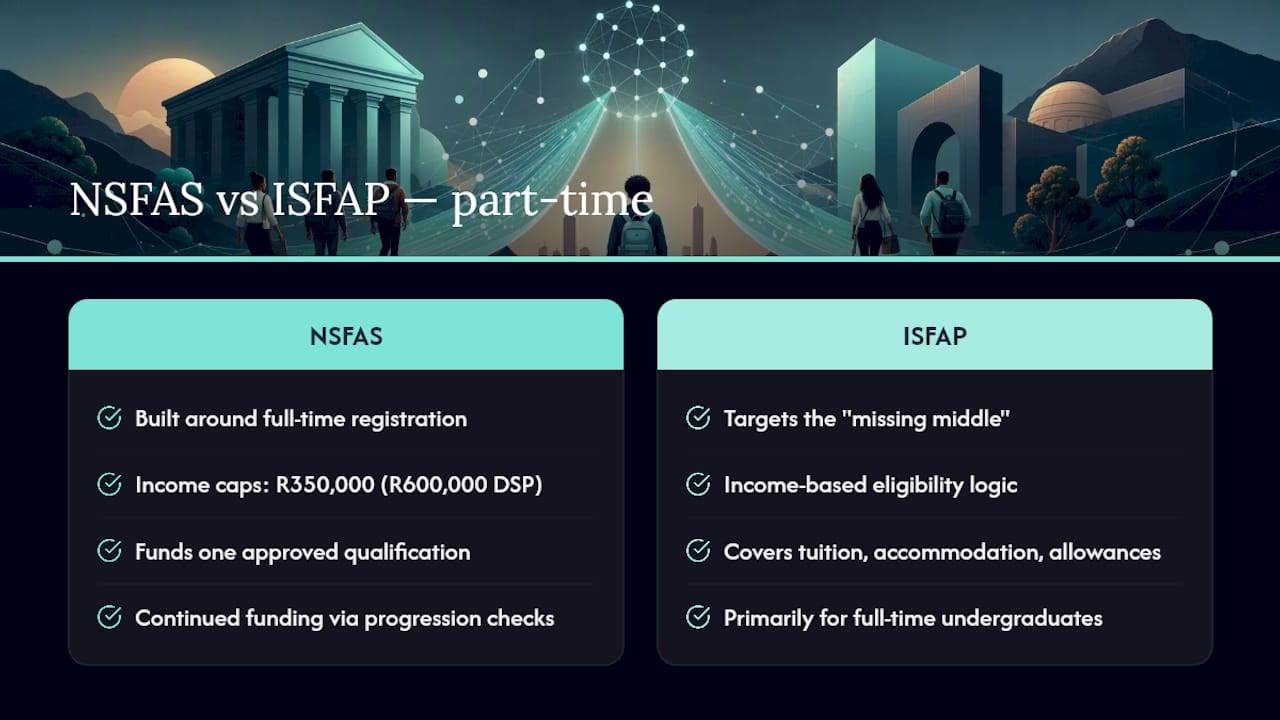
NSFAS funding is built around full-time registration at public universities and TVET colleges. NSFAS bursary guidelines tie eligibility to household income caps of R350,000 a year for most applicants, rising to R600,000 for students with disabilities, plus enrollment in an approved, full-time qualification. There is no standard part-time pathway built into that model.
The bursary funds one approved qualification per student, and continuing eligibility depends on meeting academic progression benchmarks, not simply staying registered. Students studying below full-time load will typically not meet the enrollment criteria NSFAS uses to assess funding.
That single design choice explains most of the confusion part-time students run into. NSFAS was structured to solve throughput at scale for full-time cohorts, which means its N+ rule (the number of extra years beyond the minimum a qualification takes that NSFAS will still fund) and progression checks assume a full academic load each year. A part-time timetable simply doesn’t map onto that calculation.
ISFAP fills a different gap. The Ineza Student Financial Aid Programme targets what’s often called the “missing middle,” households earning above the NSFAS threshold but still unable to self-fund tertiary study. ISFAP runs its own application cycle with separate deadlines, and its bursaries can cover tuition, accommodation, and allowances for approved applicants. It’s still primarily oriented toward full-time undergraduates, but the eligibility logic is income-based rather than employment-status based, so it’s worth confirming directly with ISFAP rather than assuming exclusion.
The practical takeaway: if you’re studying part-time because you’re working, NSFAS and ISFAP are unlikely to be your funder. If you’re part-time because full-time study genuinely isn’t an option right now, it still costs nothing to check both programs’ current criteria before ruling them out, since guidelines get reviewed annually and edge cases do get approved.
Getting Your Employer To Pay For Part-Time Study
Employed students have an advantage most bursary guides ignore: your employer already has skin in the game. Education funding analysts note that employer-based study assistance and professional development grants are frequently the strongest funding route for working students, precisely because these programs are built for people studying alongside a job.
Employers fund study for a straightforward reason: a more qualified employee is worth more to the business. Policies vary in shape. Some cover full tuition with no strings attached. Others fund partially and require you to maintain a pass rate, use annual leave for exams, or sign a retention clause that ties funding to staying with the company for a set period after you graduate.
Here’s how to actually ask for it:
- Check your HR policy first. Many companies already have a study assistance policy that nobody advertises internally, so ask HR directly whether one exists before assuming you need to negotiate from scratch.
- Build a one-page business case. Show how your qualification connects directly to your current role, and frame it as a return on investment for the business over the next twelve months, not just a personal goal.
- Propose the practical terms. State clearly what you’re asking for: partial or full tuition, study leave for exams, and any deliverable you’ll produce in return, like applying new skills to a specific project.
- Put it in writing. Send a short email to your manager and HR summarizing the request, the cost, and the timeline, so there’s a clear record if the request needs sign-off from someone higher up.
- Check your professional body in parallel. Bodies tied to your field often run their own bursaries or grants for members pursuing further qualifications, separate from anything your employer offers.
SETAs (Sector Education and Training Authorities) are worth a specific mention here. They fund training linked to scarce or critical skills in their sector, and grants often go through employers rather than directly to individuals, so ask your HR or training department whether your company draws on SETA discretionary grants for staff development.
Pro Tip: Frame your funding request around what the company gets, not what you need. “This qualification will let me handle X internally instead of outsourcing it” lands better than “I’d like to study further.”
How To Apply: Your Step-By-Step Checklist
Getting funded usually comes down to preparation, not luck. Selection panels move fast and reject incomplete applications first, so build your documents before you need them.
Documents to gather:
- Certified copy of your South African ID
- Latest academic transcript or record of results
- Proof of registration or an admission letter from your institution
- Proof of household income (payslips, SASSA letter, or an affidavit of unemployment for a parent or guardian)
- A signed letter from your employer confirming your role and, if applicable, support for your study
- A simple personal budget showing tuition, materials, and any living cost gap the bursary would close
Application steps, in order:
- List every deadline first. Corporate and trust bursaries mostly open between June and October for the following year, so build a calendar before you start writing anything.
- Draft one strong motivation letter. Explain why you’re studying part-time, how it connects to your career, and how you’ll manage both work and study, then adapt this letter for each application rather than writing from scratch every time.
- Attach a clear study plan. Funders want to see realistic timelines, especially for part-time students who might take longer to complete a qualification than a full-time peer.
- Apply early within the window, not at the deadline. Panels reviewing 500 applications tend to give closer attention to the first batch than the rush that arrives in the final 48 hours.
- Follow up in writing after two to three weeks. A short, polite check-in email signals genuine interest without becoming a nuisance.
- Keep copies of everything you submit. If you’re later asked to report the bursary to another funder, or reconcile funding between two sources, you’ll need the paper trail.
Common mistakes worth avoiding: submitting a generic, unedited motivation letter to five different funders, missing a document because you didn’t read the checklist twice, and applying only in the final week of a window that’s been open since June. Mid-cycle or late openings do happen, mostly through trusts and employer schemes rather than the big state or corporate programs, so it’s worth checking listings even outside the typical application season.
Understanding Bursary Terms: Income Caps, Progression, And Work-Back
Every bursary comes with fine print, and the terms repeat often enough across South African funders that it’s worth understanding them once rather than relearning them for each application.
Income thresholds decide who qualifies before academics even come into play. NSFAS uses a combined household income cap of R350,000 a year, rising to R600,000 for applicants with disabilities, and SASSA grant recipients are automatically treated as meeting the financial eligibility requirement. Corporate and trust bursaries set their own thresholds, often lower, so check each funder’s specific number rather than assuming NSFAS figures apply everywhere.
Academic progression rules matter more than most first-time applicants expect. NSFAS applies what’s called the N+ rule, funding a qualification for its minimum duration plus a set number of extra years, and falling short of progression benchmarks can trigger a review or withdrawal of continued funding. Most corporate and trust bursaries mirror this logic in their own contracts.
Work-back clauses are the part applicants read fastest and regret skipping. Many corporate bursaries and some trusts require a period of employment with the funder after graduation, often matching the number of years funded. Read this clause before you sign anything. Breaking it can mean repaying the full bursary as a loan.
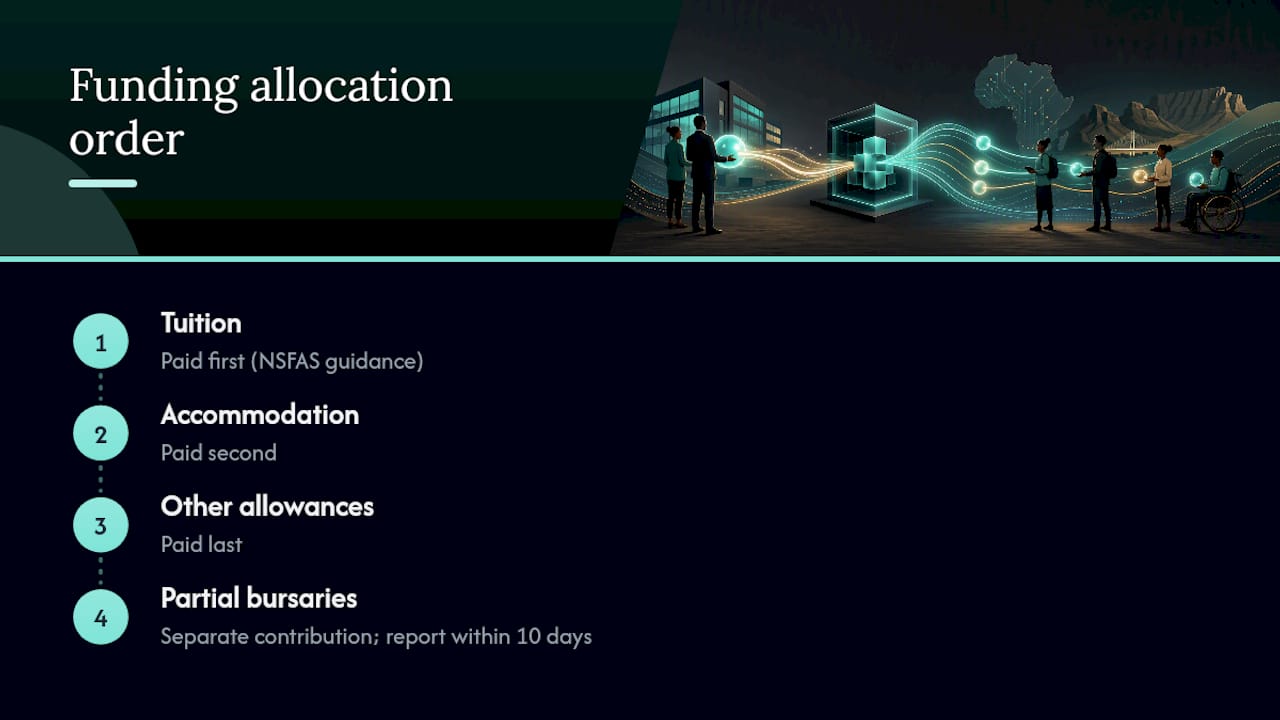
Reporting other funding is a rule that catches people off guard. NSFAS requires students to report any other bursary received within 10 days, and funding gets reconciled if you’re receiving support from more than one source. Partial bursaries follow the same disclosure rule.
Funding allocation also follows a fixed order rather than a lump sum. NSFAS guidance confirms tuition is paid first, followed by accommodation, then other allowances, which matters if you’re stacking a partial bursary with other support and trying to work out what’s actually left over for living costs.
Funders Worth Checking Right Now
Some funders are worth your time immediately; others are worth ruling out quickly so you stop wasting effort on dead ends. Here’s where the major South African players stand on part-time and working students.
| Funder | Who it typically funds | What it covers | Application timing |
|---|---|---|---|
| NSFAS | Full-time students at public universities and TVET colleges, income-capped | Tuition, accommodation, allowances | Annual cycle, opens before the academic year starts |
| ISFAP | “Missing middle” income band, mostly full-time undergraduates | Tuition, accommodation, allowances (varies by partner funder) | Separate annual cycle, check current dates directly |
| IDC External Bursary Scheme | Mainly unemployed South African citizens in eligible fields, income-capped | Tuition, accommodation, laptop, monthly allowance | Published cycle, historically opening around June and closing by September |
| Old Mutual Education Trust (OMET) | First undergraduate qualification, ties to union membership or family links | Partial bursary, up to R77,000 per student per academic year | Annual application window, check the OMET page for current dates |
| SETA and corporate bursaries | Varies by sector; some explicitly accept employed or part-time applicants | Varies widely, often tuition plus a training or mentorship component | Mostly June to October for the following academic year |
NSFAS remains the largest state funder in the country, but its structure is built for full-time throughput. If you’re studying part-time, treat NSFAS as a program to monitor for future eligibility changes rather than a current option.
ISFAP is worth a direct check if your household income sits above the NSFAS cap but below what you can comfortably self-fund. It won’t solve part-time eligibility on its own, but it’s a live program with its own criteria, not a closed door.
The IDC External Bursary Scheme publishes clear numbers: eligibility, income caps, and a defined list of covered costs including tuition, accommodation, a laptop, and monthly allowances. It’s aimed at unemployed applicants studying full-time in specific fields tied to industrial development, which makes it a poor fit for most working part-time students, but a strong option if you’re unemployed and considering a switch to full-time study instead.
Old Mutual Education Trust takes a different shape entirely. It funds partial bursaries for a first undergraduate qualification, pays up to R77,000 per student per academic year, and ties eligibility to specific criteria like union membership or family connections rather than a blanket income test. Partial funding models like this one are exactly where working students sometimes find a foothold that full-time-only programs won’t offer.
SETA and corporate bursaries are the category most worth digging into if you’re employed. Corporate bursaries frequently bundle in mentorship, vacation work, or a graduate pipeline, and applicants who can show clear career alignment with the funder’s industry tend to stand out. Check whether your employer draws on SETA discretionary grants before assuming you need to apply independently.
Field-specific searching pays off here. If you’re in IT or computer science, employer-funded upskilling is common enough that it’s worth checking listings even outside a formal bursary cycle. If you’re training toward teaching, several trusts and provincial programs run funding specifically for that pipeline, some of which accept part-time or in-service applicants.
Prioritizing Your Search: An Adviser’s Take
If I had to give a student thirty seconds of advice, it would be this: stop treating every bursary listing as equally worth your time. Employer and sector funding convert at a far higher rate for part-time applicants than state or corporate schemes built around full-time cohorts, so start there and only move to trusts and university funds if that door is closed.
Build one strong application package: ID, transcript, budget, motivation letter, study plan. Adapt it per funder rather than rewriting it each time. That single habit will save you more hours than any amount of extra searching.
Apply directly to funders when the program explicitly welcomes part-time or working applicants, since institutional financial aid offices are built to triage full-time NSFAS and ISFAP cases first. Go through your university’s financial aid office when you’re unsure whether a listed bursary has quiet exceptions for part-time study. They know their own donor-funded pots better than any public database ever will, and sometimes that unpublished exception is exactly what you need.
— Nkosi
Search Smarter, Not Harder, With BursaryZA
There are practical shortcuts to everything covered above: instead of checking a dozen provider websites for opening dates, you can search verified databases filtered by field, province, and study level.
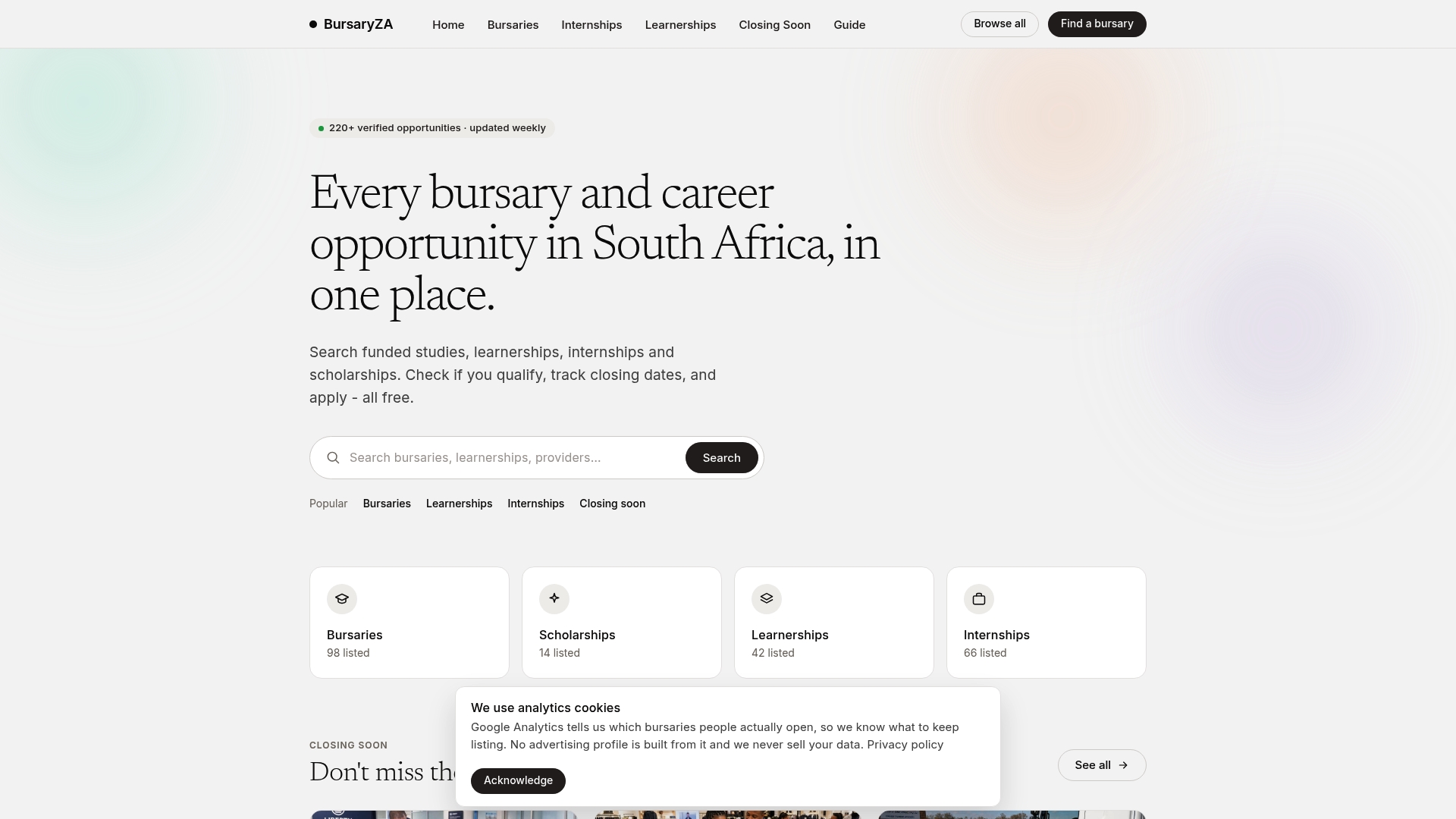
Every listing on Bursaryza includes an eligibility checklist, a closing date, and a direct link to the official application page, so you can quickly rule out programs that exclude part-time or working applicants and focus on the ones that don’t. If you’re based in Gauteng or the Western Cape, the province filters surface local employer-linked and trust-funded programs that rarely show up in generic searches. Set an alert for your field of study, and new listings land in front of you the week they open, not months later.
Start your search on the BursaryZA bursaries page today, filter by your field and province, and shortlist the funders whose eligibility criteria actually match your situation before the June application season fills up.
Sources
- NSFAS bursary guidelines (Annexure A) 2026
- IDC bursaries programme page
- Old Mutual Education Trust (OMET) programme page