What Makes a Bursary Motivation Letter Stand Out

A winning bursary motivation letter names the exact bursary, course, and institution in the first sentence, then proves academic potential, states financial need in verifiable facts, and closes with a specific career goal. Keep it to one page, roughly 400 to 500 words, written in a factual, professional tone across five clear parts: header, opening, academics, financial need, and career close.
TL;DR:
- Clearly stating the bursary, course, and institution early in the letter helps panels verify applicant focus and demonstrates initiative.
- Using specific, verifiable facts about academic achievements and household income strengthens credibility over vague or emotional claims.
- Tailoring the career goal to the provider’s priorities and the local context increases the chance of resonating with the selection panel.
- Including concrete extracurricular roles and unique skills that relate to the field showcases initiative and responsible use of funding.
- Following a strict five-part structure and proofreading against supporting documents prevents common errors that can disqualify otherwise merit-worthy applications.
Table of Contents
- How To Write A Bursary Motivation Letter Step By Step
- Sentence Templates To Adapt For Each Paragraph
- Common Mistakes That Sink A Strong Application
- Three Sample Letters You Can Adapt
- Your Pre-Submission Document Checklist
- How BursaryZA Helps You Target The Right Letter
- Writing About Financial Hardship Without Oversharing
- Making Extracurriculars And Community Work Count
- Turning Your Background Into A Selling Point
- Why Most Bursary Letters Sound The Same
- Find A Bursary Worth Writing This Letter For
- Sources
How To Write A Bursary Motivation Letter Step By Step
Selection panels read hundreds of these letters in a single sitting. The ones that get flagged for a second look follow a predictable shape, and skipping any part of that shape is usually what costs an applicant the interview slot.
Start with the header. Include your full name, ID number, contact details, the date, and the recipient’s name and title. If you cannot find a named contact, address the letter to the “Bursary Selection Committee” rather than a generic “To Whom It May Concern.” Guides that focus specifically on application formatting note that addressing a named committee member or Financial Aid Director signals initiative that a blank salutation never does.
Your opening two to three sentences carry more weight than any other part of the letter. State your name, the exact bursary you’re applying for, the course and institution, and the academic year. Something like: “I am writing to apply for the [Bursary Name] for the 2026 academic year to pursue a Bachelor of Engineering at the University of Pretoria.” No throat-clearing, no life story yet. That comes next.
The body needs three distinct paragraphs, each doing one job:
- Academic background (3 to 4 sentences): current grades or averages, subjects relevant to your chosen field, and any academic awards, leadership roles, or responsibilities.
- Financial need (3 to 4 sentences): household income situation, number of dependents, and the specific funding gap, stated as fact rather than appeal.
- Career goals and conclusion (3 to 4 sentences): what you plan to do with the qualification, how it connects to a realistic outcome, and a polite closing line thanking the committee for their consideration.
On formatting: save the final document as a PDF, never a Word file that might shift formatting on another screen. Use a standard font like Arial or Times New Roman at 11 or 12 point, single spacing, and one-inch margins. A letter that spills onto a second page usually means a paragraph needs trimming, not a smaller font size. Following this five-part structure also makes it far easier to adapt the same letter for multiple bursary applications without starting from scratch each time.
If you’re unsure why a motivation letter differs from a general cover letter or a letter of interest, it helps to understand the distinction lenders and institutions draw between formats. A letter of intent versus a letter of interest explains why a targeted, single-purpose letter like this one performs better than a generic template stretched to fit multiple applications.
Sentence Templates To Adapt For Each Paragraph
Structure alone won’t save a weak sentence. The actual words you choose in each paragraph decide whether a reader keeps going or starts skimming.
Here’s how to build out each section with language that sounds specific rather than recycled:
- Opening thesis. “My name is [Full Name], and I am applying for the [Bursary Name] to study [Course] at [Institution] for the 2026 intake.” Name three things in one sentence: you, the bursary, the course.
- Academic proof. Instead of “I am a hardworking student,” write “I achieved an 82% average in Mathematics and Physical Sciences in Grade 12 and served as Deputy Head Boy, coordinating a peer tutoring program for 40 junior students.” Numbers and titles do the convincing, not adjectives.
- Financial need. Replace “My family cannot afford university” with “My household relies on a single income of approximately R9,500 per month, supporting four dependents, and cannot cover the R65,000 annual tuition gap after NSFAS contributions.” Specific figures read as verifiable, not desperate. Guidance on writing financial sections consistently points to this kind of compact, verifiable snapshot as stronger than broad statements of hardship, since committees often check claims against supporting documents anyway.
- Career alignment. Avoid “I want to make a difference in the world.” Write “I intend to complete a B.Sc. in Civil Engineering and return to work on municipal water infrastructure projects in my home province, where access to clean water remains inconsistent.” Concrete, local, checkable. Advice aimed specifically at South African applicants backs this up: panels tend to favor community-focused, researched outcomes over sweeping promises.
- Closing line. “Thank you for considering my application. I am confident that, with this opportunity, I will complete my studies successfully and contribute meaningfully to the field of [industry].” Short, grateful, forward-looking.
Pro Tip: Before you submit anything, read your financial need paragraph out loud and ask whether every number in it appears somewhere in your supporting documents. If it doesn’t, either find the document or cut the number.
A quick before-and-after shows the gap between filler and substance:
Weak: “I have always loved science and dream of becoming an engineer one day, and this bursary would mean everything to me.”
The second version tells the reader something they can act on. The first only tells them how you feel. Committees are trained to look past feeling for evidence, and researching the provider’s own priorities before you write, whether that’s community service, STEM development, or leadership, helps you mirror what the organization actually values in your phrasing.
Common Mistakes That Sink A Strong Application
Most rejected letters aren’t rejected because the applicant lacked merit. They’re rejected because the letter buried that merit under avoidable errors.
Over-sharing emotional detail is the biggest one. A line like “My father’s death left our family devastated and I cried every night for months” feels honest, but it reads as unverifiable and off-tone to a panel scanning dozens of letters in an afternoon. Replace it with the factual version: “Following my father’s passing in 2024, my mother has been the sole income earner for our household of four.” Same circumstance, documentable framing.
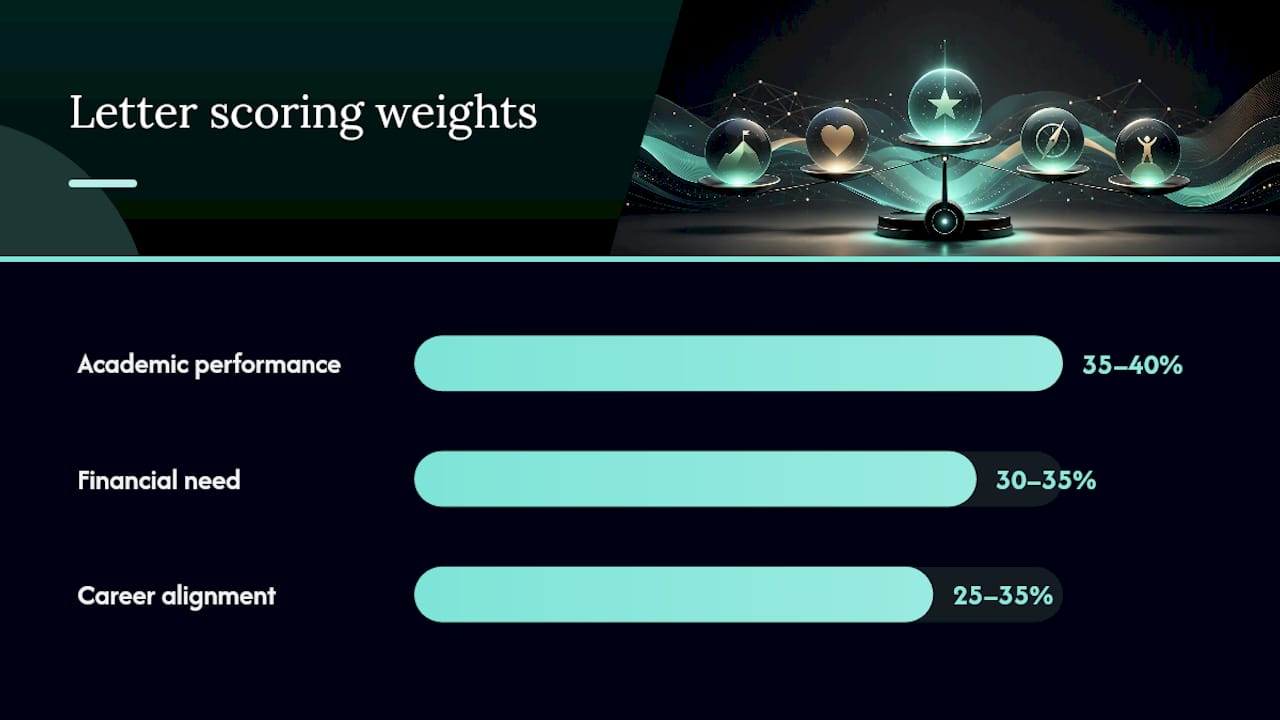
Generic templates are the second problem. If your letter could be sent to any bursary provider without changing a single sentence, the panel can usually tell. Academic performance and financial need tend to carry roughly 35 to 40% and 30 to 35% weight respectively in how these letters get scored, with career alignment making up most of the rest, so a letter that skips specifics in any of those three areas is losing points before it’s even finished being read.
Tone is the third trap. Pleading language (“I desperately need this bursary” or “Please, I beg you to consider me”) undercuts the professionalism the rest of the letter is trying to build. Swap pleading for confidence: state your situation, state your capability, and let the facts carry the request.
Quick-edit checklist before you hit send:
- Cut any sentence that describes a feeling instead of a fact.
- Confirm the bursary name, course, and institution are correct and spelled consistently throughout.
- Trim any paragraph running longer than five sentences.
- Remove greeting phrases like “To Whom It May Concern” if a named contact exists.
Three Sample Letters You Can Adapt
Templates work best when you can see why each line is there, not just what it says. Below are three approaches suited to different applicant profiles, each built around the same five-part backbone but weighted differently depending on what the writer has to lean on.
The short general-purpose letter (350 to 450 words) suits an applicant with a solid but unremarkable record. It leans equally on all three pillars, spending roughly one paragraph each on academics, need, and goals, without over-claiming in any single area. Use this version when you don’t have a standout achievement to headline but your overall profile is consistent.
The academic-achievement-focused letter (450 to 550 words) suits a top performer. It opens the academic paragraph with a specific average or subject distinction, then spends an extra sentence on leadership or extracurricular responsibility before moving to financial need. This version front-loads credibility so the panel takes the financial claims more seriously by the time they reach them.
The STEM/career-aligned letter connects study directly to an industry outcome. It names a specific sector problem (water scarcity, energy access, skills shortages in a named trade) and positions the degree as the bridge to solving a piece of it locally. This format works especially well for engineering and applied science applicants, where providers often want to see the funding tied to a workforce gap they care about.
When adapting any of the three:
- Swap the bursary name, course, and institution in the opening sentence every single time.
- Update the financial figures to match your actual household situation, never round numbers up for effect.
- Rewrite the career paragraph to name the specific sector or region the bursary provider funds, based on their stated mission.
Short, annotated examples like these speed up adaptation and cut down on the kind of copy-paste errors that happen when a student forgets to change a course name from a previous draft.
Your Pre-Submission Document Checklist
A strong letter can still get disqualified over sloppy admin. Before you submit, gather your certified ID copy, proof of residence, latest academic transcript, and, if applicable, proof of household income or a parent’s payslip.
Name your files clearly: Lastname_BursaryName_Application.pdf works better than Document1.pdf or Scan_2026.pdf when a coordinator is sorting through hundreds of submissions. Compress large scans before attaching them. Most email systems cap attachments around 25MB, and a phone-scanned transcript can easily exceed that if left uncompressed.
For email submissions, use a subject line like “Bursary Application: [Your Name] – [Bursary Name] 2026.” If you haven’t heard back within two to three weeks of the stated review period, one polite follow-up email is appropriate. Two is pushing it. Following a clear document checklist before submission is one of the simplest ways to avoid a rejection that has nothing to do with the quality of your writing.
How BursaryZA Helps You Target The Right Letter
Every listing on Bursaryza includes a verification check, an eligibility checklist, and a closing date, so you’re not guessing whether you qualify before you invest hours writing a letter.
- Use the bursary application calendar to plan which letters to write first based on closing dates.
- Browse listed eligibility criteria to identify which values a specific provider prioritizes, then mirror that language in your letter.
- Cross-check your document pack against the application guide before you submit anything.
Writing About Financial Hardship Without Oversharing
Financial need paragraphs are the hardest part of this letter to get right because the instinct is to either say too little or say too much. Neither serves you.
Saying too little sounds like “My family struggles financially.” That tells the panel nothing they can verify or weigh against other applicants. Saying too much, detailing a parent’s illness in graphic terms or narrating a specific crisis event, shifts the tone from professional to distressing, and panels are trained to look past emotional appeals for documentable facts anyway.
The middle ground is a compact snapshot: household income, number of dependents, and the specific funding gap. If your circumstances include a recent shock, a retrenchment, a parent’s illness that affected income, a family business closure, name it in one factual sentence and move immediately to how it affects your ability to fund your studies. “My mother was retrenched in early 2025, reducing our household income to approximately R6,000 per month” does the work without inviting sympathy you haven’t been asked to earn.
If you’re a first-generation university applicant, or you’ve navigated a family responsibility like caregiving for younger siblings while maintaining your grades, that context is worth one sentence, placed where it explains resilience rather than asks for pity. The goal is always the same: give the panel information they can act on, not a story they have to sit with.
Making Extracurriculars And Community Work Count
A bursary letter isn’t just an academic transcript in prose form. Committees read leadership and community involvement as evidence that you’ll represent their brand well and use the opportunity responsibly, not just competently.
If you’ve held a position, class representative, sports team captain, church youth leader, debate society chair, name the role and one concrete outcome from it. “Organized a food drive that collected supplies for 30 households” tells the panel more than “I am passionate about helping others.” Volunteering, tutoring younger students, or coaching a junior sports team all count, provided you can describe what you actually did rather than just that you did it.

Keep this section to one or two sentences inside your academic paragraph, or as a bridge into your career goals paragraph if the activity connects naturally to your intended field. A student applying for a social work bursary who spent a year volunteering at a community shelter has a stronger, more coherent letter than one who lists the activity without connecting it to their goals. If your extracurricular record is thin, don’t manufacture involvement. Focus more weight on academics and financial need instead. A social sciences bursary provider, for instance, is far more likely to weigh community involvement heavily than a narrowly technical scholarship would.
Turning Your Background Into A Selling Point
Every applicant has something that makes their application distinct from the next one in the pile, even if it doesn’t look like a traditional achievement.
Maybe you taught yourself coding through free online resources because your school didn’t offer computer science. Maybe you translate for your grandparents at medical appointments and picked up a working fluency in a second or third language along the way. These details matter because they show initiative and capability under constraint, which is exactly what a limited-funding bursary provider wants evidence of before they commit years of tuition to you.
The mistake most applicants make is assuming a skill only counts if it’s directly related to their course. It doesn’t have to be. A science bursary committee still wants to know you can manage competing priorities, communicate clearly, and follow through on commitments, and a part-time job or a language skill demonstrates all three just as well as a school science fair placing would.
Pick one or two of these details, the ones most relevant to the field you’re applying in, and place them either at the end of your academic paragraph or woven into your career goals section. Don’t list five unrelated skills. A cluttered final paragraph dilutes the one or two points that would have actually stood out.
Why Most Bursary Letters Sound The Same
Most bursary motivation letters fail for a reason that has nothing to do with the applicant’s actual qualifications: they read like they were written to satisfy a form, not to communicate with a real person on the other end.
Committees read letters where every sentence hedges, every claim is vague, and the closing paragraph could belong to literally any applicant studying literally any subject. The letters that get remembered are the ones where a reader could recreate the applicant’s actual situation from the text alone: this specific grade average, this specific household number, this specific place they intend to work after graduating. Specificity isn’t a stylistic preference here. It’s the mechanism that lets a panel trust what you’re telling them.
If you take one thing from this guide, make it this: write your financial need paragraph and your career goals paragraph as if a stranger would need to fact-check every sentence against your supporting documents, because that’s often exactly what happens. Then get one other person, a teacher, a parent, a mentor, to read the final draft before you submit it. A second set of eyes catches the vague sentence you didn’t notice was vague. Once your letter is ready, search Bursaryza for opportunities that match your field and check their specific eligibility criteria before you send your next application.
— Nkosi
Find A Bursary Worth Writing This Letter For
A strong letter only pays off if it lands in front of the right provider, and that’s where most students lose time searching scattered, outdated listings instead of writing. Bursaryza runs a verified, regularly updated database of South African bursaries, scholarships, and learnerships, each with its own eligibility checklist and closing date, so you can match your letter to a provider you actually qualify for before you spend hours drafting.
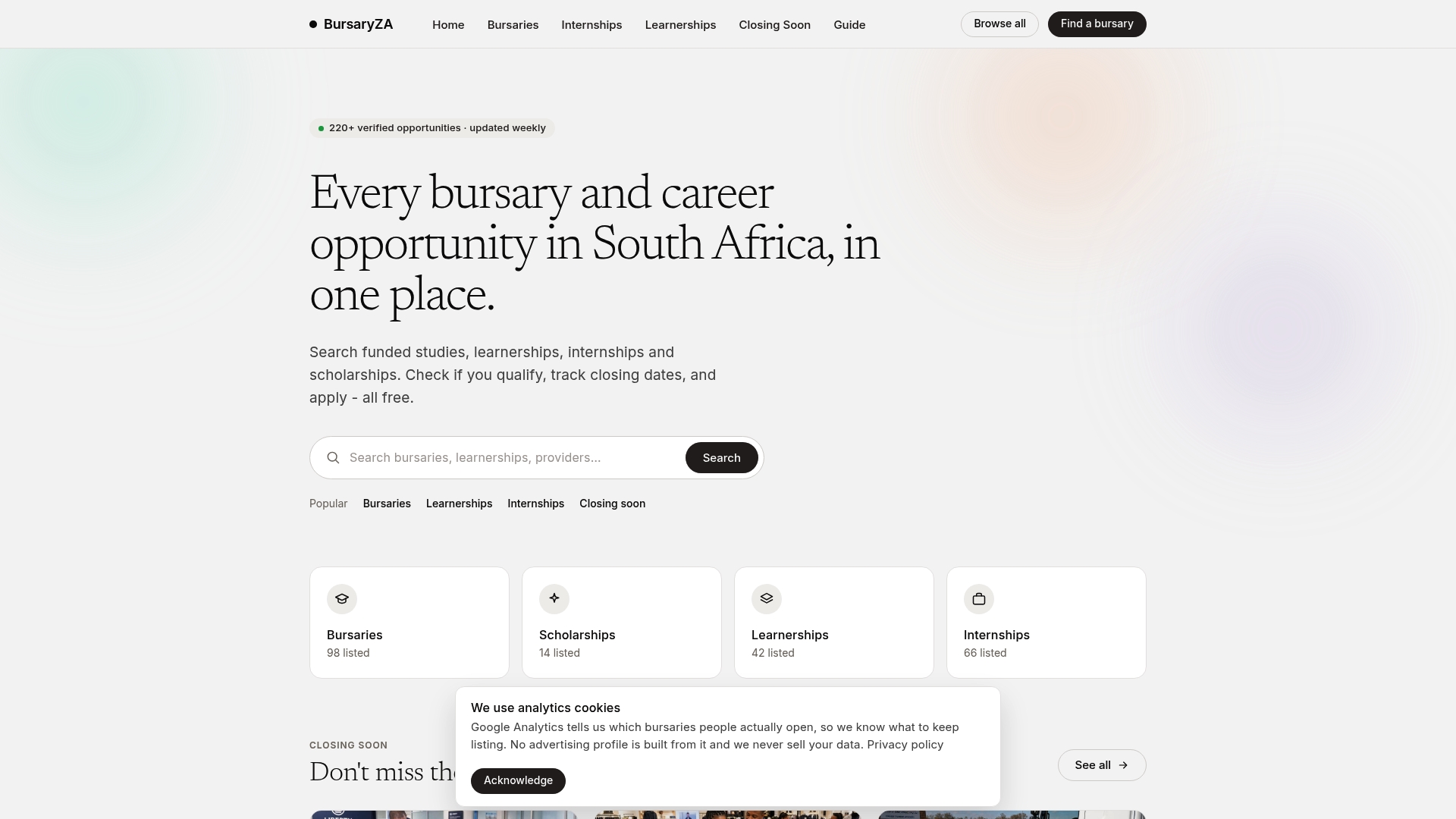
Use the filters to narrow listings by field of study, study level, or province, then check the eligibility checklist on each listing before you tailor your letter’s career goals paragraph to match what that specific provider funds. Whether you’re looking nationally or want to start with opportunities in Gauteng or the Western Cape, the fastest next step is simple: browse current bursaries on Bursaryza and shortlist two or three you meet the criteria for before you write your next letter.
Sources
- How to Write a Motivational Letter for Bursary 2026 — CollegeAidGuide
- How to Write a Bursary Application Letter (2026) — ScholarshipOwl
- How to Write Bursary Application Letters — StartGrants