Scholarship Essay Tips That Work for South African Bursaries

A strong scholarship essay does three things: it answers the exact question the funder asked, it shows one real experience in detail, and it connects that experience to what you will do with the funding. Everything else is polish. Below you will find a clear process for planning, opening, writing and editing, built around what South African funders actually ask for.
TL;DR
- Read the prompt and the word limit first. South African funders ask for anything from 250 to 500 words, and going over or under counts against you.
- Pick one pivotal experience and show it with specific detail, instead of listing achievements or telling your life story.
- Research the funder and use its values to choose your examples, but never invent or exaggerate a story.
- Use a simple structure: a short hook, two or three focused body paragraphs, and a conclusion that points to your future.
- Edit until it is error-free, use examples only to learn, and keep every sentence your own.
Table of Contents
- Start with the prompt and the funder
- Plan before you draft
- Open with something only you could write
- Build the body around one real experience
- What to leave out
- Our perspective
- Edit like a selector
- Match the essay to the application
- Find funders whose values fit your story
- FAQ
- Sources
Start with the prompt and the funder
Before you write a word, work out what you are being asked. Prompts differ more than most applicants expect. The South African Reserve Bank’s external bursary form, for example, asks for an essay of 250 words to motivate your application. The Sacbw Foundation’s bursary application also asks for a 250-word essay and a 3-minute video covering it. The Mandela Rhodes Foundation, in its application guide, says applicants write two 500-word essays. The Old Mutual bursary motivation form asks for a short autobiography of about 300 words and a separate essay of at least 300 words weighing your chosen career against an alternative.

These are four different tasks. A 250-word motivation is a tight argument. A 500-word essay has room for a scene. An autobiography is a different animal from a career comparison. Writing one generic essay and pasting it everywhere is the most common reason strong candidates sound forgettable.
Read the instructions twice
Underline the verbs: describe, explain, motivate, compare, reflect. Then note the practical rules: word count, format, whether a title is expected, whether a video or certified documents go with it. Valparaiso University’s advice is to read the instructions carefully and watch for requirements such as font, size, title and length. Funders who receive thousands of applications use these rules as a quick filter.
Research who is paying
Washington State University’s Writing Program suggests you research the scholarship, the funder and any person the award honours, then use that context to choose details that fit the funder’s values and goals. A mining company, a bank, a foundation focused on rural education and a public-sector body each care about different things. Read the provider’s “about” page and the listing’s eligibility checklist before you plan your essay. On BursaryZA, every listing shows the provider, the requirements and the closing date in one place, so you can start your research from the full list of bursaries.
Know which type of question you have
Most prompts fall into a handful of families: personal narrative, community impact, obstacles overcome, academic goals, leadership, and career aspirations. Scholarship.co.za, which lists these categories, advises recognising which one you face before you start. A “why do you deserve this bursary” prompt wants evidence of need and drive. A “tell us about a challenge” prompt wants reflection, not just hardship.
Plan before you draft
Spend ten minutes on a plan. It will save you an hour of rewriting.
- Write the prompt at the top of the page. Keep it in view while you work.
- List three or four possible experiences. A time you led something, a problem you solved, a setback you handled, a moment you chose your field.
- Pick the one that best answers the prompt. One strong story beats four thin ones.
- Write the point of the essay in one sentence. For example: “My years of helping run my township’s homework club taught me that I want to teach mathematics, and a bursary will let me finish my degree.”
- Match your word budget to your outline.
A structure that fits short essays
The University of Maryland Eastern Shore notes that scholarship essays commonly run three to five paragraphs: an introduction, two or three body paragraphs and a conclusion. It also says to write in the first person, in a somewhat formal but not overly casual tone. Valparaiso suggests a simple outline of an introduction, three talking points and a conclusion.
South African bursary funders recommend something very similar. The Thapelo Madibeng Bursary’s guidance on motivational letters describes an opening that captures attention and states your intention to apply, body paragraphs with specific examples, and a conclusion that restates your interest and thanks the reader.
Here is how that looks when you divide the word count:
| Section | Job | 250-word essay | 500-word essay |
|---|---|---|---|
| Opening | Hook the reader and state your purpose | 35 to 40 words | 60 to 80 words |
| Body 1 | Your key experience, told with detail | 90 words | 150 to 180 words |
| Body 2 | What it taught you and how it links to your field | 70 words | 120 to 150 words |
| Body 3 (optional) | Evidence of drive: marks, projects, work ethic | skip | 60 to 80 words |
| Conclusion | What the funding makes possible | 35 to 40 words | 60 to 80 words |
These splits are our suggestion for budgeting, not a funder rule. Adjust them to the prompt.
Open with something only you could write
The opening matters because a selector may read dozens of essays in one sitting. The University of Colorado Boulder’s scholarships office says a personal statement should capture the selection committee’s attention. Owens Community College recommends pulling the reader in by raising a question or creating surprise, and starting with vivid examples rather than telling.
Compare two openings for a 250-word essay:
- Generic: “I am writing to apply for this bursary because I want to study engineering and my family cannot afford university.”
- Specific: “At sixteen, I fixed my neighbour’s solar panel with a borrowed multimeter and a YouTube video. That evening, six households had light, and I knew I wanted to be an electrical engineer.”
The second tells the selector what you do, how you think and what you want, in two sentences. These sentences are only an illustration of the technique. Write your own from your own life.
If you are short on words, you do not need a long run-up. Say who you are and what you are applying for within the first two or three sentences, then move into your story.
Build the body around one real experience
The most useful single piece of advice in the research is specificity. Scholarship.co.za puts it simply: focus on one pivotal experience that shaped your goals, explain what you did and thought, and connect it to your future career. The University of Colorado Boulder agrees, advising you to show rather than tell, use concrete examples as evidence, and tailor each statement to the opportunity.
Show, then explain
Washington State University gives a clear example of the problem: if you write that you want to help people, anyone can say that. Describe your specific reasons instead, then explain what the experience reveals about you and link it to your goals. A reliable pattern is:
- Situation: where and when, in one sentence.
- Action: what you did, with numbers or names where you honestly have them (12 learners, three Saturdays, a R200 budget).
- Result: what changed, even if it was small.
- Meaning: what it taught you and why it points to this course or career.
Handle hardship with care
Many South African applicants have faced real financial pressure, and funders know it. Still, how you write about it matters. Washington State University notes that everyone experiences adversity, so the key question is what your adversity says about you and how you will succeed. Owens Community College adds that character is judged on more than grades: how you approach challenges and your work ethic count too.
So state the circumstances plainly, then spend most of your words on what you did in response: the extra classes you attended, the job you held, the way you kept your marks up. Your documents will carry the proof of need. The essay carries your character.
Connect to the funder
Use what you learned about the provider to choose which experience to tell. An applicant to a rural development foundation might choose the story about the school vegetable garden. An applicant to a financial services bursary might choose the story about running the stokvel records for the family. The Mandela Rhodes Foundation says that the most successful essays are truthful and authentic. Tailor the emphasis, never the facts.
What to leave out
Knowing what to cut is as valuable as knowing what to add. The University of Colorado Boulder lists several things to avoid: too much about childhood or high school, chronological life stories, lists of accomplishments, clichés, overly personal details, sob stories and pleas for money. It describes a good statement as a selective account of the part of your story that matters for this application, not your whole life.
In practice that means:
- No CV in paragraph form. Your marks, activities and awards belong in your CV and attachments. If you need help with that document, see our guide to a one-page bursary CV format.
- No “since I was a little girl” openings. Start at the moment that matters.
- No clichés. Phrases such as “passionate about making a difference” say nothing. Replace them with the thing you actually did.
- No begging. Show why you are a strong investment instead of asking for pity.
- No thesaurus words. Plain, clear sentences read better than words you are not sure of.
- No criticism of others. Keep the tone positive and focused on you.
Our perspective
We read the same pattern in the bursary and learnership listings we publish: the opportunities are clear about what they need, and the applications that struggle are the ones that never answered the question asked. Every listing on BursaryZA shows the eligibility checklist, the closing date and the documents required, because we believe a good application starts with understanding the funder, not with fancy writing.
That is why we tell students to treat the essay as a short, honest argument. Use the checklist to decide which of your experiences matters to that particular provider. Use the closing date to plan your drafts backwards. And use the official application link we provide, because we do not charge fees or collect applications. You deal directly with the funder.
A confident essay does not need big words. It needs one true story, told clearly, and a straight line from that story to the course you want to study. Most of the young people we write for already have that story. The work is learning to see it and trust it.
Nkosi
Edit like a selector
A first draft is only the start. Give yourself at least a day between writing and editing so you read it with fresh eyes. Then work in passes:
- Prompt check. Does every paragraph answer what was asked? Cut anything that does not.
- Word count check. Stay within the limit. Cutting 20 percent usually improves an essay.
- Specificity check. Circle every general claim (“I am hardworking”) and replace it with proof (“I studied at the library until 9 pm every weekday during exams”).
- Ending check. Washington State University advises ending memorably with a strong sentence, a clear insight or a vivid image of the future you are working toward. Owens suggests circling back to your opening rather than just summarising.
- Language check. The University of Colorado Boulder advises revising and polishing until the final draft is error-free. Read it aloud, then ask a teacher, lecturer or someone you trust to read it.
Get help without losing your voice
Feedback is helpful, but the words must remain yours. If you are a Wits student, the Wits Writing Centre offers free, confidential consultations in which consultants help you decide what to say in your own words, without editing or writing for you. Many universities have a similar service, so ask your institution’s writing or student support office.
Using examples without copying
Reading sample essays is a good way to see structure and tone. Just use them as teaching tools. The eCampusOntario guide includes sample essays from successful scholarship applications and warns that submitting any part of them as your own would be plagiarism with serious consequences. Look at how the writer opens, where the detail sits and how the ending lands, then write from your own life.
The same applies to reusing your own work. If you adapt an essay written for another application, check again that it answers the new prompt, fits the word limit and reflects the new funder’s values. Selectors can usually tell when an essay was written for a different question.
Match the essay to the application
An essay is one part of a package. Most funders also want certified copies of your ID and matric results, proof of acceptance or registration, a CV and sometimes a recommendation. The Reserve Bank’s form, for instance, lists certified matric results, proof of acceptance at a tertiary institution and a certified ID copy alongside the essay. Gather those early so the essay does not get rushed.
If the funder asks for a motivation letter instead of an essay, the advice overlaps heavily. Our guide on what makes a bursary motivation letter stand out covers the letter format in more detail, and the step-by-step guide to applying for a bursary walks through the whole process. If a reference is required, our bursary recommendation letter samples show your referee what to include.
Timing matters too. Many bursaries open and close around the same part of each year, and the exact dates change, so always confirm on the funder’s official page. Our bursary application calendar helps you plan backwards from the usual closing windows so you have time to draft, rest and edit.
Find funders whose values fit your story
The best essay is written for a funder you genuinely match. BursaryZA lists verified bursaries, scholarships, internships and learnerships, each with an eligibility checklist, closing dates, provider details and a direct link to the official application page. A matching tool lets you filter by field, study level and location, so you spend your writing effort on applications you are eligible for.
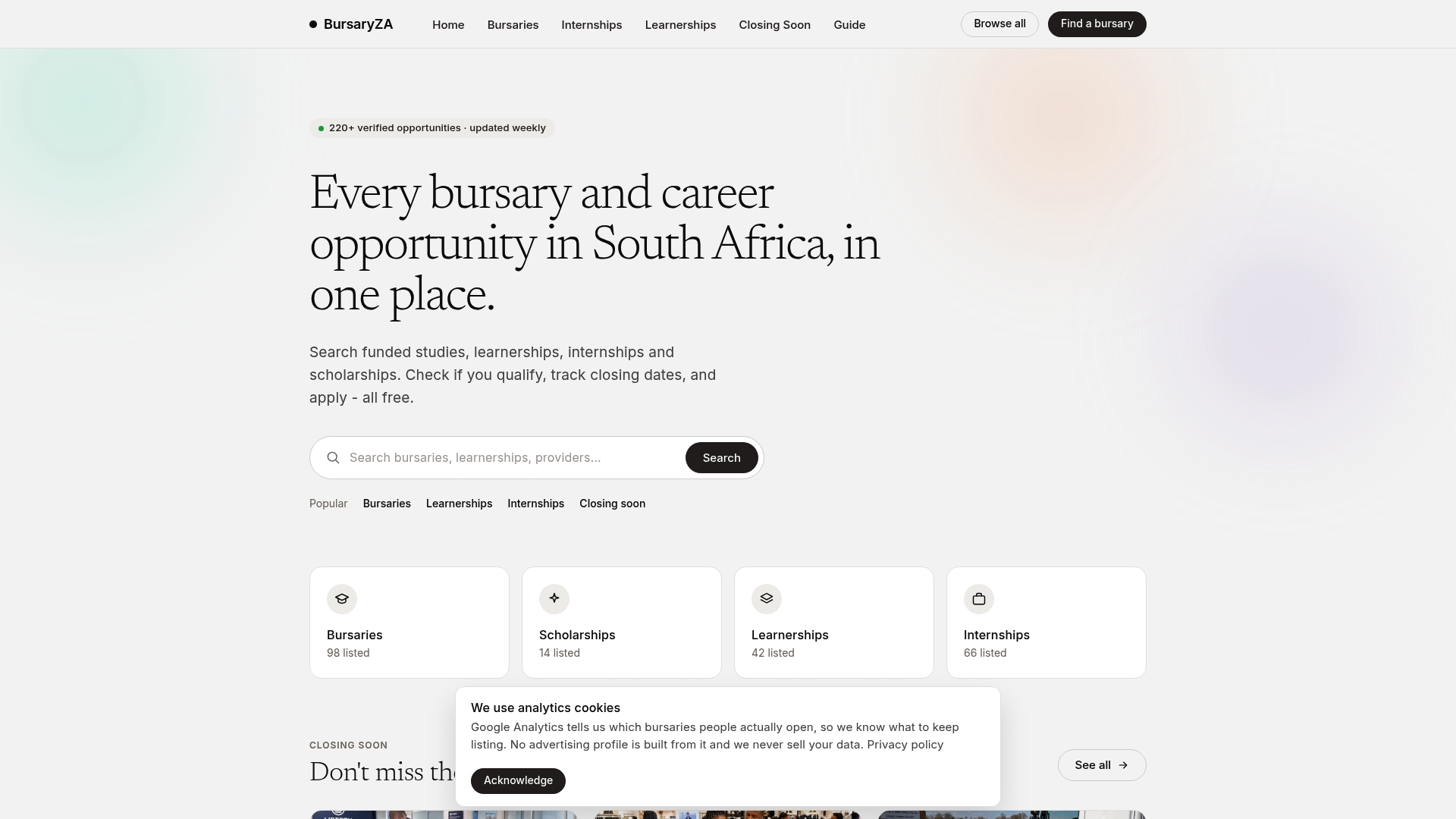
Start with the bursaries list or browse scholarships in South Africa. If you are a school leaver or graduate looking for work-based options, there are also learnerships and internships to explore. Our listings never charge fees: you apply directly with the provider.
FAQ
How do I make my scholarship essay stand out?
Choose one specific experience and describe it in detail instead of listing many achievements. Explain what you did, what it taught you and how it links to your course and the funder’s goals. Washington State University notes that specific examples and stories showing your strongest qualities in action are what make an essay memorable.
What should I not put in a scholarship essay?
Leave out clichés, a chronological life story, a list of accomplishments, sob stories and direct pleas for money. Also avoid details you would not want to discuss in an interview, since the University of Colorado Boulder lists these among the common mistakes. Keep the tone positive and focused on you.
How long should a scholarship essay be?
Follow the funder’s limit exactly. Among South African examples, the Reserve Bank and the Sacbw Foundation applications ask for 250 words, Old Mutual’s forms ask for about 300 words or more, and the Mandela Rhodes Foundation asks for two essays of 500 words. If no limit is given, three to five paragraphs is a common length.
Can I use a scholarship essay example as a template?
Use examples to understand structure and tone, never to copy sentences. Submitting any part of a sample as your own is plagiarism. Write your essay from your own experiences, then compare the shape of your draft with what you learned from the examples.
Where can I get feedback on my essay?
Ask a teacher, lecturer or a trusted adult to read it, and use your university’s writing centre if you have one. Wits students can book the free Wits Writing Centre, where consultants help you find your own words rather than rewriting your work. Always keep the final wording yours.
Sources
- 9 Steps to a good MRF application, Mandela Rhodes Foundation
- Scholarship Essays, Washington State University Writing Program
- External bursary 2027 application form, South African Reserve Bank
- Sacbw Foundation NPC Bursary Fund Application 2026
- Old Mutual Bursary motivation form
- How to Write a Motivational Letter for the Thapelo Madibeng Bursary
- Writing a Strong Scholarship Essay, Owens Community College
- 7 College Scholarship Essay Tips, Valparaiso University
- A Guide to Writing Scholarship Essays, University of Maryland Eastern Shore
- Application Tips, University of Colorado Boulder Top Scholarships
- Scholarship application question examples
- Sample Scholarship Applications, eCampusOntario
- Wits Writing Centre, Wits University