3 Ready to Send Bursary Recommendation Letters for South Africa

A bursary recommendation letter is a short, evidence-backed endorsement from a teacher, employer, or community leader that tells a selection committee why a specific student deserves the funding. The single best move you can make right now is picking a referee who knows your work well, then handing them a support packet, your CV, transcript, and the bursary’s own criteria, with at least 7 to 10 days to write. Keep the finished letter to one page, and make sure it speaks to the bursary’s actual mission, not just your grades.
TL;DR:
- A well-crafted recommendation letter should be about 400 to 600 words, directly referencing the bursary’s mission and including specific, dated examples.
- The strongest references come from teachers, employers, or community leaders who can provide relevant, concrete details aligned with the bursary criteria.
- Request the letter at least 7 to 10 days before the deadline, preferably offering a support packet with your CV, transcript, and bullet points to guide the referee’s writing.
- Avoid generic praise, vague adjectives, or weak referees; instead, include specific achievements and a clear benchmark to make the letter compelling.
- Use platforms to match your application goals with bursaries, and plan your submission timeline carefully with full support documents to maximize your chances.
Table of Contents
- Why a Bursary Recommendation Letter Matters More Than You Think
- Who Should You Ask for a Bursary Recommendation?
- How to Ask for a Recommendation Without Making It Awkward
- What Makes a Strong Recommendation Letter: A Structure Referees Can Actually Use
- Ready-to-Use Bursary Recommendation Letter Templates
- Building the Referee Support Packet
- Avoiding the Mistakes That Sink Otherwise Good Letters
- One Habit That Consistently Gets Referees to Write Better Letters
- How BursaryZA Helps You Put That Letter to Work
- Sources
Why a Bursary Recommendation Letter Matters More Than You Think
Selection committees read hundreds of applications that look nearly identical on paper. Similar grades, similar personal statements, similar hardship stories. A recommendation letter is often the only document in the file written by someone other than the applicant, which is why it carries significant weight. It functions as third-party validation: proof that the qualities you claim about yourself hold up under someone else’s observation.
This is different from a college admissions letter. Admissions letters tend to focus on potential and fit within a broader academic community. A bursary support letter has a narrower job. It has to justify the money. Committees want to know whether the funding will be used well and whether the student’s circumstances and character line up with what the bursary was created to solve, whether that’s rural access to STEM education, support for first-generation university students, or funding for students balancing work and study.
That narrower focus should shape length and tone. A scholarship recommendation letter or bursary reference letter that runs three pages loses the reader by paragraph two. Aim for roughly 400 to 600 words, which is about one focused page.
What separates a forgettable letter from one that moves the needle:
- It names the bursary or its mission directly, rather than reading like a generic template.
- It includes specific, dated examples instead of broad praise like “hardworking” or “dedicated.”
- It places the student in context, comparing them to peers the referee has actually taught or supervised.
- It closes with a clear, direct endorsement rather than trailing off into vague good wishes.
Who Should You Ask for a Bursary Recommendation?
Not every willing referee is the right referee. The strongest letters come from people who can speak to something specific and relevant to what the bursary is funding.
- Teachers and lecturers carry the most weight for academic or merit-based bursaries. A subject teacher who has watched you improve over two years, or a lecturer who supervised a research project, can speak credibly to intellectual growth and classroom performance in a way a family friend never could.
- Employers and supervisors matter most when the bursary values work ethic, part-time employment while studying, or a demonstrated ability to juggle responsibilities. If you’ve held down a job during school, a manager’s letter can carry more weight than a second academic reference, especially for need-based funding.
- Community leaders, coaches, or mentors fit best for bursaries tied to leadership, service, or community involvement. A pastor, youth group leader, or sports coach who has watched you organize, lead, or show up consistently over time can speak to character in a way academics alone can’t capture.
Before you settle on a name, ask yourself honestly whether that person can write a strong letter, not just a polite one. A referee who barely remembers your name from a large lecture hall will produce two generic paragraphs, and committees can spot that instantly. If your first choice seems lukewarm or overcommitted, it’s better to approach a second-choice referee who actually knows your work than to end up with a weak letter from your first pick.
How to Ask for a Recommendation Without Making It Awkward
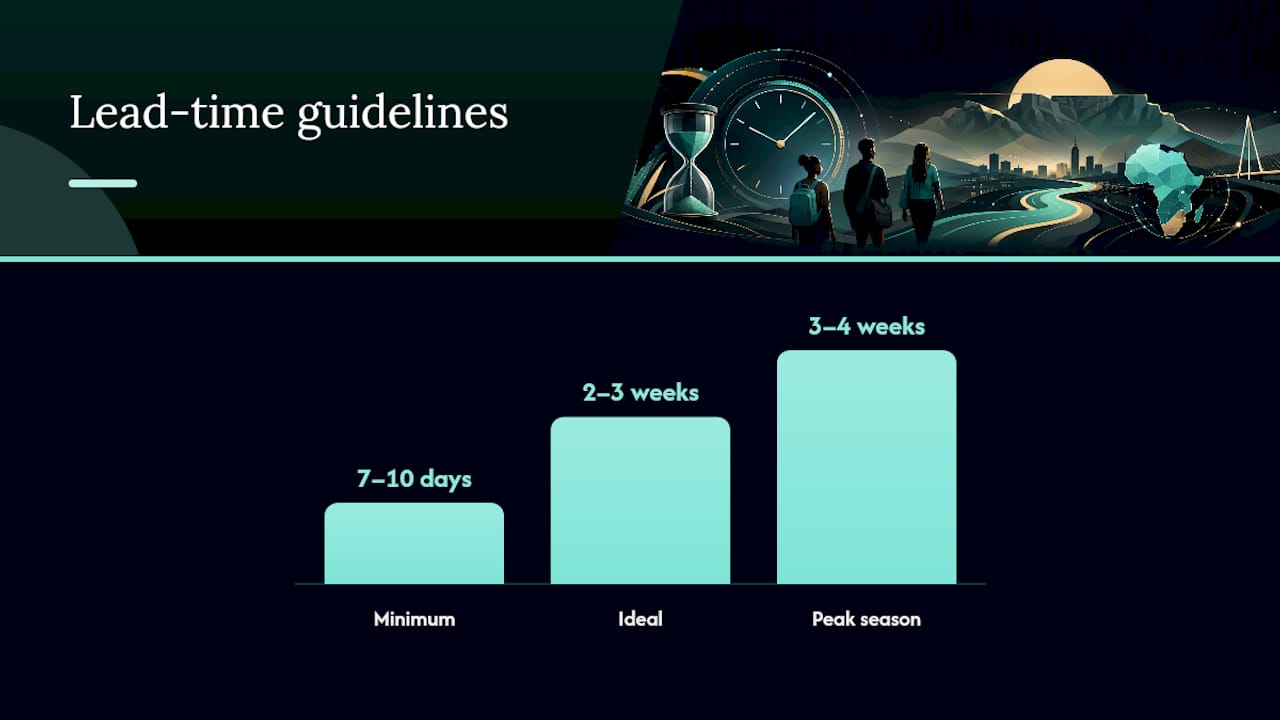
Timing matters more than most students realize. Asking a teacher for a letter the day before it’s due, or catching them in a hallway between classes, almost guarantees a rushed, generic result. Formal requests made through email or a short scheduled meeting, with real lead time, produce noticeably better letters.
Lead time guidelines:
- Minimum: 7 to 10 days
- Ideal: 2 to 3 weeks
- During peak bursary season (roughly May through August, when many South African deadlines cluster), push for 3 to 4 weeks since referees are fielding multiple requests at once
Here’s a request email you can adapt directly:
Subject: Recommendation letter request, [Bursary Name] deadline [Date]
Dear [Referee Name],
I’m applying for the [Bursary Name], which supports [one line on the bursary’s focus, e.g. “students pursuing engineering degrees from under resourced communities”]. The application is due on [date], and I’d be honored if you felt able to write a strong letter of recommendation on my behalf.
I’ve attached a short packet with my CV, transcript, the bursary’s criteria, and a few notes on projects or moments you might remember that could be useful. If you’re not able to write a strong letter, I completely understand, just let me know and I’ll ask someone else.
Thank you for considering it.
[Your name]
Notice the phrase “strong letter.” Building that word into the request gives your referee an easy, face-saving way to decline if they can’t write something genuinely enthusiastic, which protects you from ending up with a lukewarm endorsement you didn’t see coming.
If you’re asking in person, keep it just as direct: “I’m applying for [bursary], and I’d really value a strong recommendation from you if you have the time. I can send over everything you’d need.”
What to hand your referee, ideally in one email or folder:
- Updated CV or résumé
- Academic transcript or report card
- The bursary’s eligibility criteria and stated mission, copied directly from the provider’s page
- The submission deadline and exact method (email, online portal, or printed and sealed)
- Three to five suggested bullet points or memory-jogging notes about specific projects, grades, or moments
Pro Tip: Draft two or three bullet points yourself describing specific achievements, “led the debate team to provincial finals in 2025,” not “was a good leader,” and hand them to your referee as raw material. It respects their time and dramatically increases the odds that concrete details actually make it into the final letter.
What Makes a Strong Recommendation Letter: A Structure Referees Can Actually Use
If you’re coordinating with a referee, or writing a draft for them to edit, a repeatable structure removes the guesswork. Most persuasive letters follow six components in roughly this order:
- Salutation and context: Who the letter is for and which bursary it supports, named explicitly rather than left generic.
- Relationship and timeframe: How the referee knows the student and for how long, e.g., “I taught Thandiwe physical sciences for two years, from Grade 10 through Grade 11.”
- Mission alignment: A sentence connecting the student’s qualities directly to what the bursary funds. If the bursary supports first-generation students in STEM, the letter should say so explicitly, not just praise general intelligence.
- Two to three specific stories: Concrete, dated evidence beats adjectives every time. “She rebuilt our school’s robotics club from four members to nineteen in one semester” does more work than “she’s a natural leader.”
- A benchmark endorsement: A direct comparison gives the committee something to measure against. “One of the top three students I’ve taught in the last five years” is far more persuasive than “an excellent student,” because it signals the referee has actual comparison points and isn’t just being generous.
- Closing and contact information: A clear recommendation statement plus a phone number or email, signaling the referee stands behind the letter and is reachable if questions come up.
When candidates have nearly identical transcripts, and in competitive bursary rounds that happens constantly, it’s often the letter with real stories and a comparative benchmark that becomes the deciding factor. Committees can’t interview every applicant, so a referee’s specific, comparative language becomes the closest thing they get to an outside opinion they can trust.
On formatting: keep it to one page, printed on letterhead where the referee has access to it, and always with a physical or digital signature. An unsigned letter, or one that arrives as an unformatted email body copy pasted into a PDF, looks careless even when the content inside is strong.
Ready-to-Use Bursary Recommendation Letter Templates
Below are three annotated templates you can adapt or hand directly to a referee as a starting draft.
-
Teacher or academic referee template. Best for merit-based or academic bursaries.
Dear Selection Committee,
I have taught [Student Name] mathematics for the past two years at [School Name]. During that time, [he/she/they] consistently ranked among the top students in a class of 34, and in 2025 achieved the highest mark in the grade on the final provincial exam.
Beyond academic results, [Student Name] tutored struggling classmates every Friday afternoon for a full term, unpaid and unprompted, and helped raise the class average by six percentage points. This bursary’s focus on developing future educators and mentors in under-resourced schools fits [Student Name]'s demonstrated pattern of lifting others up, not just performing well individually.
I recommend [Student Name] without reservation, and place [him/her/them] among the top three students I have taught in the last eight years. I’m reachable at [phone/email] should you have questions.
[Referee Name, Title]
Why it works: the opening establishes relationship and timeframe immediately, the tutoring detail is dated and specific, and the benchmark (“top three in eight years”) gives the committee a real comparison point.
-
Need-based bursary template. Best when financial hardship is central to the criteria, paired with the student’s own bursary application letter demonstrating need directly.
Dear Selection Committee,
I have known [Student Name] for three years as [his/her/their] employer at [Business Name], where [he/she/they] works weekends and school holidays to help support younger siblings while maintaining a full academic course load.
Despite working roughly 15 hours a week, [Student Name] has never missed a shift due to schoolwork, and has been promoted twice for reliability and initiative. This bursary’s aim of supporting students balancing financial responsibility with academic ambition describes [Student Name]'s situation precisely.
I have no hesitation recommending [him/her/them] for this funding, and I’m available at [phone/email] to discuss further.
[Referee Name, Title]
Why it works: it demonstrates need through behavior (consistent work hours, promotions) rather than asking the reader to simply take the hardship claim on faith.
-
Community service or leadership template. Best for bursaries tied to civic involvement, coaching, or mentorship criteria.
Dear Selection Committee,
As coordinator of [Community Program], I have worked directly with [Student Name] for eighteen months, during which [he/she/they] organized weekly tutoring sessions for 20 primary school children in our neighborhood, entirely on a volunteer basis.
Attendance at these sessions grew from 6 children in the first month to 20 by the sixth, largely due to [Student Name]'s consistency and the trust built with local families. This bursary’s mission of developing community-minded leaders matches exactly what I’ve watched [Student Name] build from nothing.
I strongly endorse this application and can be reached at [phone/email] for any follow-up.
[Referee Name, Title]
Why it works: the attendance growth from 6 to 20 gives the committee a measurable outcome instead of a vague claim about “making an impact.”
For applications with strict word limits, trim each template to two paragraphs: relationship plus one specific story, then mission alignment plus the benchmark endorsement. Cut the third paragraph’s detail but keep the closing contact line intact.
Building the Referee Support Packet
The single biggest lever you control is what you hand your referee before they start typing. A concise packet containing your CV, transcript, and the bursary’s own criteria consistently produces more detailed, relevant letters than a bare request.
Your packet should include:
- Current CV or résumé
- Academic transcript or most recent report card
- A one-paragraph personal statement or summary of your goals
- The bursary’s eligibility criteria and mission statement, copied verbatim from its official page
- Exact submission instructions and deadline
- Three suggested bullet points plus one benchmark line the referee can adapt or reject
That last item matters more than students expect. A packet that ties two suggested lines directly to the bursary’s mission tends to produce letters that committees rate as noticeably more relevant, because the referee isn’t left guessing what the funder actually cares about.
Pro Tip: A week before the deadline, send a short, polite reminder rather than assuming your referee remembers. Something like, “Just checking in ahead of the [date] deadline, happy to resend anything you need,” keeps things professional without nagging.
Avoiding the Mistakes That Sink Otherwise Good Letters
Most weak letters fail for avoidable reasons, not because the referee didn’t like the student.
Watch for these:
- Requesting the letter fewer than 7 days before the deadline
- Vague, adjective-only praise with no specific examples (“hardworking,” “kind,” “smart”) and nothing to back it up
- No signature, letterhead, or contact information
- The bursary’s actual name or mission never mentioned anywhere in the letter
- A referee who barely knows the student agreeing out of politeness rather than genuine enthusiasm
Before you submit, run through a quick check: Is the bursary named correctly? Does the letter include at least one specific story? Is it signed? Does the file open correctly and match the requested format? If a referee comes back with something thin or generic, it’s fair to ask a second person, ideally one with more direct knowledge of your work, rather than submitting a weak letter just to hit the deadline.
One Habit That Consistently Gets Referees to Write Better Letters
The single habit that separates strong letters from generic ones is a tailored briefing, not a blank request. Students who send a referee three specific bullet points and one comparison line (“top five students I’ve taught this decade”) almost always get back a letter with real substance, because the referee isn’t starting from zero.
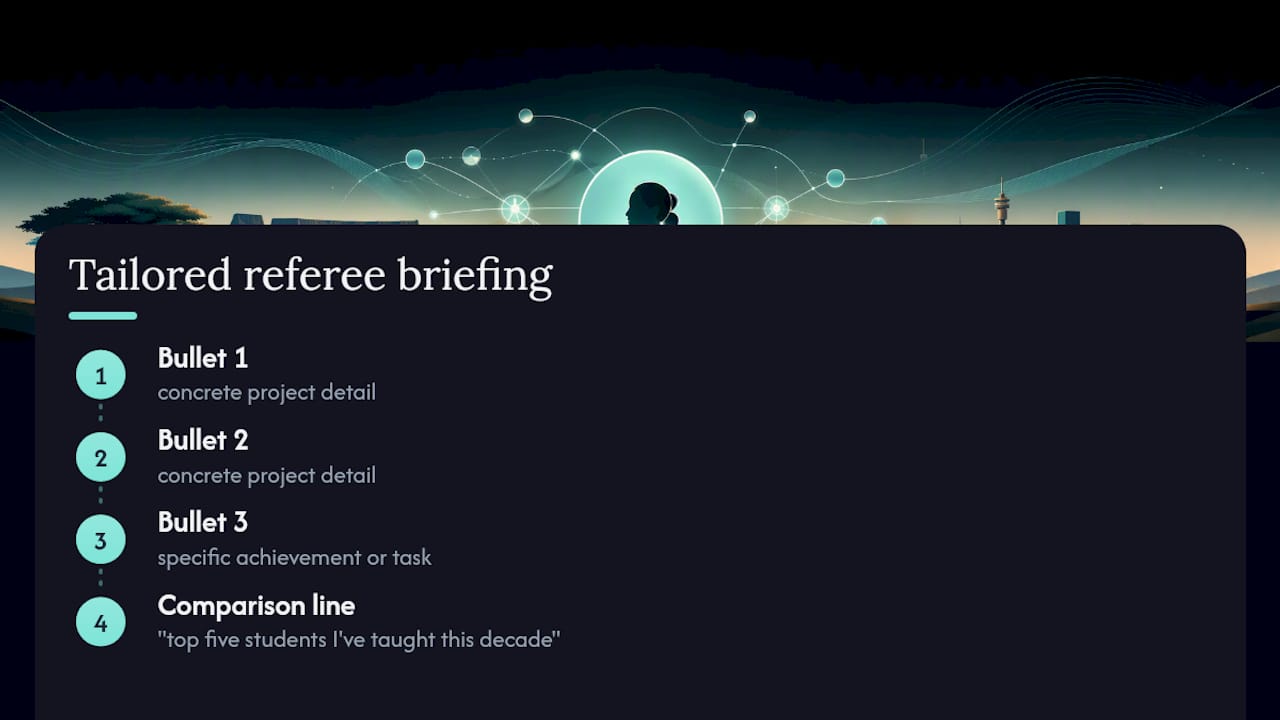
One pattern shows up again and again: a student who briefs a teacher with two concrete project details gets a paragraph built around those exact details, while a student who just asks “could you write me a letter?” gets two sentences of polite generality. The difference isn’t the referee’s skill or willingness. It’s what they were handed to work with.
Treat your referees as people you’ll likely need again, for university references, job letters, or future funding rounds. A thank-you note after the letter is submitted, regardless of the outcome, costs nothing and keeps that relationship open for the next request.
— Nkosi
How BursaryZA Helps You Put That Letter to Work
A great recommendation letter only pays off if it lands in front of the right bursary, one that actually matches your field, study level, and financial situation. There are platforms that provide a searchable database of verified South African bursaries, scholarships, internships, and learnerships, each with eligibility checklists to help applicants understand committee expectations.
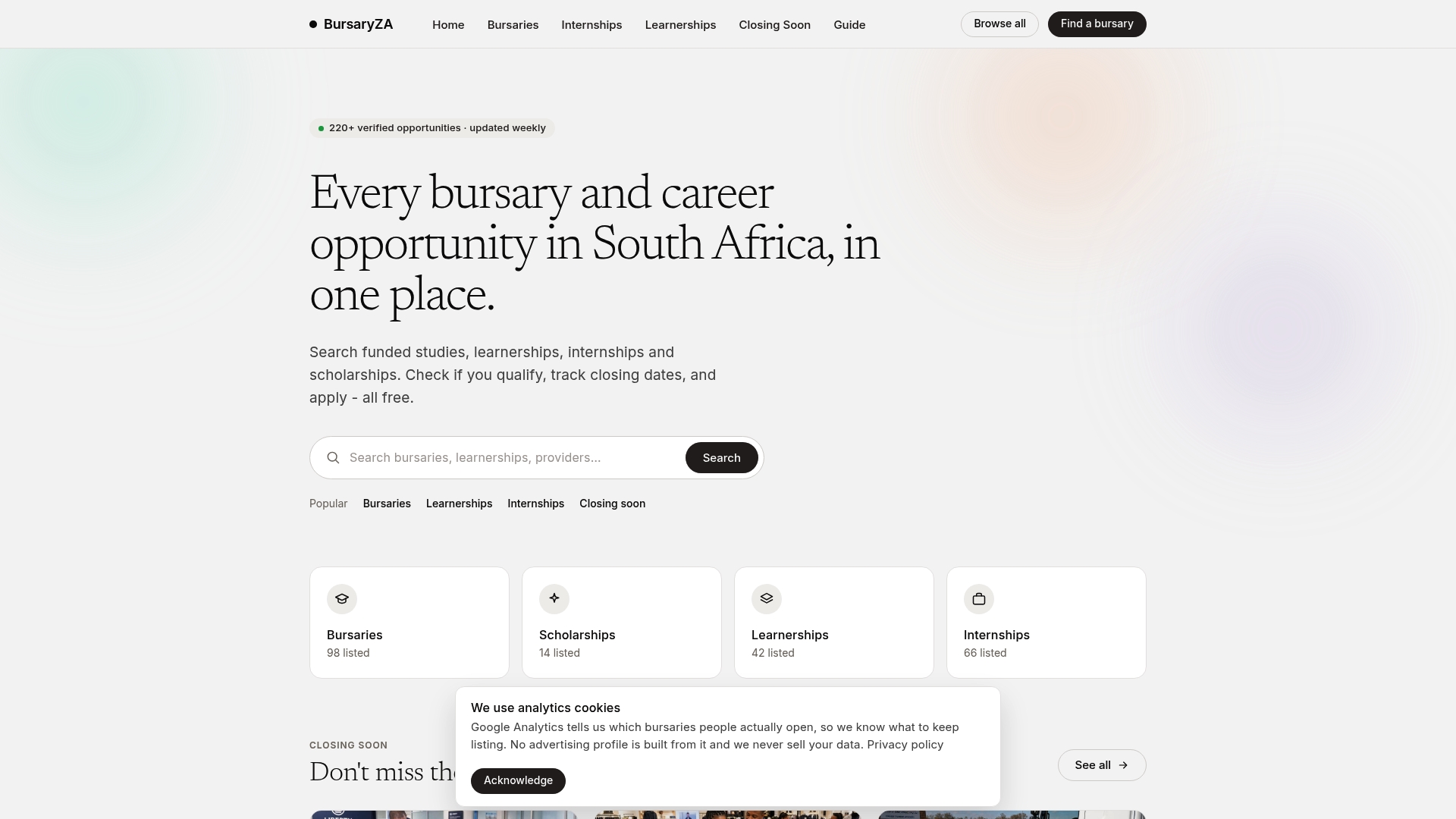
Instead of guessing which providers value academic merit versus financial need versus community leadership, the matching tool lets you filter by field of study and location, so the mission-alignment work you just did in your letter actually points at a real, open opportunity. Pair that with the bursary application calendar to plan backward from each deadline and give your referees the full 2 to 3 weeks they need.
Once your letter and support packet are ready, browse current bursaries in South Africa and start matching your documents to funders whose criteria your recommendation letter was written to satisfy.
Sources
- How to write an effective letter of recommendation (PMC)
- Example of bursary application letter (Regenesys)
- Scholarship Letter of Recommendation | Resume Optimizer Pro