One Page Bursary CV Format and 3 Month Doc Rules for South Africa

Use one page, never more than two, and lead with academic results, achievements, leadership, and clear contact details. Skip an objective statement and skip work history you don’t have. Save the file as a PDF with a proper filename, and send it exactly the way the funder’s form asks.
TL;DR:
- A bursary CV must be concise, one to two pages, with clear, organized formatting, and focus on academic results and leadership evidence.
- Lists of achievements should include measurable impacts, specific roles, and dates to ensure credibility and easy review by committees.
- Supporting documents, such as certified ID copies and recent results, must be current within three months, as outdated certifications often lead to rejection.
- Tailoring the CV to match the bursary’s eligibility criteria and including a strong, specific motivation letter significantly improves the chances of success.
- Using verified bursary platforms helps applicants find current opportunities with clear deadlines and requirements, reducing last-minute application errors.
Table of Contents
- What a Bursary CV Actually Does for Your Application
- What to Put in Every Section of Your CV
- A One-Page Bursary CV Template You Can Copy Right Now
- Formatting Rules That Keep Your CV Looking Professional
- The Supporting Documents You Need Before You Submit
- Tailoring Your CV and Writing a Motivation That Fits
- Mistakes That Get Bursary CVs Rejected
- Why Verified Listings Change How You Should Use Your CV
- What I’d Tell a Student With No Work Experience
- Find Verified Bursaries and Track Closing Dates With Bursaryza
- Official Forms and Guides Worth Checking Before You Submit
- Sources
- FAQ
What a Bursary CV Actually Does for Your Application
A bursary CV is not a life story. It’s a marketing document that connects what you’ve already achieved to what you want to study and where you’re headed afterward. Selection committees read hundreds of these in a single sitting, so organized, professionally formatted CVs with readable fonts and clear headings get through the first screening while cluttered ones get set aside, often without a second look.
What committees are actually scanning for:
- Measurable academic evidence: subject marks, averages, distinctions
- Proof you can follow instructions (matching document names, correct formatting)
- Signals of leadership or community involvement beyond the classroom
- A CV that’s concise, one to two pages, focused on academics and leadership rather than paid work history
If a reviewer can’t find your matric average in five seconds, that’s a problem you created, not one they’ll solve for you.
What to Put in Every Section of Your CV
Every bursary CV needs the same skeleton. The details inside each section are where applicants either shine or quietly disqualify themselves.
- Personal details: Use the exact name on your ID document, not a nickname. Include a phone number, a professional email address (skip anything cutesy), and your town or city.
- Education, most recent first: For matric, list your subjects with actual marks, not just “passed.” For tertiary students, include your institution, course, year of study, and current average.
- Achievements and leadership: List the role, the dates, and what changed because you were there. “Head girl, 2025, coordinated a food drive that fed 200 families” beats “Head girl” every time.
- Community service and extracurriculars: Sports captaincy, church youth groups, tutoring younger students. All of it counts if you can name the role and the impact.
- Skills and languages: List actual proficiency levels (fluent, conversational, basic) rather than a vague list of languages.
- References: Two contacts, ideally a teacher or principal, with name, role, and a working phone number or email.
Reverse chronological education entries and quantified achievements consistently read as more credible than generic descriptions, mainly because they give a reviewer something concrete to check.
A One-Page Bursary CV Template You Can Copy Right Now
Here’s a working skeleton. Swap in your own details and keep the structure intact.
Header Thabo Nkosi | 082 000 0000 | [email protected] | Soweto, Gauteng
Profile Final-year matric student pursuing a BSc in Civil Engineering. Seeking bursary funding to complete tertiary studies and pursue a career designing sustainable infrastructure in underserved communities.
Education
| Level | Institution | Year | Details |
|---|---|---|---|
| Matric (NSC) | Soweto Secondary School | 2026 | Mathematics, Physical Science, English |
| Grade 11 | Soweto Secondary School | 2025 | Average 78% |
If your final results aren’t out yet, write: “Awaiting final NSC results, currently averaging 78%Examinations/releaseofnscexamsresults.aspx) across six subjects.”
Achievements and Leadership
- Deputy Head Boy, 2026: led weekly assembly and coordinated peer mentoring for 40 Grade 8 learners.
- Top 3, Provincial Mathematics Olympiad, 2025.
- Volunteer tutor, Saturday homework club, 2024 to present: assisted 15 primary school learners with numeracy.
Skills and Languages Skills: Microsoft Excel (intermediate), basic AutoCAD, public speaking. Languages: isiZulu (fluent), English (fluent), Sesotho (conversational).
References Available on request.
Formatting notes: use 11pt or 12pt for body text, 14pt for your name, one-inch margins, and a plain font like Calibri or Arial. Export as a PDF before submitting anything.
Formatting Rules That Keep Your CV Looking Professional
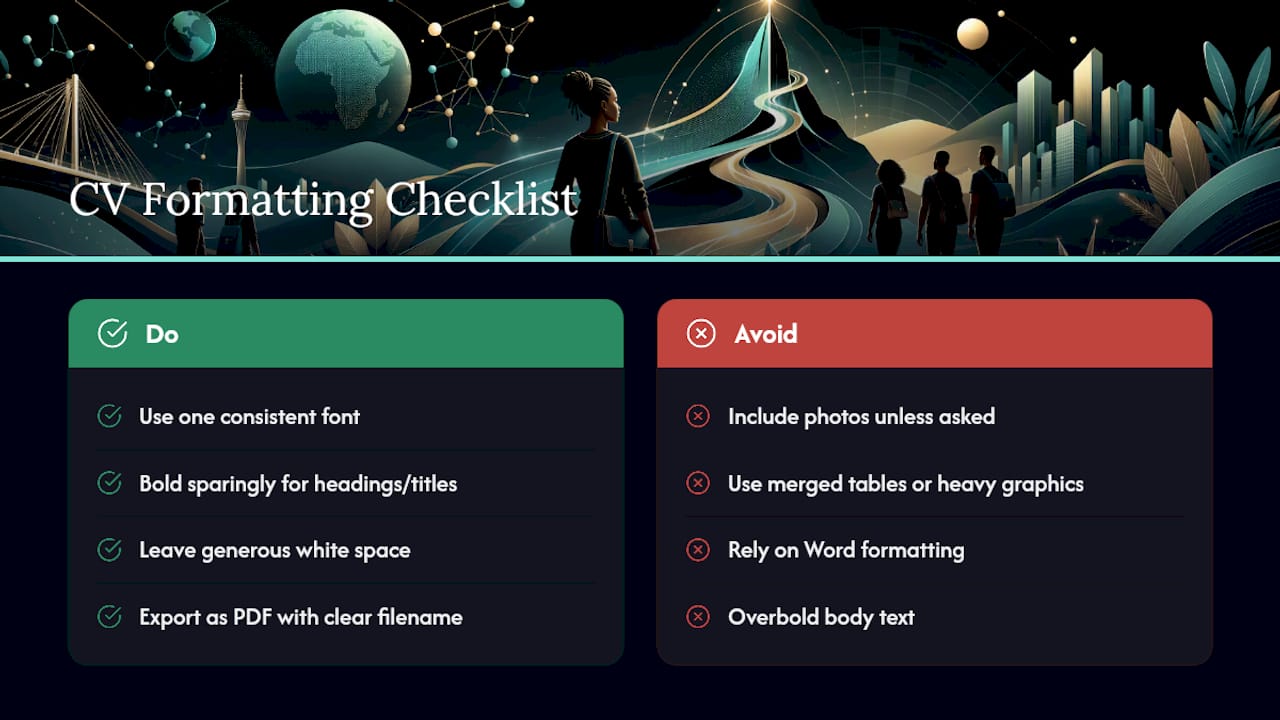
Stick to one font throughout, use bold sparingly for headings and job titles, and leave enough white space that a tired reviewer’s eyes don’t glaze over. Skip photos unless the bursary provider specifically asks for one. Exporting as PDF with a clear filename such as CV_Nkosi_Thabo_2027.pdf prevents the formatting from breaking when it opens on someone else’s computer, which happens constantly with Word documents.
Bold your marks, your averages, and your role titles. That’s what a reviewer’s eye jumps to first. Avoid tables with merged cells or heavy graphics. They tend to break when a form gets converted to PDF or uploaded to a portal.
Pro Tip: Keep one detailed “master CV” that lists everything you’ve ever done, then trim it down to a fresh one-page version for each bursary you apply to. Editing down is faster than starting from scratch every time.
The Supporting Documents You Need Before You Submit
Your CV rarely travels alone. Most funders want a bundle of certified documents alongside it, and missing even one can knock your application out before anyone reads your CV.
- A certified copy of your ID (check the certification date; most providers want it stamped within the last three months)
- Your most recent matric or university results, or an official transcript
- Proof of registration or acceptance at your intended institution
- Proof of parental or guardian income, or a sworn affidavit where income can’t be documented
- A death certificate, where applicable, if a parent or guardian has passed away
Certification older than three months is one of the most common reasons applications get rejected outright, so check each provider’s own recency rule before you send anything. If you’re submitting by email, combine everything into a single PDF named clearly. If you’re using an online portal, follow its upload instructions exactly. Some want separate files per document type.
Tailoring Your CV and Writing a Motivation That Fits
Read the bursary advert twice before you touch your CV. Funders list eligibility criteria for a reason, and mirroring their exact language (subjects, minimum averages, field of study) signals that you actually read the brief.
- Reorder your achievements so the most relevant ones sit at the top for that specific bursary.
- Use a two-line profile formula: your study level and field, why the funding matters to you, and where you’re headed afterward.
- A one-page motivational letter is different from your CV’s profile. The letter goes deeper into your personal circumstances; the CV profile stays brief and factual.
- Swap vague lines like “I am passionate about engineering” for specific ones like “I want to design low-cost housing solutions for rural municipalities.”
Tying your field of study directly to a career goal and your financial need reads stronger than a generic objective statement, mostly because it gives the reviewer a reason to remember your name.
Mistakes That Get Bursary CVs Rejected
Most rejections have nothing to do with talent. They come down to administrative slip-ups: a certified document that’s expired, an ID name that doesn’t match the application form, or a results copy that’s outdated by a full year.
On the content side, vague claims (“hardworking,” “team player”) without evidence, inflated marks that don’t match your actual transcript, and irrelevant part-time work history all weaken an otherwise strong CV. Formatting problems, like a three-page CV or a font nobody can read at a glance, cost you points before anyone even reaches your achievements.
Run this before you hit send:
- Confirm your ID name matches every document exactly.
- Recheck certification dates on all copies.
- Read every line aloud for typos and inflated claims.
- Confirm the file is a PDF with the correct name.
Why Verified Listings Change How You Should Use Your CV
A well-formatted CV only pays off if it lands in front of the right funder, with the right documents, before the deadline. That’s the part most students underestimate.
A reliable bursary platform runs a verification process on every listing, so applicants aren’t guessing whether a bursary is legitimate or long expired. Each listing carries an eligibility checklist alongside the closing date, which helps you match your CV and supporting documents to that list before submitting.
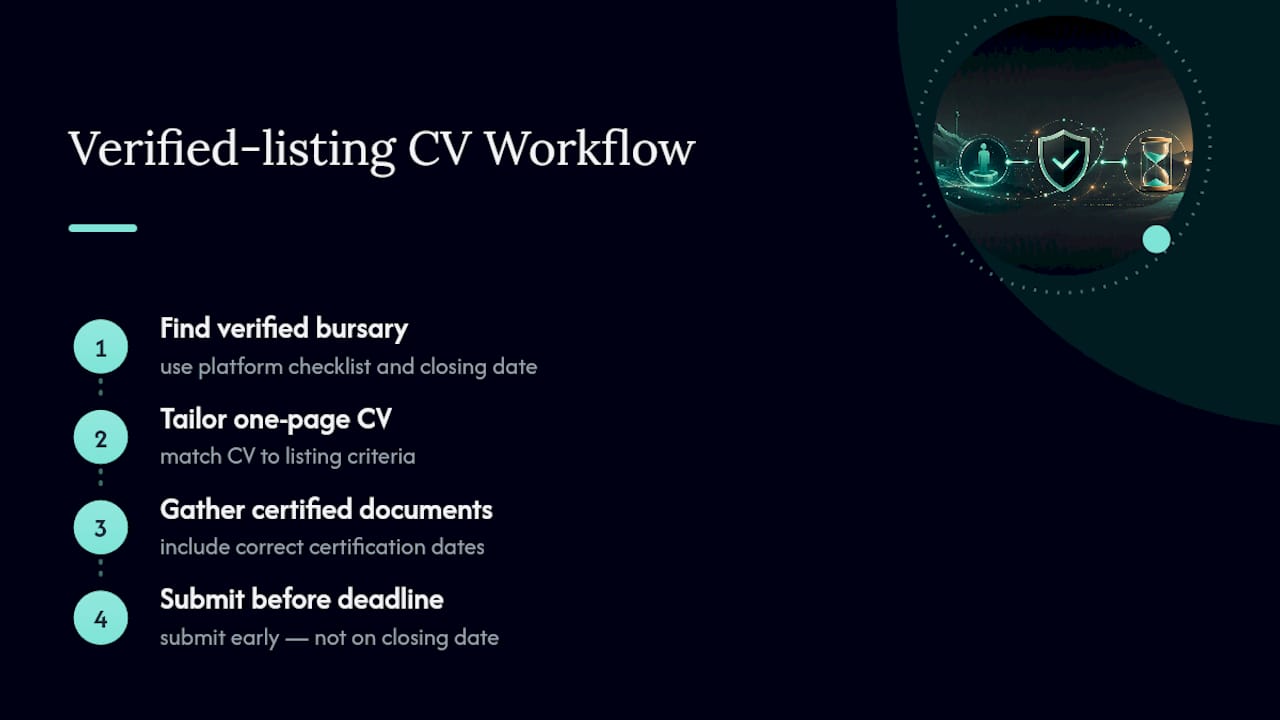
The workflow that works: find a bursary through a verified source, tailor your one-page CV to its criteria, gather your certified documents, then submit before the closing date, not on it. Rushed, last-minute submissions are where certification dates slip and forms get half-filled.
What I’d Tell a Student With No Work Experience
Stop apologizing for the gap where “work experience” should go. Committees care about impact, not job titles. A tutoring project, a class you improved in, a club you ran, all of that counts as evidence you can commit to something.
Make the reviewer’s job easy: readable facts first, honest gaps second. Never inflate a mark or hide a missing document. Supply what you have, verified and clean, and let the CV speak for itself.
— Nkosi
Find Verified Bursaries and Track Closing Dates With Bursaryza
Once your CV is ready, the harder part is finding funders whose criteria actually match your profile, before their deadlines pass. Bursaryza is built for exactly that gap: every listing on the site carries a verification checklist and a closing date, so you’re not chasing outdated PDFs from a search engine or wondering if an offer is even real.
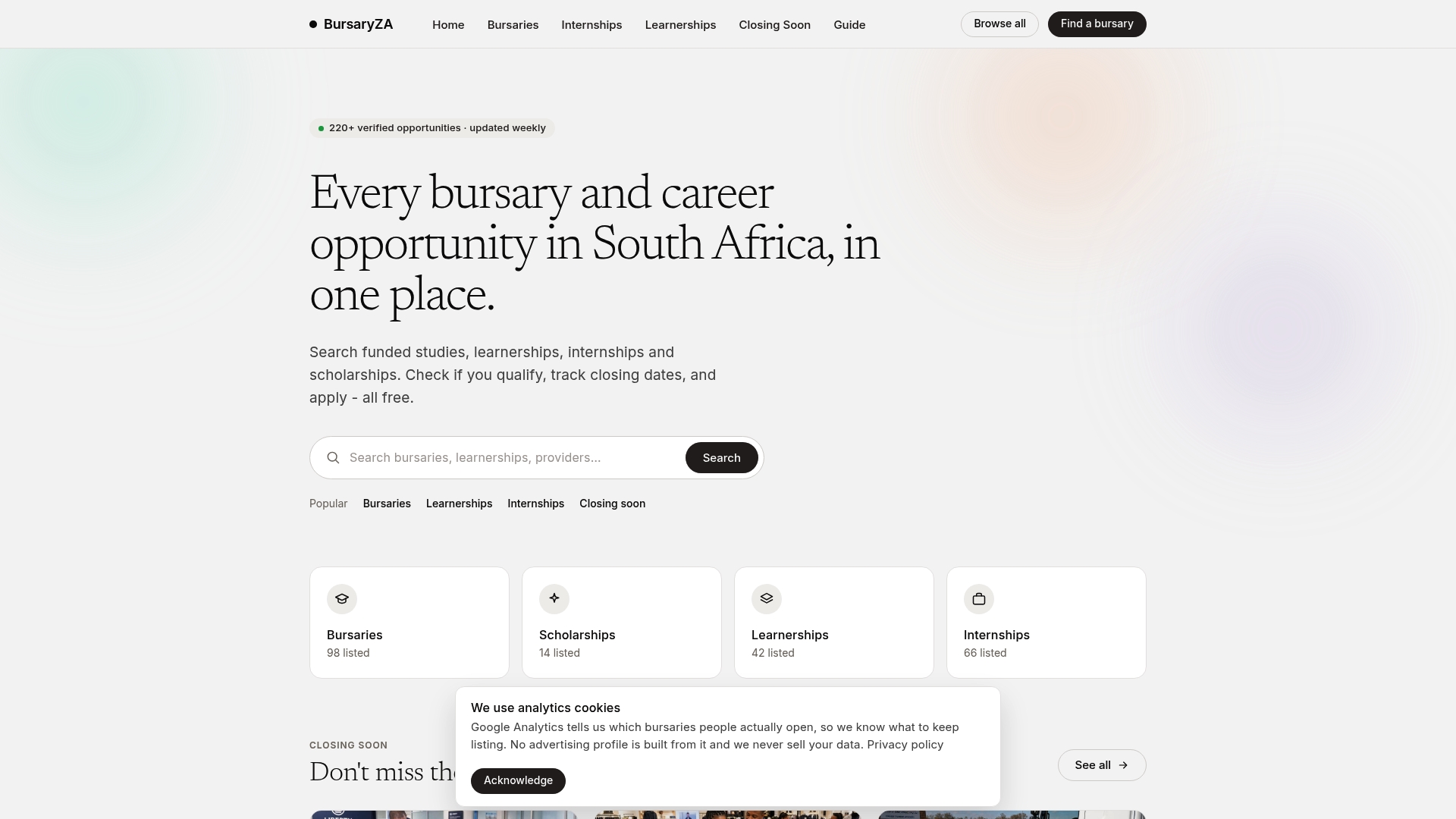
Browse the current bursaries in South Africa and filter by field of study or province, then cross-check the eligibility list against your CV before you apply. If timing is your bigger concern, the bursary application calendar shows upcoming closing dates so you’re not scrambling to certify documents the night before a deadline. Pair a verified listing with the one-page CV format above, and you’ve removed most of the guesswork that sinks otherwise strong applications.
Official Forms and Guides Worth Checking Before You Submit
Before you finalize anything, check these directly. Requirements shift year to year, and funders rarely accept a CV that ignores their own form instructions.
- National Treasury’s external bursary application form, which lists exactly which certified documents are required
- The South African Reserve Bank’s external bursary form, which specifies a 250-word motivational essay and firm closing dates
- SendCV’s step-by-step bursary CV guide for practical, student-focused formatting advice
- A document checklist for student applications if you want a broader sense of how certification and paperwork requirements are structured elsewhere
Sources
- How to Send CV for a 2027 Bursary: A Complete, Step-by-Step Guide for South African Students - SEND CV
- External bursary application form (National Treasury)
- Creating a great CV (UCT Careers guidance)
FAQ
How Should a Bursary CV Look?
It should be one page, never more than two pages, use a plain font, clear headings, and bold text on marks and titles, with academics and leadership front and center rather than a long work history.
How Do I Apply for a Bursary?
Read the funder’s eligibility criteria and official form carefully, prepare your certified supporting documents, tailor your one-page CV and short motivation to match the listed criteria, and submit before the closing date through the exact channel the funder specifies. Sites like Bursaryza list the closing dates and checklists for current opportunities.
What Is a CV for a Scholarship Meant to Include?
A scholarship or bursary CV should include your personal details, reverse chronological education history with marks, measurable achievements and leadership roles, relevant skills and languages, and two references, all fitted onto one page.
How Should a Matric Student With No Work Experience Write a CV?
Replace the missing work history section with academic achievements, leadership positions, community service, and any projects or tutoring you’ve done, since committees weigh demonstrated impact over paid experience. A short, honest profile line connecting your intended field of study to your financial need does more work than any padded job title would.
How Often Do Certified Documents Need to Be Updated?
Most bursary providers want certified copies dated within the last three months, so check each specific form’s own rule before you submit, since an outdated certification is one of the more common reasons applications get rejected.