Finance Learnerships in South Africa: How to Qualify and Apply

A finance learnership is a paid, work-based programme that combines classroom learning with workplace experience and leads to a registered qualification. Most are open to unemployed South Africans aged roughly 18 to 35 who have a matric certificate, with the exact limits set by the programme and the employer. This guide shows who qualifies, what finance employers ask for, which documents to prepare and how to apply without wasting your time.
TL;DR
- A learnership is work-based training towards a qualification. You are not paying fees, and you are not simply studying or simply working.
- Entry rules differ by programme. Many finance learnerships ask for Grade 12 with a minimum mark in English and in Accounting, Mathematics or Mathematical Literacy.
- Age limits vary too: some programmes cap applicants at 30, others at 35. Read the advert for the exact limit.
- Prepare certified copies of your ID and matric certificate, plus a clean CV, before the advert appears.
- Apply only through the official employer or SETA page, and never pay anyone to secure a place.
Table of Contents
- What a finance learnership actually is
- Who offers finance learnerships
- Eligibility: what finance employers usually ask for
- What you get: stipend, duration and experience
- How to apply, step by step
- Closing dates and how to check an opportunity is real
- Find verified opportunities on BursaryZA
- Mistakes that cost applicants a place
- FAQ
- Sources
What a finance learnership actually is
Fasset, the sector education and training authority for finance and accounting services, describes a learnership as a work-based education and training programme geared towards a qualification and a key part of the National Skills Development Strategy. In practice that means you sign a learnership agreement with an employer, you are placed in a real workplace, and you study towards a nationally recognised qualification at the same time.
The Institute of Certified Bookkeepers notes that learnerships respond to unemployment, unequal access to education and skills shortages in South Africa. That is why finance employers use them to build a pipeline of entry-level staff: banks, insurers, accounting practices and public bodies all need people who can already work with numbers, clients and compliance rules.
For a deeper explanation of the system behind these programmes, see our guide to what a learnership is in South Africa’s skills system.
How it differs from a bursary, internship or job
| Learnership | Bursary | Internship | Ordinary job | |
|---|---|---|---|---|
| Main purpose | Qualification plus workplace experience | Pays for full-time study | Short-term work exposure | Paid work, usually no qualification attached |
| Who pays | Employer, often with SETA funding | Funder pays fees | Employer | Employer |
| You earn | A monthly stipend or salary | Usually no income, allowances possible | Often a stipend | A salary |
| Outcome | A registered qualification | A degree or diploma | CV experience | Income and experience |
Internships offer entry-level exposure, and some are only open after you hold a formal qualification. A learnership is different because you can start it straight after matric and you leave with a credential, not only experience. If you already hold a diploma or degree and want workplace experience, you may be better placed to look at internships and in-service training placements.
Who offers finance learnerships
Finance learnerships come from four broad types of organisation. Knowing which type you are looking at helps you judge the requirements.
- SETA-funded programmes. BANKSETA covers banking and microfinance, Fasset covers accounting and financial services, and Insetta covers insurance. These bodies fund employers to take on unemployed learners. BANKSETA’s guidelines for employers for 2026/27 set capped funding of up to R112,000 per learner for end-to-end delivery of learnerships for unemployed learners. The funding window for employers has a fixed closing date each year, and the 2026 window closed on 27 March. Employers then recruit, so adverts tend to appear after funding is approved.
- Banks and insurers. Large financial institutions run their own intakes. Old Mutual’s 2026 Amathuba finance-sector learnership, for example, lists possible career paths such as underwriting, financial investment advice and insurance brokerage. For banking specifically, our page on where to find banking learnerships is a good next step.
- Professional bodies and training centres. Bookkeeping, accounting technician and trainee accountant routes run through bodies such as the Institute of Certified Bookkeepers and SAIPA.
- Public sector and regulators. Government departments, agencies and regulators run finance-related learnerships and internships. A good example of the type is the Financial Sector Conduct Authority’s learnership programme, which aims to build foundational knowledge, practical skills and workplace exposure in the financial services sector.
Eligibility: what finance employers usually ask for
There is no single rule. MerSETA’s guidance on learnerships is clear that entry requirements depend on the qualification, and the organisation taking on the learner sets selection criteria. The same page explains that entrants must generally be at least 16 and younger than 35, and that finance-related programmes may require prior basic finance training.
Here is how that looks in real finance programmes.
| Programme | Education | Age and status |
|---|---|---|
| BANKSETA Letsema (post-matric route) | Certified Grade 12 certificate, at least 60% in English, at least 50% in Accounting or Mathematics, or 60% in Mathematical Literacy | Unemployed, under 30 in the recruiting year, South African citizen with valid ID, not on another learnership or studying |
| Old Mutual Amathuba 2026 | Grade 12 or equivalent, at least 50% in English, an official second language, and Pure Mathematics or Mathematical Literacy | Citizen, aged 18 to 30, unemployed, no concurrent studies, no previous Wealth Management NQF4 learnership |
| Institute of Certified Bookkeepers | NQF Level 4 Grade 12 numeracy and communication or higher, plus a pre-enrolment numeracy and literacy assessment; Grade 12 Accounting preferred | Set by the host employer |
Two details deserve attention.
Age limits are not uniform. The Letsema programme asks for applicants under 30 in the recruiting year on its youth programmes page, while BANKSETA’s FAQ says Letsema applicants must be under 35 at the start of the learnership. Pages can differ, so treat the advert for the specific intake you are applying to as the deciding document, and contact the programme if two pages disagree.
Your maths choice matters. Many finance programmes accept Mathematics or Mathematical Literacy, but at different pass marks. If you wrote Mathematical Literacy, check that the programme accepts it and at what percentage before you spend time on an application.
Trainee accountant routes are different
If your goal is a professional designation, the learnership is part of a longer path. The Fasset careers pages explain that becoming a Chartered Accountant (South Africa) involves a three-year training contract completed after your degree. SAIPA’s guidance for trainees says the trainee must be employed at a SAIPA-approved training centre and be pursuing or have completed a recognised BCom Accounting degree that covers specified accounting, taxation, auditing or internal audit, commercial law and management accounting or financial management subjects. Those routes suit graduates and students, not school leavers.
What you get: stipend, duration and experience
A finance learnership normally runs for 12 months, though the length depends on the qualification level and the programme, so always confirm it in the advert. During that time you are placed in a workplace and the employer pays you a stipend. The Institute of Certified Bookkeepers’ policy shows that readiness is assessed through both formal education and basic numeracy and literacy, and that practical employment at an accredited workplace forms part of the learnership arrangement.
Stipends vary by employer, sector and qualification level. Our guide to learnership stipends explains the typical ranges and what can be deducted, so you can compare an offer with what is usual before you accept it. Read your learnership agreement carefully: it should state the stipend, the duration, the qualification you are working towards and who your workplace mentor is.

Where it can lead
A finance learnership gives you three things employers value: a registered qualification, supervised workplace experience and references. Typical next steps include permanent roles in banking operations, insurance administration, bookkeeping, credit control or compliance support. Some learners then register for a diploma or degree and work towards a professional designation. Old Mutual’s own programme material points to underwriting, investment advice and insurance brokerage as destinations for its learners.
How to apply, step by step
- Match your results to the criteria. Open the advert and tick off age, citizenship, matric subjects and marks, and unemployment status. If one is missing, move on. An application that fails a hard criterion is usually screened out.
- Prepare your documents early. Employers commonly ask for a certified copy of your South African ID, a certified copy of your matric certificate, an updated CV and any other qualifications or transcripts. Some add proof of residence. Certification is normally done by a commissioner of oaths, such as at a police station. Ask whether a certification date limit applies, since some employers want recent stamps.
- Write a short, accurate CV. Keep it to one or two pages, list your marks for the subjects the employer cares about, and add any volunteering or part-time work. Our guide to writing a learnership CV gives the five sections to include.
- Apply on the official page only. Use the employer’s careers portal, the SETA’s own site or the email address named in the advert. Submit once, with every requested document attached, in the format asked for.
- Expect assessments. Some programmes, including bookkeeping routes, run a numeracy and literacy test before enrolment. Practise basic percentages, ratios and reading comprehension.
- Keep your phone and email active. Shortlisting messages are often brief, and a missed call can mean a missed place.
What happens after you are selected
When an employer enrols you, a learnership agreement is signed, along with an employment contract. Fasset’s registration procedure for employers says the agreement is submitted to the SETA with the learner’s employment contract and a certified copy of the learner’s ID, and that the SETA must register it within 21 days of its decision. You should receive a copy of your signed agreement.

Closing dates and how to check an opportunity is real
Finance learnership adverts do not follow one national calendar. Many large employers publish intakes in the months after the SETA funding window closes, and smaller employers advertise whenever they secure funding. Because dates shift every year, use the closing date on the listing as your deadline and confirm it on the employer’s own page.
Before you apply, run through these checks:
- Does the advert point to an official domain? A bank, insurer, SETA or government website is what you want. Be wary of free email addresses and social media pages that ask you to apply by message.
- Is money requested? A legitimate learnership does not charge a placement, registration or “processing” fee. If someone asks you to pay, walk away.
- Is there a named employer and a stated qualification? Genuine adverts say who the host employer is and which qualification you will earn.
- Can you find the same opportunity on the employer’s own site? If not, ask the employer directly before sending personal documents.
That last point matters because your ID copy is sensitive. Send it only once you are sure of who is receiving it.
Our perspective
Most young people we speak to do not struggle because they lack ability. They struggle because the opportunity they are chasing was already closed, or because they missed one requirement buried in a long advert. A finance learnership is one of the few routes where you can earn, learn and get a qualification from the same programme, so a wasted application costs more than it seems.
That is why every listing on BursaryZA shows the eligibility checklist, the closing date, the document requirements and a direct link to the official application page. We do not charge fees and we do not collect applications, so you apply with the provider and not through us. Our matching tool lets you filter by field, study level and location, which means you spend your time on programmes you can actually qualify for.
Our advice: build your document pack once, check the criteria line by line, and apply to several suitable programmes instead of waiting for a single perfect one.
Nkosi
Find verified opportunities on BursaryZA
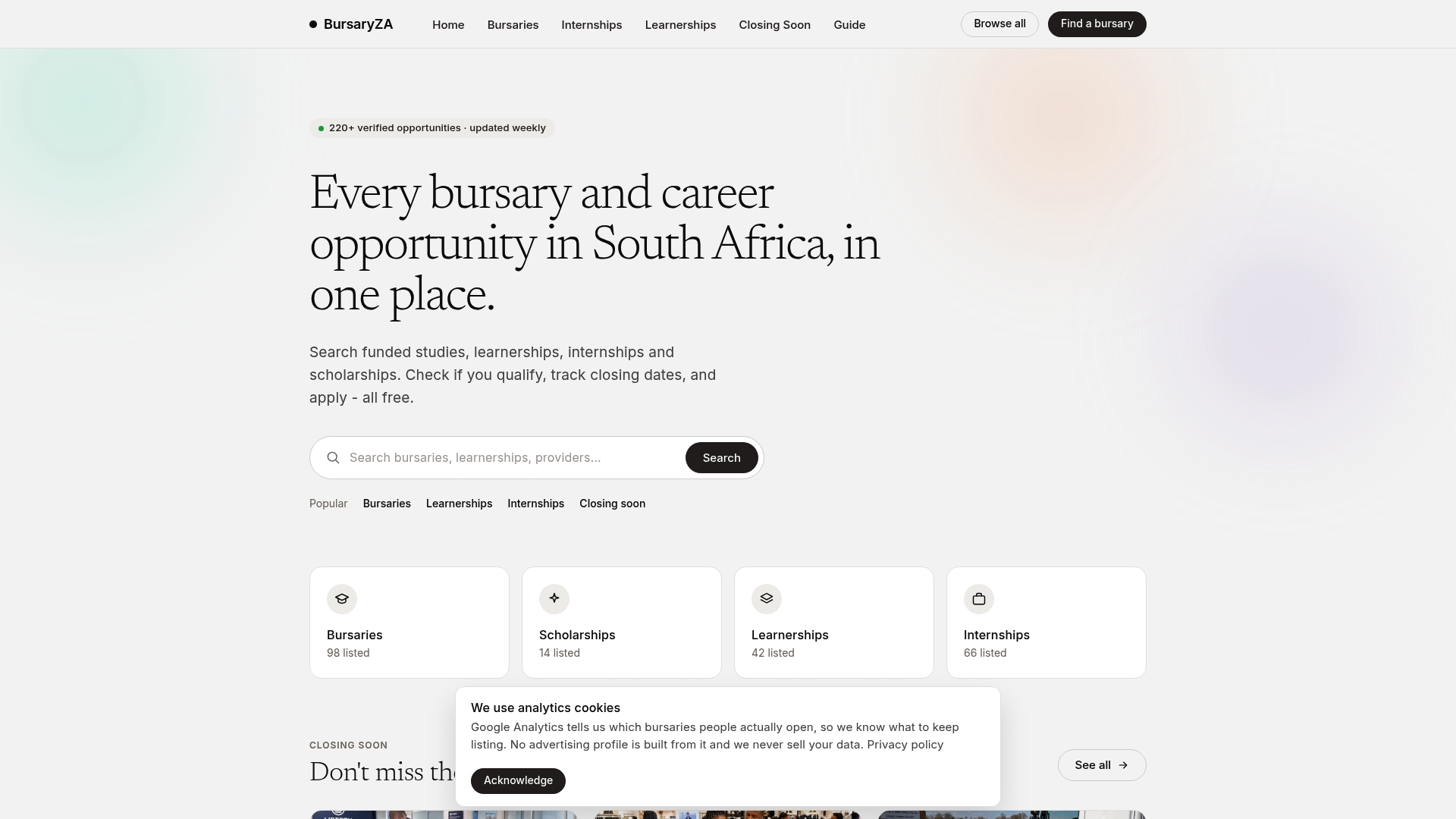
BursaryZA is a searchable database of verified bursaries, learnerships, internships and scholarships in South Africa. Each listing shows who qualifies, when it closes, which documents you need and where to apply, and you can filter by field, study level and location.
Start on the BursaryZA homepage and search for finance, banking, accounting or insurance programmes near you.
If you want to see how a major employer presents its first-job programme for school leavers, our listing for the FNB First Job Learnership Programme shows the format you can expect: requirements, closing date and official application link in one place. If you are considering a trade route as a backup, our guide to artisan learnerships explains how to qualify.
Mistakes that cost applicants a place
- Applying without checking subject marks. A 49% where 50% is required ends the application.
- Sending uncertified copies. Many employers reject them outright.
- Applying while studying. Several programmes require you not to be on another learnership or in full-time studies.
- Using a vague CV. Say what you did, for how long and what you learned, and give your marks for English, maths and accounting.
- Ignoring the age cut-off. Check whether it is calculated at the start of the learnership or in the recruiting year.
- Missing the email. Check your spam folder after applying.
FAQ
Do I need Accounting to apply for a finance learnership?
Not always. Some programmes accept Mathematics or Mathematical Literacy instead, and the Institute of Certified Bookkeepers lists Grade 12 Accounting as preferred rather than compulsory for its finance learnerships. Check the advert for the subject and percentage requested.
Can I do a finance learnership if I am over 30?
Possibly. Some programmes cap applicants at 30, while others allow people under 35, and MerSETA states that learnership entrants must be younger than 35. The limit is set by the programme, so read each advert carefully.
Do finance learnerships pay a stipend?
Yes, learners are paid by the host employer while they train. The amount depends on the employer and the qualification level, so compare any offer against the ranges in our learnership stipend guide and confirm the figure in your agreement.
Does a finance learnership guarantee a permanent job?
No. It gives you a qualification and workplace experience, which strengthens your applications, but whether you are kept on depends on the employer and available vacancies. Ask about retention at your interview.
Where should I look for 2026 and 2027 finance learnerships?
Start with the SETA and employer careers pages, then use a verified database such as BursaryZA to see current closing dates and requirements in one place. Check every opportunity against the official page before you send documents.
Sources
- Fasset: Getting Started guide
- ICB: Learnerships
- Youth opportunities as interns, learners or apprentices
- BANKSETA: Funding Window Guidelines for Employers 2026-27
- Old Mutual: Amathuba Learnership Programme 2026
- MerSETA: Learnerships
- BANKSETA: Youth Programmes
- BANKSETA: FAQ
- ICB: Learnership Policy and Procedures
- SAIPA: How to enrol a trainee
- Fasset: Learnership agreement registration procedures
- Youth Feed: Documents required for learnership applications