Get Verified In Service Training Placements in South Africa

In-service training is the workplace-based learning (WIL) component that many South African qualifications require before you can graduate, covering N6 diplomas, some degrees, and professional articles. If your program includes a mandatory practical component, you likely need it, and placements typically run six to 36 months with stipends that vary by funder. Start by checking your faculty or TVET WIL office, then cross-reference verified listings on a platform like Bursaryza.
TL;DR:
- Most placements last between six and 18 months, with stipends ranging from R3,500 to R4,000 per month, depending on the program and funding source.
- Eligibility requirements vary by qualification and funding program, often including citizenship, residence, age, and specific field alignment.
- Securing a placement depends on verified listings through your institution, SETAs, provincial departments, or trusted portals like Bursaryza.
- A comprehensive logbook, signed by a supervisor and covering all competencies, is crucial for graduation and should be checked and approved before the placement begins.
- Applicants should gather all required documents, follow application instructions precisely, and request written learning and performance summaries to maximize placement value.
Table of Contents
- Where to find in-service training opportunities in South Africa
- Who qualifies: eligibility and selection criteria
- Duration, stipends, and how placements get funded
- How WIL is assessed: logbooks and sign-off
- How to apply: your step-by-step checklist
- Practical tips, red flags, and getting real value from your placement
- Why verified listings and clear eligibility checks matter
- Find your next verified placement on Bursaryza
- Sources
Where to find in-service training opportunities in South Africa
Your first stop should always be your own institution. Every university and TVET college runs a WIL office or careers unit that keeps a placement database, and they usually know which employers already have signed agreements in place. Skipping this step and cold-applying to companies wastes time your WIL coordinator could save you in one conversation.
Beyond campus, government and SETA channels are where the funded placements live. Provincial departments run their own schemes, like the KZN Works in-service training programme, which places students in six to 18-month roles that may carry a stipend. At the national level, the National Skills Fund’s WIL programme funds apprenticeships, learnerships, and internships specifically to help graduates and TVET students clear the work-experience hurdle standing between them and their qualification.
Employers and SETAs advertise directly too. Programs like the Mthashana TVET College ETDP SETA opportunity and the SAB TVET In-Service Trainee programme show exactly how these listings read: specific qualification requirements, named placement sites, fixed durations.
Where you search matters as much as what you search:
- Your institution’s WIL/careers office and placement database
- SETA and provincial department postings (KZN Works, ETDP SETA, and similar)
- Employer-run TVET in-service programs advertised directly
- Verified aggregator portals, including Bursaryza’s internships and learnerships listings
Who qualifies: eligibility and selection criteria
Eligibility hinges first on your qualification type. N6 certificate holders, national diploma students, and degree candidates with a compulsory workplace component each face different requirements, and professional streams (accounting articles, for example) have their own separate rules.
Beyond the academic side, SETA-funded posts often carry additional filters:
- Citizenship or permanent residency, since public funding targets South African nationals
- Age brackets, common in youth employment initiatives
- Specific N6 subject or field alignment with the host employer
- Sometimes provincial residency, especially for departmental programs like KZN Works
Read the listing language carefully. “N6 Human Resources” means exactly that field, not a related one. When a listing is ambiguous, phone or email the contact before applying rather than guessing and losing a slot to someone who confirmed first.
Duration, stipends, and how placements get funded
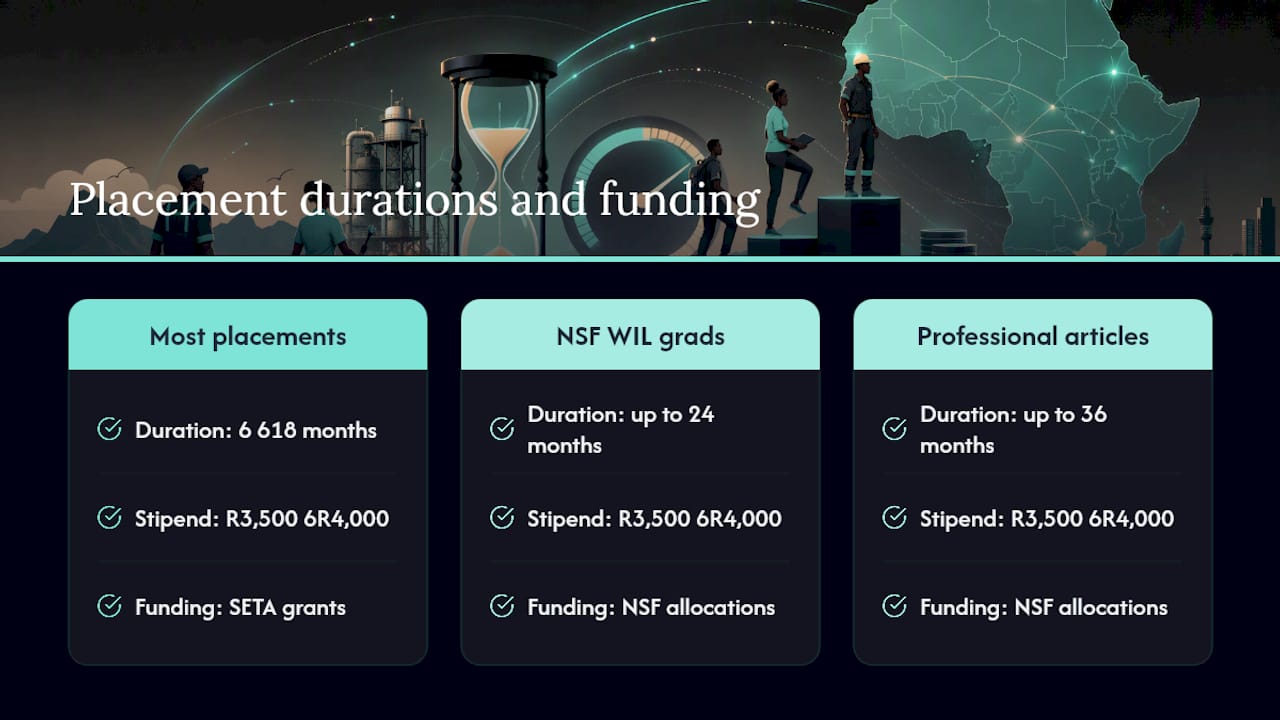
Most in-service placements run six to 18 months. Post-qualification internships and professional-article pathways stretch longer, with the NSF’s WIL programme funding placements up to 24 months for unemployed graduates and as long as 36 months for professional articles.
Stipends vary, but recent listings give you a real benchmark. The Mthashana TVET College ETDP SETA program pays N6 graduates R4,000 a month across an 18-month placement, roughly in line with the R3,500 to R4,000 range other SETA-funded posts tend to offer.
That money doesn’t come from a single pot. SETA discretionary grants, NSF allocations, and departmental budgets each operate on their own funding cycles, which is why availability shifts year to year and why a stipend that existed last intake might not repeat this one. Treat any stipend as conditional until you have a signed offer, not a guarantee based on what a previous cohort received.
How WIL is assessed: logbooks and sign-off
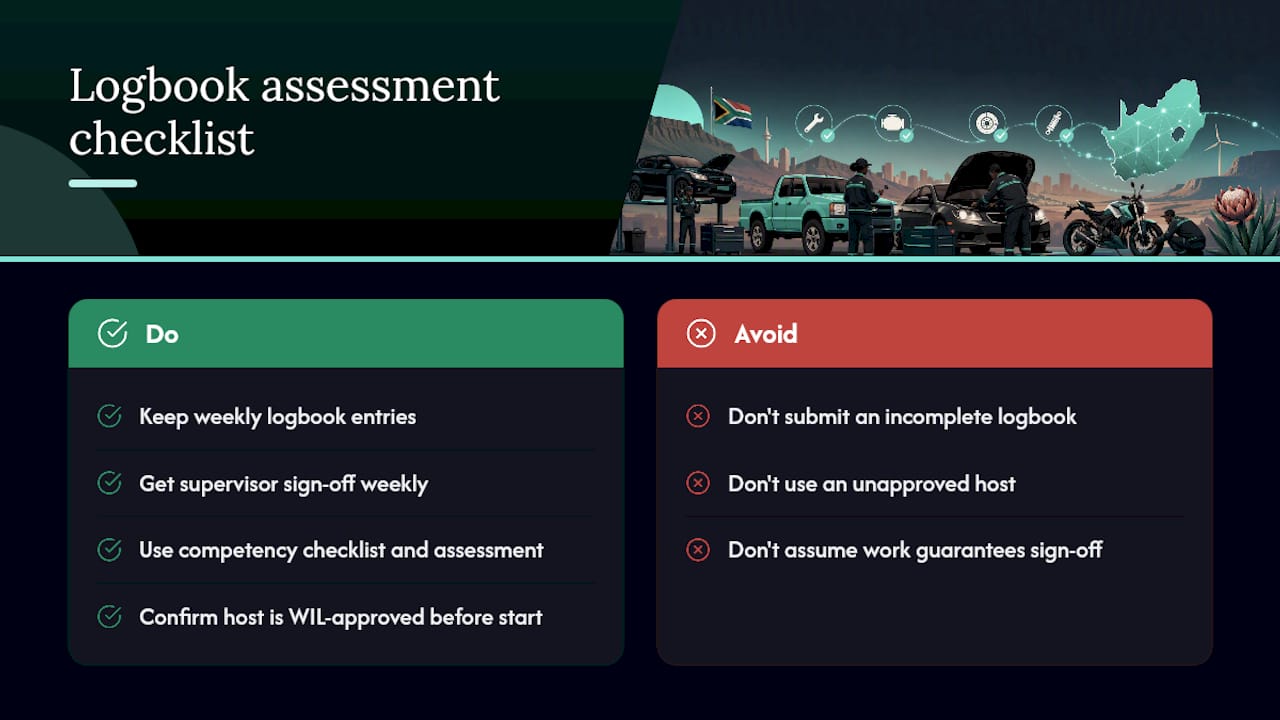
Your logbook is the single most important document in the entire process. Weekly entries, signed off by your workplace supervisor, form the primary evidence your institution uses to confirm you actually completed the required competencies, not just occupied a desk for the duration.
Institutions don’t just take your word for it either. WIL units, like the one CUT operates, approve host employers in advance, monitor placements while they’re active, and formally sign off on competencies once you finish. Expect deliverables beyond the logbook itself: competency checklists, a supervisor assessment, sometimes a reflective portfolio tying your tasks back to curriculum outcomes.
Here’s the part students underestimate: an incomplete logbook or an unapproved host can block your graduation even after you’ve done the actual work. Confirm your host is registered with your WIL office before day one, not after month three.
How to apply: your step-by-step checklist
Applying for in-service training rewards preparation more than speed. Work through these steps in order:
- Confirm requirements first. Check with your faculty or TVET WIL office on your exact required placement length and any timing windows tied to your academic calendar.
- Assemble your documents. You’ll typically need your ID, academic transcript or N6 certificate, CV, matric or NCV certificate, proof of current registration, and any host letters you’ve already secured.
- Search trusted channels. Cross-check your institution’s database against SETA and NSF postings and verified portals like Bursaryza, and note the exact reference number on any listing you apply to.
- Follow instructions to the letter. Submit exactly as instructed, keep copies of everything, and be ready for a short interview and onboarding paperwork once you’re shortlisted.
Pro Tip: Combine every document into a single labeled PDF, and put the listing’s reference number in your email subject line. Coordinators managing dozens of applications will find yours faster, and a scattered submission is an easy reason to get passed over.
Practical tips, red flags, and getting real value from your placement
A placement is only as good as the structure around it. Ask for a written learning plan and your supervisor’s direct contact before your start date, not after you arrive confused. Peer-reviewed research on teacher trainees in South African schools found that strong mentorship and realistic placement conditions separate genuinely useful WIL experiences from ones that just fill hours.
Watch for warning signs before you commit:
- Vague host details or no named supervisor
- Any request for payment from you as the applicant
- Unclear or shifting stipend information
- No mentorship structure mentioned anywhere in the listing
Pro Tip: Ask for a written performance summary when your placement ends, even if nobody offers one automatically. It becomes your strongest reference document for job applications months later, when your supervisor may not remember the details.
Why verified listings and clear eligibility checks matter
Bad information costs students months, not minutes. When a listing hides its real eligibility criteria or a stipend figure turns out to be outdated, you’ve lost an application slot you could have used elsewhere. Bursaryza verifies listings and builds eligibility checklists specifically so you’re applying to opportunities you actually qualify for, not guessing.
— Nkosi
Find your next verified placement on Bursaryza
Bursaryza exists for exactly the scenario in this article: you have limited time before your WIL deadline, and you can’t afford to chase dead-end listings or half-verified postings scattered across a dozen websites.
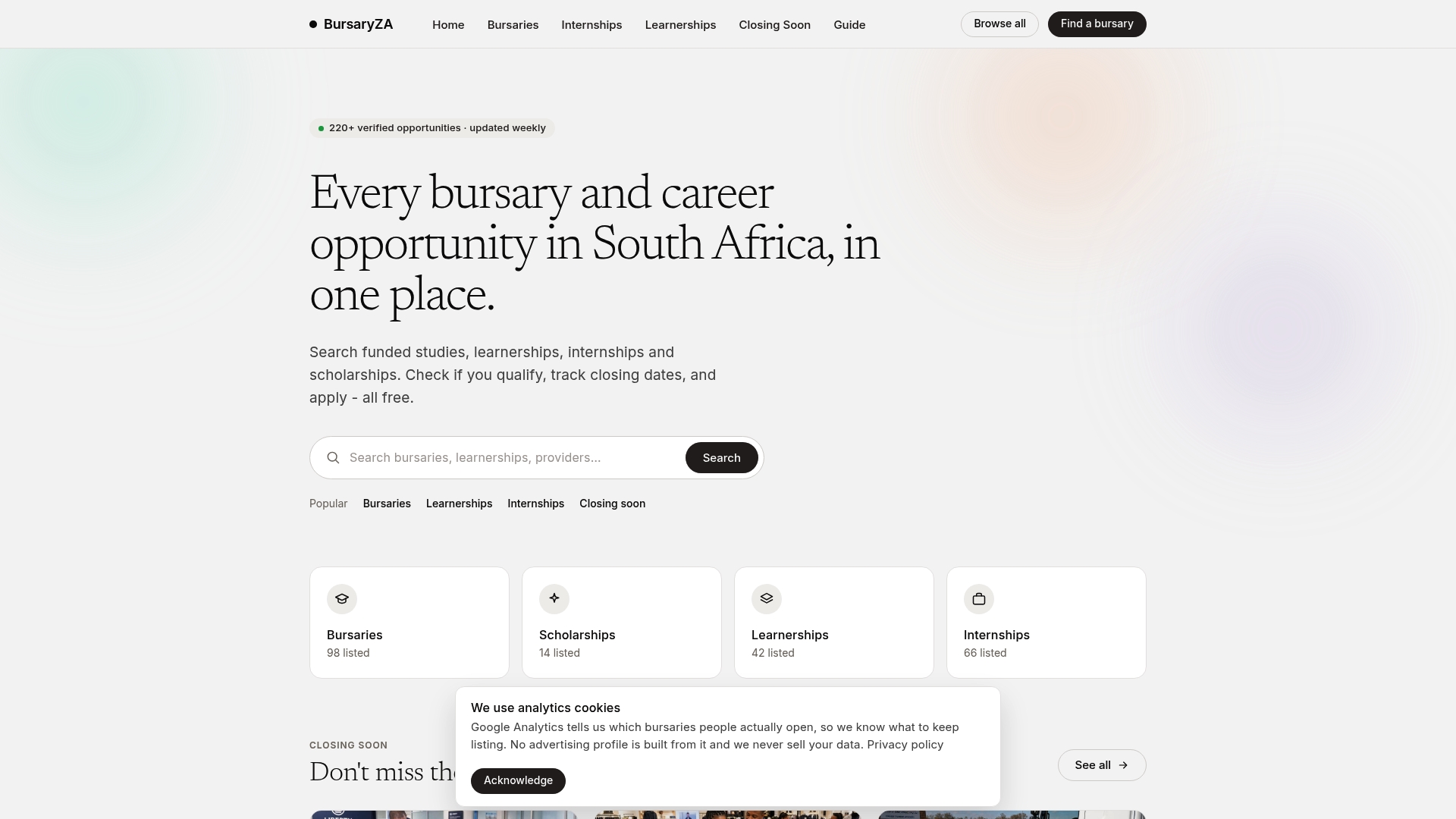
Start with the internships hub if you’re hunting for in-service placements broadly, or the learnerships page if your qualification lines up with a SETA-funded learnership pathway instead. Each listing carries an eligibility checklist upfront, so you can rule out mismatched postings before you waste an application. Filter by field, closing date, or province, and set alerts so a fresh N6 or diploma-level placement doesn’t close while you’re mid-semester and distracted. If you’re also chasing funding alongside your placement search, the bursaries section runs on the same verification standard. Head to Bursaryza now, filter for your field and qualification level, and apply to listings that actually match your documents.
Sources
For verification and updates, keep these on hand: KZN Works for provincial placements, the NSF’s WIL programme for national funding rules, CUT’s WIL unit as a university example, and Bursaryza for verified live listings.
- In Service Training Programme - KZN Works
- Work-integrated Learning - National Skills Fund
- Work Integrated Learning - CUT