What Is a Learnership in South Africa’s Skills System?

A learnership is a registered, work-based learning program that blends classroom theory with real workplace experience over a fixed term, usually building toward an NQF-registered qualification. It must be registered with a SETA and backed by a signed agreement between you, your employer, and an accredited training provider. Most learnerships pay a stipend rather than a full salary, and most run for around 12 months, though the exact length depends on the qualification’s NQF level.
TL;DR:
- Verify that the learnership is registered with the appropriate SETA and obtain its registration number before applying.
- Expect stipends aligned with sector-specific minimum wages, not full salaries, and be cautious of programs offering no documentation of registration.
- Confirm the program’s duration matches the NQF level and sector, typically around 12 months but potentially longer for higher levels or technical trades.
- Ensure you meet the eligibility criteria, including a Matric or Grade 10 certificate, age limits, and South African citizenship, with documents ready for application.
- Use official sources and verified listings to find legitimate learnership opportunities and request a signed agreement before committing.
Table of Contents
- How a Learnership Is Structured and What You Earn
- Who Can Apply and What Documents You’ll Need
- How Learnerships Work Day to Day: Agreements, Duties, and Pay
- Who Runs and Funds Learnerships: SETAs, SAQA, and the Law
- Learnership vs Internship vs Apprenticeship: Which Fits You?
- What a Learnership Actually Gets You (and What It Doesn’t)
- How to Find and Verify a Legitimate Learnership
- Why Verification Matters More Than the Perks
- Find Verified Learnership Listings on BursaryZA
- Sources
How a Learnership Is Structured and What You Earn
A learnership splits your time between two environments: a classroom or training center where you learn theory, and a workplace where you apply it. If you’re doing an electrical engineering learnership, for example, you might spend a few days a month at an accredited training provider covering circuit theory and safety regulations, then the rest of your time on-site wiring panels under supervision.
The endpoint is not just a certificate of attendance. It’s a qualification registered on the National Qualifications Framework, which means it’s recognized across South African education and employment systems and can count toward further study.
Duration isn’t arbitrary. It’s tied to the outcomes and assessments built into that specific qualification, not a fixed calendar block:
- Many learnerships run close to 12 months, but this varies by NQF level and sector.
- Higher NQF levels (5 and above) often take longer because they demand more theoretical depth.
- Some technical trades stretch beyond a year when practical competency takes longer to assess.
Always check the stated duration in the actual advert. Two learnerships with similar titles can differ by months depending on the training provider and qualification level.
Who Can Apply and What Documents You’ll Need
Learnerships mostly target young, unemployed South Africans who need a structured route into a specific occupation. That covers school leavers, Matric holders, TVET college graduates, and unemployed youth trying to break into fields like finance, IT, engineering, or hospitality.
Eligibility criteria shift from one advert to the next, but a few patterns hold across most listings:
- A minimum of Grade 10 or a Matric certificate, depending on the NQF level of the qualification.
- Age limits, often between 18 and 35, particularly for programs funded through youth employment initiatives.
- South African citizenship or valid documentation confirming your right to work.
- Sometimes a relevant subject background (Math or Science for technical learnerships, for instance).
You’ll typically need a certified ID copy, your latest Matric certificate or academic transcript, and an updated CV. Some SETAs also ask for proof of address or a short motivational letter, so it helps to have those ready before you start applying.
How Learnerships Work Day to Day: Agreements, Duties, and Pay
Every legitimate learnership runs on a tripartite agreement, a legal contract signed by you, your employer, and an accredited training provider. This agreement must be registered with the relevant SETA, and that registration is what separates a real learnership from a vague “training opportunity” some companies advertise to get free labor.
Once registered, three parties carry distinct obligations:
- The employer commits to employing you for the full term, providing genuine workplace training, and releasing you for scheduled theory sessions without penalty.
- The training provider delivers the accredited curriculum and coordinates assessments tied to your qualification.
- You, the learner, attend all training sessions, complete assigned workplace tasks, and sit the required assessments on schedule.
Pay is where expectations often go sideways. A learnership stipend is not a salary in the traditional sense. It’s an allowance set by SETA guidance or aligned with National Minimum Wage schedules, and it varies by sector, NQF level, and the specific SETA funding the program. Don’t expect learnership pay to match a permanent role at the same company. It’s designed to cover living costs while you train, not to function as competitive income.
Pro Tip: Ask for the SETA registration number and a copy of your learnership agreement before your first day. If an employer hesitates or can’t produce either, that’s a strong signal the program isn’t properly registered.
Who Runs and Funds Learnerships: SETAs, SAQA, and the Law
Twenty one SETAs cover different sectors of the South African economy, from manufacturing to media to mining, and each one registers learnerships tied to occupations within its industry. That sector alignment matters. A learnership registered with a construction sector SETA won’t be recognized the same way in banking, so the SETA behind a program tells you a lot about where the qualification will actually count.

SAQA, the South African Qualifications Authority, oversees the NQF itself, confirming that a qualification is properly registered and slots into the national framework at the correct level. The Skills Development Act of 1998 is the legal backbone behind all of this, setting out registration rules and learner protections.
Funding flows through the same system: employers who run compliant learnerships can claim grants or levy reimbursements from their SETA. That’s a big reason companies bother running these programs at all, and it’s part of why verifying SETA involvement protects you as an applicant.
- SETAs register programs and manage sector-specific funding.
- SAQA confirms NQF status and qualification legitimacy.
- The Skills Development Act sets the legal rules everyone has to follow.
Learnership vs Internship vs Apprenticeship: Which Fits You?
The difference between a learnership and an internship comes down to what you walk away with. A learnership ends in an NQF-registered qualification. An internship usually just gives you workplace exposure and a reference, with no formal credential attached. An apprenticeship sits closer to a learnership but focuses specifically on trade and artisan certification, often running longer and ending in a trade test rather than a classroom-based assessment.
| Feature | Learnership | Internship | Apprenticeship |
|---|---|---|---|
| Formal qualification | Yes, NQF-registered | Usually none | Trade certificate/trade test |
| Typical duration | ~12 months, varies by NQF level | 3 to 12 months | Often 2 to 4 years |
| Best suited for | School leavers, unemployed youth wanting a credential | Graduates wanting workplace exposure | Those pursuing a skilled trade |
| Payment structure | Stipend, SETA-linked | Stipend or unpaid | Wage scale tied to trade progression |
If you want a recognized qualification fast, a learnership usually beats an internship for that specific goal. If you’re set on becoming a qualified electrician or plumber, an apprenticeship is the more direct route.
What a Learnership Actually Gets You (and What It Doesn’t)
The upside is real: you finish with a recognized qualification, practical experience, and a stipend that covers you while you train, all under structured mentorship rather than sink-or-swim exposure.
The limitation nobody advertises loudly enough is that a learnership is a fixed-term contract. It ends when you complete it, and employers are under no obligation to offer permanent work afterward. Stipend amounts also vary widely, so don’t assume two learnerships in the same field pay the same rate.
- Watch for adverts with no SETA registration number listed anywhere.
- Be wary of vague or unsigned “agreements” that don’t name a specific training provider.
Pro Tip: Treat any learnership advert that skips the registration number as a red flag worth investigating before you hand over your ID or Matric certificate.
How to Find and Verify a Legitimate Learnership
Start your search on official SETA portals, established career sites, and verified aggregators like BursaryZA’s learnership listings, which filter opportunities by field and eligibility so you’re not wading through outdated or unregistered postings.
Before applying anywhere, run through this verification routine:
- Ask for the SETA registration number and confirm it matches the sector.
- Request a copy of the learnership agreement before signing anything.
- Confirm the training provider is accredited for that specific qualification.
Once you’ve confirmed legitimacy, prepare your application pack:
- Certified ID copy
- Matric certificate or academic transcript
- Updated CV with contact details
- Any sector-specific documents the advert requests
Apply early, follow up within a week if you haven’t heard back, and keep copies of everything you submit. Programs with genuine SETA backing tend to move faster than vague “opportunities” that never quite explain who’s running them.
Why Verification Matters More Than the Perks
Most guides to learnerships focus on the stipend and the qualification, but the real risk in this space isn’t low pay. It’s fake or unregistered programs that dress themselves up as learnerships to get free labor out of desperate job seekers. That distinction gets glossed over constantly, and it shouldn’t be.
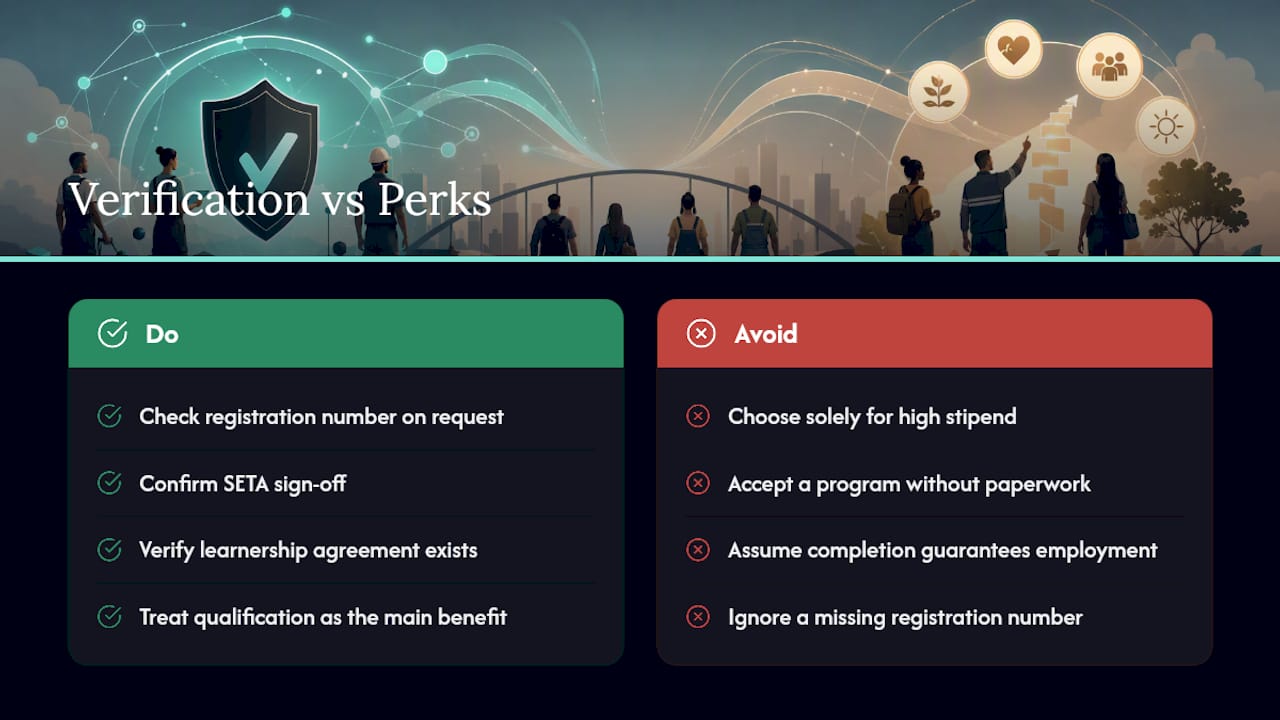
A properly registered learnership agreement is your actual protection here, not the promise of a job at the end. Too many learners chase the stipend number and skip the paperwork check, then find out six months in that no SETA ever signed off on their program. If a learnership can’t produce a registration number on request, walk away regardless of how good the pay sounds.
The other underrated truth: completion doesn’t guarantee employment, and that’s not a flaw in the system, it’s how it’s designed. Treat the qualification and experience as the win, and any job offer afterward as a bonus, not an entitlement.
— Nkosi
Find Verified Learnership Listings on BursaryZA
Job boards and company career pages leave you guessing which “learnership” adverts are actually SETA-registered. BursaryZA cuts that guesswork out by listing only verified opportunities, each with an eligibility checklist, closing date, and a direct application link, so you know exactly what you qualify for before you spend time on a form.

Every listing on our learnership index shows the provider, the field, and the requirements upfront. If you’re also weighing a bursary to fund further study alongside your learnership search, browse current bursaries or filter opportunities by your province, including Gauteng and the Western Cape. For extra grounding on how classroom learning pairs with workplace training, GetVoucher offers useful supplementary reading on structured learning models. Search now, save the listings that match your qualifications, and get your application in before the closing date passes.
Sources
- Learnerships — merSETA
- Skills Development Act 97 of 1998 (PDF)
- What Is A Learnership? | Careers Portal