Where to Find Banking Learnerships in South Africa Right Now

Your fastest route into a banking learnership runs through two channels at once: BANKSETA’s Letsema and Kuyasa intakes, which typically open in July and August, and the year-round career portals of the big banks themselves. Between them, roughly 75% of BANKSETA-funded learnership completers move into full-time banking jobs, so the programs genuinely lead somewhere, not just to a certificate you file away.
Do three things this week. Check BANKSETA’s site now, even outside the July-August window, since some streams open earlier. Sign up directly on Standard Bank, FNB, Nedbank, Absa, and Capitec’s career pages so you get notified the moment a role posts. And set an alert on BursaryZA’s learnership listings so you’re not relying on memory or luck.
While you wait for openings, gather:
- Certified copy of your South African ID
- Certified Matric certificate or highest qualification
- Proof of residence (not older than three months)
- Updated CV with contact details for two references
- Proof of unemployment status, if requested by the provider
Key Takeaways
Banking learnerships in South Africa run through two channels: BANKSETA’s seasonal Letsema and Kuyasa intakes, and the year-round career portals of Standard Bank, FNB, Nedbank, Absa, Capitec, and Land Bank.
| Point | Details |
|---|---|
| Watch two timing windows | BANKSETA opens intakes around July to August; banks post vacancies year-round on their own portals. |
| Prepare documents early | Certify your ID, Matric certificate, and proof of residence before any opening appears. |
| Know the payoff | About 75% of BANKSETA-funded learnership completers move into full-time banking jobs. |
| Budget around the stipend range | Expect roughly R3,500 a month on Letsema and R5,200 to R5,900 on several bank-run 2026 streams. |
| Use a verified source | BursaryZA aggregates verified learnership listings with closing dates and direct links to official portals. |
Table of Contents
- Which Banks and Institutions Run Banking Learnerships in South Africa
- Who Qualifies, and What You Need Before You Apply
- How to Apply for a Banking Learnership, Step by Step
- How Long Learnerships Run and What They Pay
- Where to Search for Live Openings and How to Track Them
- What Improves Your Application, and What Kills It
- Why the Numbers Matter for Your Career Decision
- Why a Verified Listing Beats a Random Job Board Search
- How BursaryZA Helps You Land a Verified Banking Learnership
- Sources
Which Banks and Institutions Run Banking Learnerships in South Africa
Every major South African bank runs its own learnership pipeline, and BANKSETA runs the sector-wide safety net that catches applicants who don’t land a spot directly with a bank.
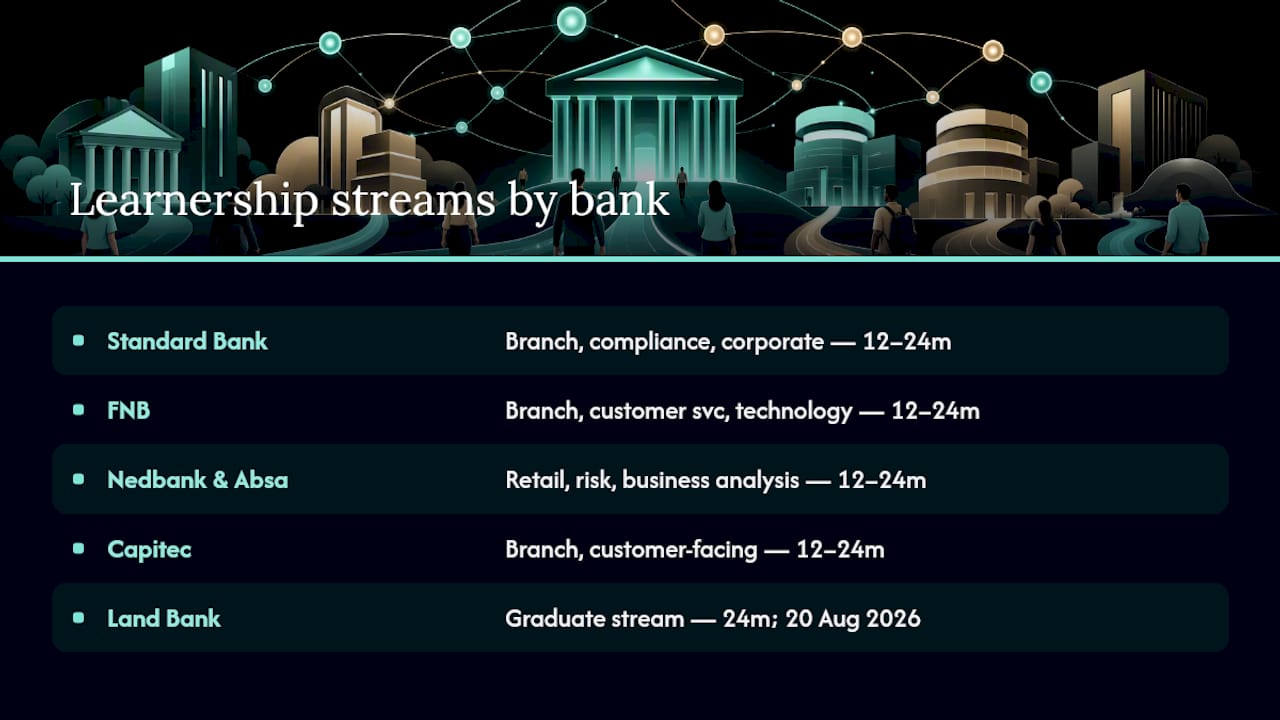
Standard Bank offers multiple accredited learnership streams running 12 to 24 months, spanning branch operations, compliance, and corporate functions, each paying a monthly stipend. FNB runs comparable branch and customer-service intakes alongside a dedicated technology and engineering stream for candidates aiming at IT rather than the counter. Nedbank and Absa both rotate learnerships through retail banking, risk, and business analysis, while Capitec, given its retail footprint, tends to concentrate openings in branch and customer-facing roles. Land Bank, as the country’s agricultural development bank, runs a graduate-focused stream. Its 2026 Graduate Learner Programme lists 24-month contracts tied to specific roles, with a closing date of August 20, 2026 for several positions.
BANKSETA doesn’t hire directly. It funds and quality-assures two flagship streams: Letsema, aimed at post-Matric candidates and pegged to NQF Level 5, and Kuyasa, a graduate stream sitting at NQF Level 5 or 6. Both work through accredited training providers rather than a single employer, which is why they can absorb candidates the individual banks turn away.
A quick read on timing: banks post learnership vacancies continuously, whenever headcount opens up, but BANKSETA’s intake for the following year’s cohort typically opens in July and August. Miss that window and you’re waiting almost a full year for the next one, which is exactly why the reminder in the section above matters more than it looks.
Contract length across providers clusters between 12 and 24 months, with graduate-level Kuyasa and Land Bank streams sitting at the longer end.
Who Qualifies, and What You Need Before You Apply
Eligibility rules are consistent enough across providers that you can prepare once and apply everywhere. Most programs require:
- South African citizenship and a valid ID
- Current unemployed status (this rules out candidates already in formal employment)
- Age roughly between 18 and 35, though exact cutoffs vary by provider
- Grade 12 (Matric) at minimum, or a three-year degree for graduate streams like Kuyasa
- Basic computer literacy
Documents to have certified and ready: your ID, Matric certificate or degree, proof of residence, and, for some banks, consent for a credit check through the ITC system. A poor credit record or an active judgment against your name can disqualify you from certain financial-sector roles, so it’s worth checking and, where possible, resolving ITC listings before you submit anything. Graduate streams and specialist fields like risk or actuarial work sometimes ask for a specific degree major, so read the advert closely rather than assuming Matric alone gets you in. Most providers also state they welcome applications from people with disabilities and consider affirmative access criteria as part of selection.
How to Apply for a Banking Learnership, Step by Step
Step 1: Find the opening. Check bank career pages directly, since many roles post there before anywhere else. Watch BANKSETA’s site for the July-August Letsema and Kuyasa intake, browse BursaryZA’s learnership listings for verified postings, and use LinkedIn or Indeed as a supplement rather than your main source, since not every bank learnership gets posted on job boards.

Step 2: Prepare your documents and a banking-specific CV. Lead with anything that signals numeracy, computer skills, and customer-facing communication, even if it came from a part-time job or school role. Recruiters in this sector read dozens of generic CVs a day; specifics stand out.
Step 3: Submit through the official portal only, and confirm receipt. Never pay a third party to submit an application or “hold your place” in a program. Official recruitment always runs through the provider’s own portal, not an agent.
Step 4: Prepare for the selection process. Expect a screening of your documents first, then an online assessment testing numeracy and verbal reasoning, followed by an interview, sometimes panel-style, focused on your reliability and communication under pressure.
Pro Tip: Quantify anything you can on your CV. “Handled customer queries” says nothing. “Resolved 15 to 20 customer queries daily during a school holiday retail job” tells a recruiter you can handle volume, which is exactly what a bank branch needs.
How Long Learnerships Run and What They Pay
Programs typically run 12 to 24 months, and the qualification you walk away with depends on the stream. Letsema sits at NQF Level 5. Kuyasa and most bank-run graduate programs land at NQF Level 5 or 6, while entry-level, Matriculated bank streams often sit at NQF Level 4 to 6 depending on the role.
Stipends vary noticeably by provider. BANKSETA’s Letsema stream pays around R3,500 a month, while some bank-run 2026 stipends range from about R5,200 to R5,900 a month, with certain specialist Capitec adverts reporting higher figures still. That gap is worth knowing before you decide which route to prioritize if you’re weighing multiple offers.
Every completed learnership should come with a SAQA-accredited qualification or a signed-off workplace logbook, and that paperwork is what makes the credential worth something on a CV later. Confirm accreditation status with the provider before you commit; a qualification without SAQA backing carries far less weight with future employers.
Where to Search for Live Openings and How to Track Them
- Start with BANKSETA’s own site, especially in the July to August window, for Letsema and Kuyasa.
- Check bank career portals directly, since Standard Bank, FNB, Nedbank, Absa, and Capitec all post vacancies year-round, often through internal systems like Workday before they ever reach a public job board.
- Set an alert on BursaryZA’s verified learnership listings, so new postings land in your inbox instead of requiring daily manual checks.
- Use LinkedIn and Indeed as backup channels, useful for catching adverts that slip past provider sites, but not your primary source.
- Verify every listing against the provider’s own site before applying anywhere that asks for personal documents or payment upfront.
Scam postings tend to reuse real bank names but link to Gmail addresses or ask for an “application processing fee.” A legitimate bank or BANKSETA listing never charges you to apply.
What Improves Your Application, and What Kills It
Do this: certify your documents before you’re asked twice, tailor your CV to banking-relevant skills, use a professional email address, and only ever apply through a provider’s official page or portal.
Avoid this: any recruiter asking for money, an email domain that doesn’t match the bank’s name, requests for your full banking credentials or online banking password (a legitimate employer never needs this), and listings with no closing date, location, or provider contact information.
The most common self-inflicted rejection reason isn’t lack of experience. It’s incomplete paperwork, an uncertified document, or an unresolved ITC flag discovered late in the process. One applicant tweak that consistently helps: replacing a vague line like “good with people” with a measurable outcome, such as “improved customer wait times by managing a queue of 30-plus people during peak hours at a retail job.”
Pro Tip: Fix ITC and criminal-record concerns before you apply, not after you’re shortlisted. Banks run these checks late in the process, and finding out then costs you the seat, not just the delay.
Why the Numbers Matter for Your Career Decision
Roughly 75% of people who finish a BANKSETA-funded learnership move into full-time banking employment afterward. That’s a strong signal that completion, not just enrollment, is what banks reward when hiring.
Stipends during the program range from about R3,500 a month on Letsema to R5,200 to R5,900 on several bank-run 2026 programs, so budget accordingly rather than assuming every stream pays the same. Before signing anything, confirm the training provider appears on BANKSETA’s accredited list. That single check protects you from ending up with a certificate that means nothing to your next employer.
Why a Verified Listing Beats a Random Job Board Search
Job boards mix real bank postings with expired links, scraped duplicates, and outright scams, and sorting through that noise costs you time you don’t have during a tight application window. A verified database that checks eligibility criteria and links straight to the official provider page removes that guessing entirely. When every listing carries a real closing date and a direct application link, your odds of applying to something legitimate, on time, go up without you having to become an expert in spotting fake recruiters yourself.
How BursaryZA Helps You Land a Verified Banking Learnership
Finding legitimate banking learnerships shouldn’t mean scrolling through outdated Facebook posts or job board duplicates that lead nowhere. BursaryZA pulls verified listings from official bank and BANKSETA sources into one searchable database, so you spend your time applying, not hunting.
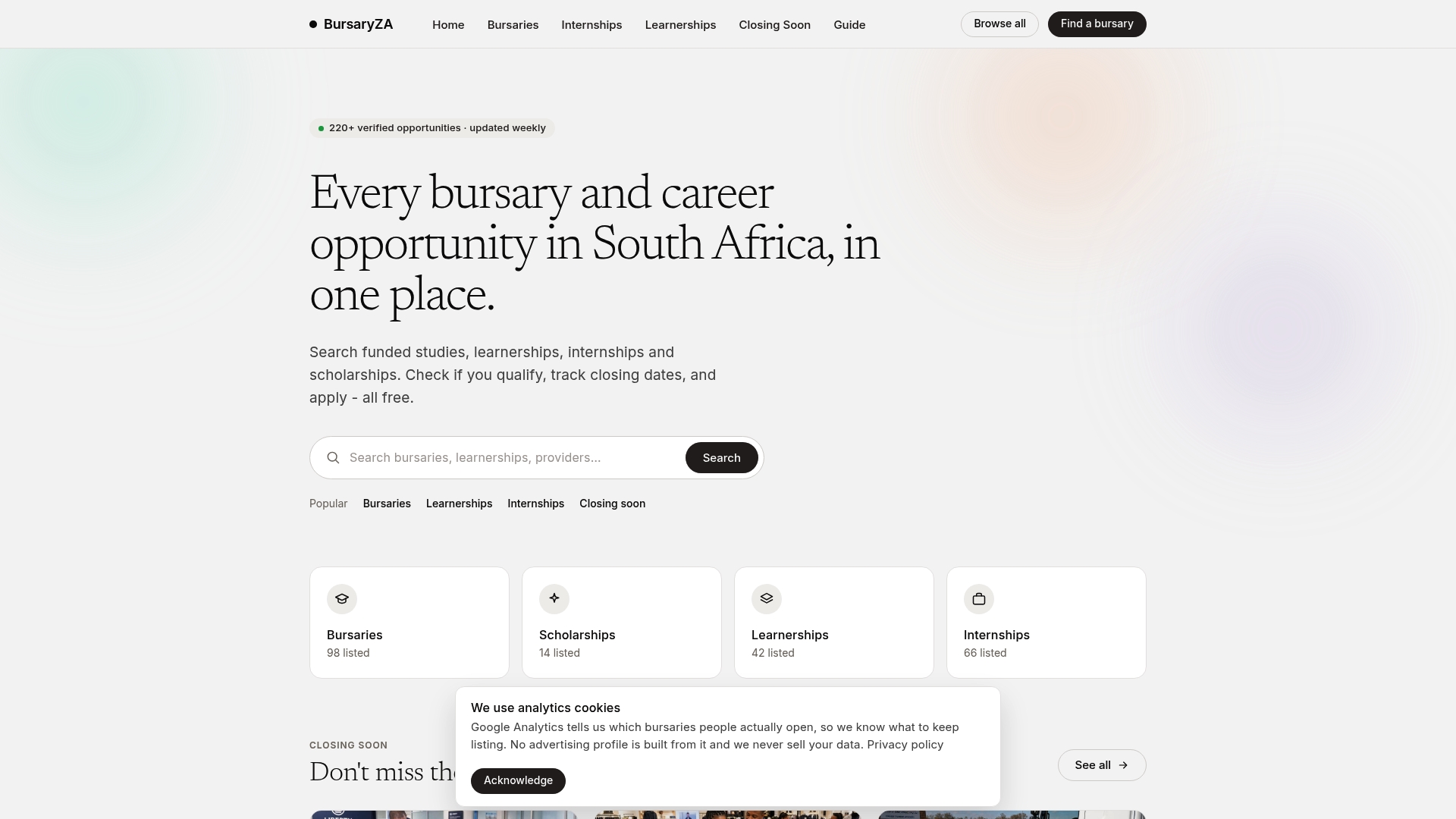
Three things BursaryZA does for you specifically: it flags closing dates so you never miss a Land Bank or BANKSETA window, it filters listings by eligibility so you only see programs you actually qualify for, and every application link routes directly to the provider’s own official portal, never a third party. Browse the current learnerships in South Africa listings now, filter by field or province, and set an alert so the next Standard Bank or FNB opening lands in your inbox the day it posts.
Sources
- BANKSETA learnerships empower youth (SAnews)
- BANKSETA - Banking Sector Education & Training Authority - BANKSETA
- Learnerships with Standard Bank Group | Standard Bank
- Land Bank Banking Graduate Learner Programme 2026 – Apply