WorldSkills 2027 Applications Open Across 34 Skills Categories
If you can weld, code, cook, repair vehicles, work with electrical systems, style hair or demonstrate another specialised practical skill, WorldSkills South Africa 2027 could put that ability on a national stage. Applications are open across 34 skills areas for eligible students, apprentices and...

WorldSkills 2027 Applications Open Across 34 Skills Categories is a learnership offered by WorldSkills (open nationally). Applications close on 30 Apr 2027.
Who can apply
- WorldSkills is open to candidates following several education and training pathways.
- Completing an apprenticeship related to your chosen skill
- Completing a learnership related to your chosen skill
- Studying towards a relevant qualification at a university
- Studying at a TVET College
- Studying through a private skills development provider
- Studying at a Community Education and Training College
- Studying at a technical high school
- Your studies or training should relate directly to the skill category you choose.
- WorldSkills is a practical competition, so applicants should select an area in which they are genuinely developing technical competence rather than choosing a category simply because it sounds interesting.
How to apply
Applications are submitted directly to WorldSkills - we do not collect applications. Read the eligibility criteria, prepare your supporting documents, then complete your application on the official page.
Go to the application pageFull details
If you can weld, code, cook, repair vehicles, work with electrical systems, style hair or demonstrate another specialised practical skill, WorldSkills South Africa 2027 could put that ability on a national stage. Applications are open across 34 skills areas for eligible students, apprentices and learners, with entries closing on 30 April 2027.
The competition gives technically and vocationally skilled young people an opportunity to test their abilities against demanding occupational standards instead of being judged only by academic results.
Participants can come from universities, TVET Colleges, Community Education and Training Colleges, technical high schools, private skills development providers, apprenticeships and learnerships.
What is WorldSkills South Africa?
WorldSkills South Africa is a national skills initiative championed by the Department of Higher Education and Training.
It forms part of the wider WorldSkills movement, which promotes vocational, technological and service-oriented careers while giving young competitors an opportunity to demonstrate practical excellence.
WorldSkills competitions cover everything from traditional artisan trades to information technology, engineering, hospitality and modern technical fields.
The focus is simple: showing what you can actually do with the skills you have developed.
Strong performers can progress through the competition system and potentially move towards opportunities to represent South Africa on the international WorldSkills stage.
Who can apply for WorldSkills 2027?
WorldSkills is open to candidates following several education and training pathways.
You may qualify if you are:
Your studies or training should relate directly to the skill category you choose.
WorldSkills is a practical competition, so applicants should select an area in which they are genuinely developing technical competence rather than choosing a category simply because it sounds interesting.
Which skills can applicants compete in?
The 2027 campaign covers 34 skills areas, spanning traditional trades, engineering, digital technology, hospitality, personal services and transport.
Examples include:
- Bricklaying
- Carpentry
- Electrical Installations
- Plumbing and Heating
- Refrigeration and Air Conditioning
- Graphic Design Technology
- Information Technology Network Systems Administration
- Information Technology Software Solutions for Business
- CNC Turning
- Mechanical Engineering CAD
- Mechatronics
- Mobile Robotics
- Water Technology
- Welding
- Beauty Therapy
- Cooking
- Hairdressing
- Health and Social Care
- Restaurant Services
- Aircraft Maintenance
- Autobody Repair
- Automobile Technology
- Car Painting
The 2027 competition also reflects the growing importance of modern technical fields such as digital technologies, renewable energy and specialised engineering.
The variety means WorldSkills is not limited to traditional artisan trades.
A skilled chef, software specialist, automotive technician, hairdresser or robotics student can belong on the same national skills stage as an electrician or welder.
Are there age restrictions?
Applicants should check the eligibility conditions for their chosen skill carefully because age requirements can differ between categories.
For Aircraft Maintenance, Mechatronics and Water Technology, candidates must not turn 26 years old or older during 2028.
Do not assume that qualifying academically automatically means you meet every competition requirement.
Check the conditions attached to the specific skill you intend to enter before completing your application.
Why should TVET students pay attention?
WorldSkills is particularly relevant to young people following vocational and occupational education pathways.
TVET students often spend significant time learning practical skills in fields such as electrical engineering, welding, automotive work, hospitality, plumbing and mechanical engineering.
WorldSkills gives participants an opportunity to demonstrate those abilities competitively.
Instead of a qualification being the only evidence of what you have learned, the competition asks participants to perform practical tasks against defined standards.
Your qualification shows what you studied. WorldSkills gives you a chance to demonstrate what you can do.
What happens during a WorldSkills competition?
Competitors are given practical tasks connected to their chosen occupation.
Depending on the skill, that could involve building, repairing, designing, programming, preparing food, diagnosing problems or completing another technical challenge.
Participants may be assessed on areas such as:
- Technical accuracy
- Quality of work
- Speed
- Problem-solving
- Time management
- Safety
- Following specifications
- Professional standards
- Attention to detail
The exact tasks depend on the competition category.
Participants should therefore approach WorldSkills as a serious skills competition rather than an ordinary application process.
Could WorldSkills help your career?
Competing at a high level can help participants identify strengths and weaknesses that may not become obvious during ordinary classroom training.
Preparing for competition can push candidates to improve their:
- Technical precision
- Confidence
- Ability to perform under pressure
- Problem-solving skills
- Occupational knowledge
- Time management
- Quality control
These are also qualities employers value.
Even beyond medals, the preparation and competitive experience can help a young artisan, technician or service professional build confidence in their chosen field.
What happens if you perform well?
WorldSkills follows a competitive progression structure.
Successful candidates may need to compete against others in their chosen skill before progressing through higher competition stages.
Top performers can eventually compete at national level, where leading competitors may be selected to represent South Africa internationally.
That means an application can potentially become the beginning of a much bigger competitive journey.
You are not simply registering for an event - you are putting your practical ability forward for comparison with some of the country’s strongest young skilled competitors.
Itumeleng’s Insider Tip: Choose the skill that best matches what you already study or practise. WorldSkills rewards practical competence, so entering a category because it sounds exciting will not help if you have little hands-on experience in that field. Start practising early rather than waiting until selection begins.
What is the indemnity form?
Applicants need to download and complete the required indemnity form before completing their application.
Do this before starting the online process.
Having the form ready can prevent unnecessary delays when completing your entry.
You should also prepare accurate information about your institution, training provider, qualification, province and selected competition skill.
What information should you prepare?
Before starting your application, have the following information ready:
- Your identification information
- Correct contact details
- Province of your institution
- University, college or training-provider information
- Qualification or training details
- Your chosen WorldSkills category
- Information about your apprenticeship or learnership where applicable
- Completed indemnity form
- Any additional information requested during registration
Make sure your email address and telephone number work.
If competition organisers need to contact you about the next stage, incorrect details could create unnecessary problems.
How do you choose the correct skill?
Start with your actual training.
For example, someone studying electrical engineering may consider Electrical Installations, while an apprentice welder should investigate Welding.
A hospitality student may be more suited to Cooking or Restaurant Services, while an information technology student might consider Network Systems Administration or Software Solutions for Business.
Ask yourself three questions:
- What am I currently studying or training in?
- Which practical skill can I already demonstrate confidently?
- Which competition category most closely matches that training?
Your answer should guide your selection.
How do you apply for WorldSkills 2027?
Applications are completed online.
First, identify the skill that matches your training and check that you meet its eligibility requirements.
Download and complete the indemnity form before starting your application.
Then prepare your personal, institution and training information.
Applications must be submitted through the official WorldSkills South Africa online application portal.
Review your information carefully before submitting and keep proof or confirmation of your application.
When do applications close?
Applications opened on 1 September 2026 and close on 30 April 2027.
Although the application window is relatively long, serious competitors should not use that as a reason to delay.
Applying early gives you more time to concentrate on developing your practical ability instead of worrying about registration close to the deadline.
Why should applicants start practising now?
WorldSkills is based on demonstrated ability.
Reading about welding is different from producing an accurate weld under competition conditions.
Understanding programming theory is different from solving a timed software problem.
Knowing a recipe is different from preparing professional food under pressure.
The same principle applies across the competition.
The strongest preparation happens through repeated practical work.
Use the months ahead to improve accuracy, speed, confidence and familiarity with the tools and standards used in your field.
Final Thoughts
WorldSkills South Africa 2027 gives students, apprentices and learners an opportunity to take practical talent beyond the classroom or workshop.
With 34 skills areas, the competition covers pathways ranging from electrical installations, welding and automotive technology to cooking, information technology, hairdressing, mechatronics and other specialised fields.
Applications are open to qualifying candidates studying or training through universities, TVET Colleges, Community Education and Training Colleges, technical high schools, private providers, apprenticeships and learnerships.
The application deadline is 30 April 2027, but applicants who are serious about competing should begin preparing much earlier.
Choose the skill that genuinely matches your training, complete the required indemnity form, submit accurate information and then focus on the part that matters most: becoming exceptionally good at your skill.
Frequently asked questions
What is the WorldSkills 2027 Applications Open Across 34 Skills Categories?
The WorldSkills 2027 Applications Open Across 34 Skills Categories is a learnership offered by WorldSkills for South African students and applicants interested in Engineering, Commerce/Business, and IT/Computer Science. If you can weld, code, cook, repair vehicles, work with electrical systems, style hair or demonstrate another specialised practical skill, WorldSkills South Africa 2027 could put that ability on a national stage. Applications are open across 34 skills areas for eligible students, apprentices and... You can read the full details, eligibility criteria, and application steps on this page before you apply.
Who qualifies for the WorldSkills learnership?
To qualify for the WorldSkills learnership, applicants generally need to meet a few key conditions. These include WorldSkills is open to candidates following several education and training pathways., Completing an apprenticeship related to your chosen skill, and Completing a learnership related to your chosen skill. It is open to applicants at TVET level. Read every requirement carefully on the official listing, because meeting all of them improves your chances of being shortlisted.
When does the WorldSkills learnership close?
According to our sources, the WorldSkills learnership closes on 30 April 2027. We last checked this listing on 15 September 2026. We always recommend verifying the closing date on the official listing, as providers sometimes extend or bring forward their deadlines.
What documents do I need to apply?
Our sources do not list the exact documents required for the WorldSkills learnership, so treat the following as a typical guide rather than a confirmed list. Most South African applications ask for a certified copy of your ID, your matric certificate or latest results, an academic transcript, and proof of household income. Confirm the precise document checklist on the official listing before submitting, because requirements vary between providers.
How do I apply for the WorldSkills learnership?
Applications are completed online. First, identify the skill that matches your training and check that you meet its eligibility requirements. Download and complete the indemnity form before starting your application. Then prepare your personal, institution and training information. Applications must be submitted through the official WorldSkills South Africa online application portal. Review your information carefully before submitting and keep proof or confirmation of your application. You can start your application using the official link provided on this page. Apply early and keep a copy of any reference number or confirmation you receive, in case you need to follow up.
Sources
This page summarises information published by:
You might also apply for
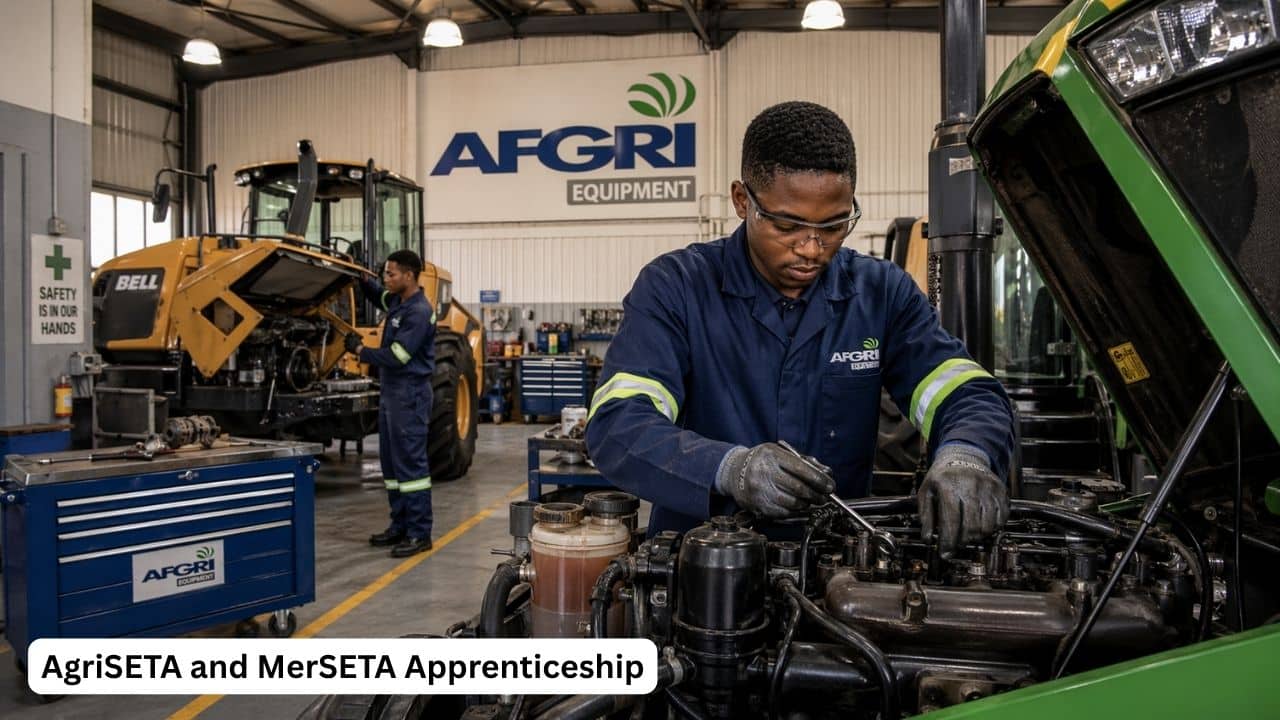
AFGRI Opens 40 AgriSETA and MerSETA Apprenticeship Opportunities for Future Mechanics
AFGRI has opened 40 AgriSETA and MerSETA apprenticeship opportunities for young South Africans who want to build a future in mechanical trades. With hands-on workshop exposure, structured training, and a path into tractor or earthmoving mechanics, this programme could be the breakthrough many asp...

Apply for AFGRI Apprenticeships 2026 (X40 Posts)
AFGRI Equipment invites South African unemployed youth to apply for the Apprenticeship Programme 2026. Apprenticeship Application Closing Date: 30 September 2026 Apprenticeship Locations: Multiple locations across South Africa About the AFGRI Apprenticeship Programme AFGRI Equipment is offering 4...
AFGRI Artisan Training Opportunities for Unemployed Youth 2026 (X40 Posts)
South Africa’s agricultural and earthmoving machinery sectors continue to face a shortage of qualified artisans. If you are interested in becoming a tractor mechanic or earthmoving mechanic, the AFGRI Equipment Artisan Training Opportunities offers one of the most practical and structured entry r...