Bursaries That Closed in January 2026 and What to Do Now

Every bursary that closed in January 2026 is now shut, and so are the February and March ones. Today is 28 October 2026, so these deadlines are useful in one way only: they show you when each provider tends to run its cycle, so you can be ready before the next one. Below you will find what closed in January, February and March 2026, what each bursary covered, who qualified, and how to build a calendar that stops you missing the next round.
TL;DR
- January 2026 closings included the Council for Geoscience full-time bursary (23 January) and the Tshipi e Ntle community bursary (30 January). Both are closed.
- February and March 2026 closings included university trust funds, a film and television postgraduate bursary, a corporate STEM bursary and a disability-related Compensation Fund bursary.
- Many providers repeat their cycle each year, so a closed 2026 deadline is a good guide to when to prepare for 2027. Always confirm the new date on the provider’s own page.
- Late-year and early-year bursaries are different: some corporate programs close mid-year for the following academic year, while trusts and university funds often close once the year has started.
- Apply only through official provider pages. A genuine bursary never asks you to pay to apply.
Table of Contents
- Why a closed deadline is still worth reading
- Bursaries that closed in January 2026
- Bursaries that closed in February 2026
- Bursaries that closed in March 2026
- At a glance: the 2026 closing dates
- What about April, May and June?
- Our view: how we would use a calendar of closed deadlines
- Build your own closing-date calendar
- Spotting a bursary that is worth your time
- Where to look next on BursaryZA
- FAQ
- Sources
Why a closed deadline is still worth reading
Searching for deadlines in a month that has passed is common, and it is a smart instinct. Funders rarely rebuild their calendar from scratch. A bursary that closed on 23 January this year is likely to open and close in a similar window next year, although dates and even the programs themselves can change. That is why we treat this list as a planning tool rather than a to-do list.
Two rules keep you safe when you use it:
- Treat last year’s date as a prompt to check, never as the date to apply by. Providers move deadlines, change criteria and sometimes pause a program.
- Go to the provider’s official page for the current call. If you find a bursary through an advert or a social media post, find the funder’s own site before you submit anything.
Bursaries that closed in January 2026
January is a short window. Most schools and universities are still settling into the year, but some funders use these weeks for in-year or late-intake calls.
Council for Geoscience full-time bursary (closed 23 January 2026)
The Council for Geoscience advertised its 2026 full-time bursary with a closing date of 23 January 2026. The package covered tuition, accommodation or transport, books, meals, field excursions and a laptop allowance. That is a wide package for a science-council bursary, and it reflects how field-based the geoscience degrees are.
If you study or plan to study earth sciences, geology or a related field, this is the type of program to keep on your radar. Fields that need fieldwork usually have funders who cover field costs, so look for “field excursions” in the benefits list when you compare offers.

Tshipi e Ntle Manganese Mining community bursary (closed 30 January 2026)
The Tshipi e Ntle Manganese Mining Community Bursary Scheme 2026 had an application deadline of 30 January 2026. It included tuition fees, accommodation, a laptop and prescribed books.
As the name says, this is a community scheme. Community bursaries are tied to the area around a mine, so where you live matters as much as your marks. Read the eligibility section of the advert first, because a strong application from outside the community area will not be considered.
Bursaries that closed in February 2026
February closings are mostly smaller, local or institution-based funds. They are easy to miss because they are not heavily advertised.
Athlone Institute Bursary Project Fund (closed 27 February 2026)
The Athlone Institute Bursary Project Fund (AIBPROF) closed on 27 February 2026. It targets residents of Paarl or Mbekweni, or parishioners of specific churches. This is a good example of a narrow, local fund: few applicants qualify, which can improve your odds if you are one of them.
Kovsie Alumni Trust Bursary Fund (closed 27 February 2026)
The Kovsie Alumni Trust Bursary Fund 2026 at the University of the Free State had a closing date of 27 February 2026 for semester 1 applicants. Note the semester detail. University funds often have separate dates for first and second semester, so a student who misses one window may still have another.
Bursaries that closed in March 2026
March brings a mix of national schemes and corporate programs aimed at students already at university.
Compensation Fund vocational rehabilitation bursary (encouraged by 31 March 2026)
The 2026 Compensation Fund Vocational Rehabilitation External Bursary Scheme is aimed at unemployed COID beneficiaries with permanent disablement, their dependants, and dependants of fatally injured employees. The applicant must have been accepted at a recognised TVET, CET or higher-education institution. The bursary covered tuition, prescribed study material, a monthly stipend and accommodation, and was renewable each year subject to funds and academic performance.
This one worked differently from the others. It stayed open throughout the 2026 academic year, and applications were encouraged by 31 March 2026. The Fund also advises that an application with no response within two months should be considered likely unsuccessful. If you applied to any funder and heard nothing, do not wait indefinitely: contact the provider through the details on its official page and ask for a status update, then move on to other options.
NFVF international bursary for film and television postgraduate study (closed 9 March 2026)
The NFVF international bursary closed on 9 March 2026 at 17:00 CAT. It was open to South African citizens or permanent residents with a good academic record and financial need, accepted or enrolled full time at an accredited overseas institution for postgraduate film or television study beginning in September or October 2026. The course had to be one not offered in South Africa, and acting and live-performance courses were excluded. The bursary was capped at R280,000, inclusive of tuition and living expenses.
The useful lesson is the start-date logic: the call closed around six months before the course began. If you are planning study abroad, work backwards from the intake date and add time for admission paperwork.

CCBSA bursary (closed 13 March 2026)
The CCBSA Bursary closed on 13 March 2026. Its stated requirements were:
- South African citizenship
- a strong matric and first-year academic record
- completion of first or second year and entry into second or third year in 2026
- registration at a South African university
- study preferably in listed STEM fields, with certain other degrees considered
Recipients received tuition, accommodation, meal allowances and textbooks, and had to be available for work at a CCBSA site during university vacations. That vacation-work condition is common in corporate bursaries. Check it before you accept, because it affects how you plan your holidays.
At a glance: the 2026 closing dates
| Bursary | Closing date (2026) | Who it was for | What it covered |
|---|---|---|---|
| Council for Geoscience full-time bursary | 23 January | Full-time geoscience students | Tuition, accommodation or transport, books, meals, field excursions, laptop allowance |
| Tshipi e Ntle community bursary | 30 January | Community applicants near the mine | Tuition, accommodation, laptop, prescribed books |
| Athlone Institute Bursary Project Fund | 27 February | Residents of Paarl or Mbekweni, or specific parishioners | See the provider page |
| Kovsie Alumni Trust Bursary Fund | 27 February | UFS semester 1 applicants | See the fund document |
| NFVF international film and TV bursary | 9 March | Postgraduates studying abroad | Up to R280,000 including tuition and living costs |
| CCBSA Bursary | 13 March | Second- and third-year university students, mainly STEM | Tuition, accommodation, meals, textbooks |
| Compensation Fund vocational rehabilitation bursary | Encouraged by 31 March | Eligible COID beneficiaries and dependants | Tuition, study material, stipend, accommodation |
What about April, May and June?
We have not listed specific April, May or June 2026 bursaries here, because we only want to show deadlines we can point to on the provider’s own page. Searches for those months tend to turn up a mix of reopened calls, rolling programs and old adverts. The safest approach is to check each funder directly and to look at our own listings, which show the closing date, eligibility checklist and application link for each opportunity.
One structural point holds for the rest of the year. Many corporate and public-sector bursaries for the following academic year close in the second half of the year, and the pages that currently rank for this topic are already organised around the 2027 intake. If you are reading this in late October, the practical question is no longer what closed in January, but what is still open for 2027 and what will open in early 2027. Our page on bursaries still open in South Africa is where to start.
Our view: how we would use a calendar of closed deadlines
We built BursaryZA because students were losing opportunities to missed dates and unclear requirements, not to a lack of effort. From what we see across listings, three habits separate applicants who get funded from those who do not.
First, they plan backwards. A bursary that closes in January for a course starting in the same year gives you very little time to gather an academic record, ID copies, proof of income and motivation letters. Start collecting those documents in the previous year, and keep them in one folder.
Second, they apply widely and to a shortlist they have actually read. A single application to a famous program is a weak plan. Five to eight carefully matched applications are much stronger. Our guide to 2027 bursaries for matriculants explains how to build that shortlist of three to five that fit you.
Third, they separate the types of funder. Corporate bursaries often want a specific field and work during vacations. Community schemes want you to live in a specific area. University trusts follow the semester calendar. Public-sector and fund-based programs may be rolling. Knowing which type you are looking at tells you when to expect the call.
We do not charge fees and we do not collect applications. Every listing links to the official application page so you apply directly with the funder. Our key-dates overview, When Are Bursaries Closing?, shows how those windows fall across the year.
— Nkosi
Build your own closing-date calendar
A simple calendar will do more for you than any list. Here is how to set one up in about an hour.
- List your fields and level. Write down your intended field, your study level (first year, continuing, postgraduate) and your province. These three filters remove most of the noise.
- Collect last year’s dates. Use the 2026 dates above as a rough guide to when each program ran. Mark them as “expected window”, not as deadlines.
- Confirm each current date. Open the provider’s official page and write down the current closing date, the documents needed and the application method.
- Set two reminders per bursary. One reminder is for four weeks before the deadline, to gather documents. The second is for one week before, to submit. Do not wait for the last day, because online portals slow down or fail when many people apply at once.
- Track outcomes. Note the date you applied and, if the funder gives a response time, when to follow up. The Compensation Fund’s two-month guidance is an example of the kind of timeline to record.
Documents to have ready
Most applications ask for the same core items. Keep scanned, readable copies of:
- your ID document
- your latest academic results (matric or university transcripts)
- proof of household income, where the bursary is need-based
- proof of registration or an acceptance letter from the institution
- a motivation letter you can adapt for each funder
If you are headed to a TVET college, read our explainer on TVET bursary requirements before you apply, since the income rules and documents differ from university funding.
Spotting a bursary that is worth your time
A closed deadline is also a chance to learn what a good call looks like. Before you invest an evening in an application, check for these signs:
- A named funder and a contact route. You should be able to see who is paying and how to reach them.
- Clear eligibility. Citizenship, academic average, field, year of study and any residence requirement should be stated, as they were in the CCBSA and Athlone examples above.
- A stated list of benefits. Tuition, accommodation, books, meals, laptop or stipend should be named. The Council for Geoscience advert is a good model.
- Any work-back or vacation-work condition, stated up front.
- No fee to apply. If someone asks you to pay to be considered, walk away.
Where to look next on BursaryZA
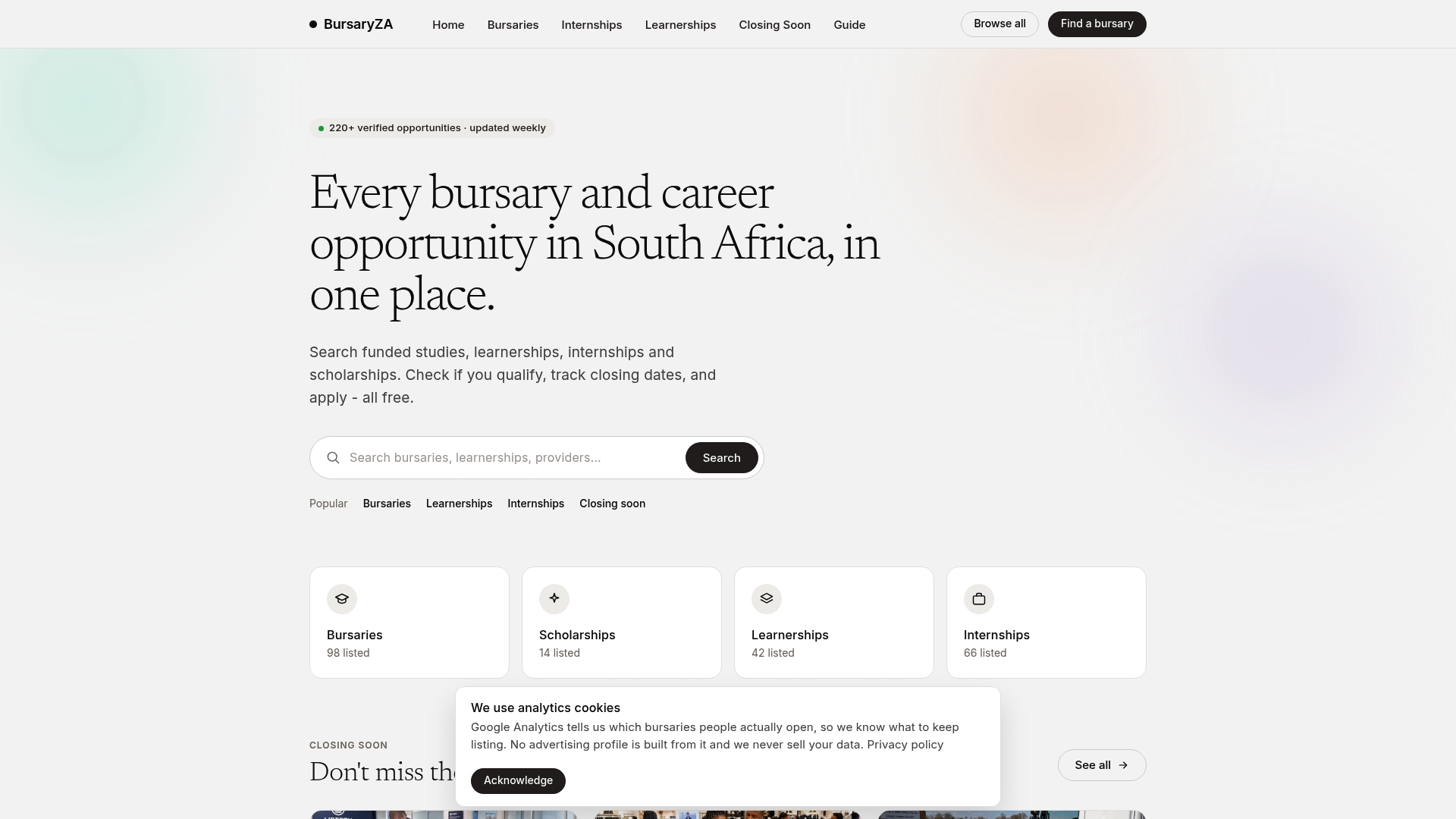
If you want to see what is open right now, our searchable database of verified bursaries, scholarships, internships and learnerships lets you filter by field, study level and location. Each listing shows the eligibility checklist, closing date, provider details and a direct link to the official application page. You can start on our home page, or browse by region, such as bursaries and opportunities in North West.
If you are looking for work experience rather than study funding, our page on internships closing on 31 October 2026 shows what is nearest to its deadline.
FAQ
Can I still apply for a bursary that closed in January 2026?
No, those calls are closed and the funders will not normally accept late applications. The best use of the date is to note the likely window for next year and watch the provider’s official page. The Compensation Fund bursary was an exception in 2026 because it stayed open through the academic year, but its applicants were still encouraged to apply by 31 March.
Will the same bursaries open again in January 2027?
Many funders run an annual cycle, but there is no guarantee that the dates, criteria or even the program will stay the same. Use the 2026 dates as a guide to when to start preparing, then confirm the current call on the funder’s own page before you apply.
How do I find out whether my application was successful?
Check the provider’s stated response time and contact them through the details on their official page. The Compensation Fund, for example, advises that an application with no response within two months should be considered likely unsuccessful. If a funder gives no timeline, a polite follow-up after a few weeks is reasonable.
Do I need to pay to apply for a bursary?
No. Genuine bursary providers do not charge an application fee, and neither do we. Every BursaryZA listing links to the official application page so you apply directly with the funder.
What should I do if I missed every 2026 deadline?
Shift your focus to the 2027 cycle and to programs with rolling or later windows. Shortlist funders that fit your field and level, prepare your documents now and set reminders for each opening. Our list of bursaries still open is the quickest place to begin.
Sources
- Council for Geoscience 2026 full-time bursary advert
- Tshipi e Ntle Manganese Mining Community Bursary 2026
- Athlone Institute Bursary Project Fund
- Kovsie Alumni Trust Bursary Fund 2026
- 2026 Compensation Fund Vocational Rehabilitation External Bursary Scheme
- NFVF international bursary for film and television postgraduate studies 2026
- CCBSA Bursary application