Shortlist 3 to 5 Now: 2027 Bursaries for Matriculants in South Africa

Yes, 2027 bursaries are open to matriculants right now, but deadlines move fast and some have already passed. Start today: check verified listings like BursaryZA for closing dates, apply to NSFAS if you qualify, and then target two or three field-specific bursaries that match your marks and household income.
TL;DR:
- Most bursaries close between August and September 2026, so applicants need to plan and prepare their documents at least two months in advance.
- NSFAS is the primary option for lower-income students needing broad coverage without a work-back obligation, while corporate bursaries often require a commitment to work for the funder post-graduation.
- Applicants must verify the legitimacy of bursary listings by checking for direct links, clear closing dates, and verifiable contact information before applying.
- Maintaining a detailed application process, including tailored motivation letters and early referee contacts, significantly improves chances of success.
- Using verified online platforms with filtered eligibility checklists and direct application links helps narrow options and manage deadlines effectively.
Table of Contents
- Where to Find Verified 2027 Bursary Openings
- Bursary Categories: What Each One Actually Covers
- Do You Qualify? The Eligibility Checklist
- Documents You Need Before You Start Applying
- When 2027 Bursaries Open and Close: Plan Backward
- How to Apply Effectively: A Step-by-Step Approach
- Common Mistakes That Get Applications Rejected
- A Final Word on Prioritizing Your Applications
- Track Every Bursary Deadline Without the Spreadsheet Chaos
- Sources
Where to Find Verified 2027 Bursary Openings
Skip the group chats and screenshots. Go straight to the source: official funder pages, university financial aid offices, and a verified listings platform that links directly to the application. The South African Reserve Bank, for instance, publishes its own external bursary application form as a downloadable PDF, not a third-party summary. That is the version you should be filling in.
A reliable search routine narrows thousands of listings into a shortlist you can actually manage in a weekend. Filter by your intended field of study, your province, and closing date, in that order. If you are set on IT or computer science, browse field-specific listings instead of scrolling generic bursary roundups that mix in postgraduate or bridging-year funding you don’t qualify for yet.
Before you invest an evening writing a motivation letter, confirm the listing is real. A trustworthy bursary listing gives you:
- A direct link to the funder’s own application page or PDF form, not a redirect through three other sites
- An explicit closing date, not “applications open” with no end point
- Verifiable contact details on the funder’s own domain
- Clear eligibility terms stated in plain language, not vague promises of “full funding for all”
Some of the biggest 2027 windows have already closed or are closing within weeks of each other. The Ninety One bursary scheme shut its doors on August 31, 2026, and the SARB scheme closes September 30, 2026. That’s a one-month gap between two major funders, which is exactly why checking dates weekly instead of “eventually” matters more than most matriculants realize. A funder that closed in August isn’t gone forever, but it won’t reopen for the 2027 intake once the date passes.
Bursary Categories: What Each One Actually Covers
Not all bursaries work the same way, and treating them as interchangeable is where a lot of matriculants waste applications.
NSFAS is the government’s main financial aid scheme and suits students from households below its income threshold who need tuition, accommodation, and living allowances covered without a work-back obligation tied to a specific employer. It’s the right first stop for most matriculants from lower-income households, and understanding exactly who qualifies before you apply saves you from submitting an application that gets rejected on income grounds alone.
Corporate bursaries dominate fields like engineering, IT, and accounting, and they almost always come with a work-back clause: you study on the company’s funding, then work for them for a set number of years after graduating. The Sasol Foundation’s 2027 bursary illustrates the scale some of these reach, covering the full cost of undergraduate study for households earning up to R800,000 a year, a threshold well above what most students assume corporate bursaries allow.
Government departments and research councils fund specific national priorities, often in health sciences, agriculture, or the sciences, and they tend to have narrower, more technical eligibility rules tied to policy goals rather than pure financial need.
University and trust bursaries carry their own logic entirely. Some require you to already be registered at a partner institution; others are tied to a specific faculty or even a named donor’s field of interest. Match your category to your own profile first. A student aiming for medicine and coming from a middle-income household should be looking at health sciences bursaries and university-specific funds before assuming NSFAS is the only door open to them.
Do You Qualify? The Eligibility Checklist
Most national bursaries in South Africa require you to be a South African citizen, and many exclude permanent residents entirely, so confirm this on the funder’s own page before you spend hours on an application.
Household income bands differ sharply between funders, so treat any “universal cutoff” you hear as a myth. Sasol Foundation’s 2027 undergraduate program considered households earning up to R800,000, while other trusts cap eligibility far lower, closer to R350,000 or R400,000. The Allan Gray Orbis Fellowship adds a different layer entirely: it sets firm academic minimums and age limits, then varies its financial coverage according to household income band rather than applying one flat award to everyone who qualifies.
Beyond citizenship, marks, and income, watch for the qualifiers that quietly disqualify strong applicants: many bursaries require you to be a first-time undergraduate with no prior degree, some reserve a quota of places for a specific province, and a portion are locked to students who will attend a named partner university only.
Documents You Need Before You Start Applying
Nothing kills a strong application faster than an uncertified ID copy submitted the night before a deadline. Get your paperwork sorted before you write a single motivation letter, because most of it takes days to arrange, not minutes.
Your core document set should include:
- Certified copy of your ID (certified at a police station or by a commissioner of oaths, not just photocopied)
- Your latest available results: June exam results if final matric results aren’t out yet, or your final results once they are
- Proof of household income: recent payslips for employed parents or guardians, or a sworn affidavit if a parent is unemployed or informally employed
- Proof of acceptance or a conditional offer letter from the institution you plan to attend
- A signed motivation letter, tailored to the specific funder documentation process
Field-specific extras catch people off guard. Arts and design bursaries often want a portfolio; some university-linked funds want a full academic transcript rather than a results printout. The SARB’s own 2027 application form is explicit about this level of detail, demanding a certified ID, your latest matric results, proof of acceptance, and a 250-word motivation, with a hard rule that incomplete forms won’t be considered at all. Scan and save every document the moment it’s certified, and check the certification date hasn’t expired before you submit.
When 2027 Bursaries Open and Close: Plan Backward
Most funders open applications for the 2027 intake between March and June, then close them well before the academic year even starts, often in August or September of 2026. That gap catches matriculants off guard every year: they assume “2027 funding” means they have until 2027 to apply, when the real window closes months earlier.
Some deadlines leave zero room for error. Guides on applying for South African bursaries consistently flag that late or incomplete submissions get rejected outright, no exceptions, no late grace period.
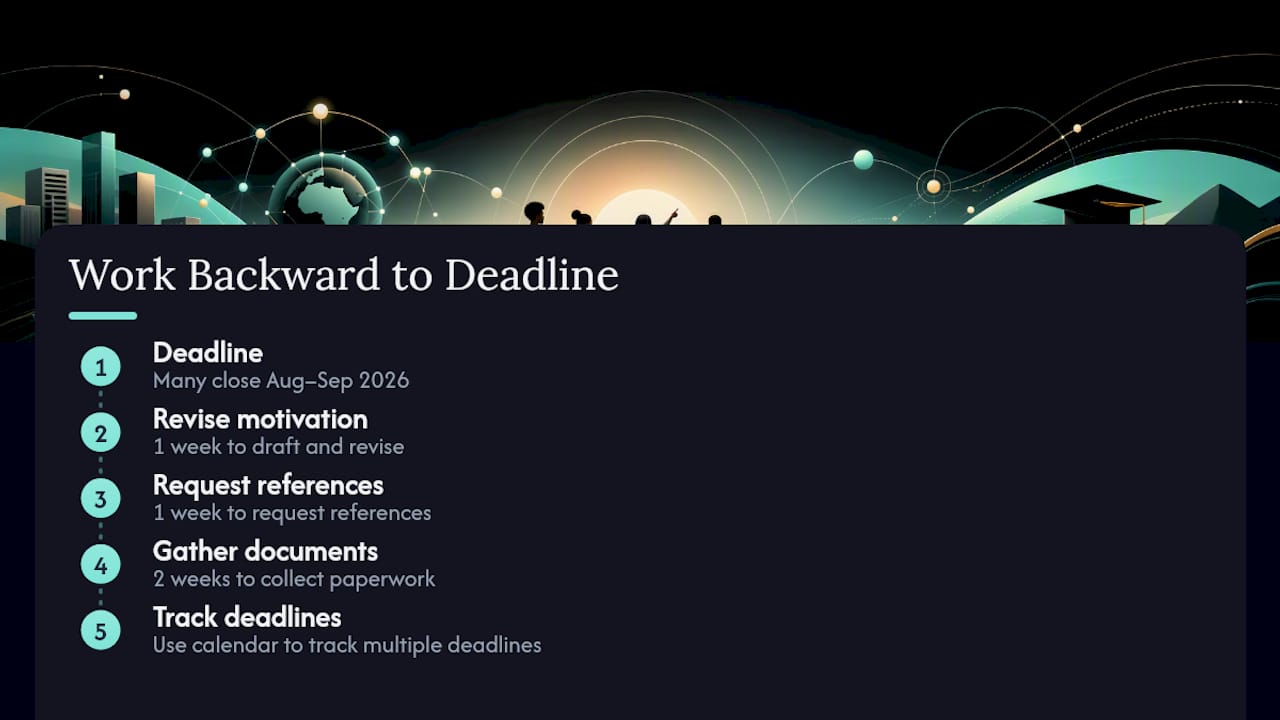
Work backward from your target closing date. Give yourself two weeks to gather documents, one week to request references, and another week to draft and revise your motivation letter before the deadline, not on it. A bursary application calendar that tracks multiple closing dates side by side keeps you from discovering, three days too late, that the fund you wanted most closed while you were finishing paperwork for a different one.
How to Apply Effectively: A Step-by-Step Approach
A strong application isn’t about applying to everything. It’s about applying well to the handful of bursaries where you genuinely fit.
- Shortlist ruthlessly. Cross off any bursary where you don’t meet the citizenship, income, or academic requirement. Rank what’s left by closing date first, fit second.
- Structure your motivation letter around fit, not just need. Open with a direct statement of what you want to study and why. Follow with concrete evidence of academic and career fit, then your financial circumstances, then a clear closing ask. Funders assess letters on how clearly your study plan aligns with their goals, and well-structured letters consistently outperform ones built purely around hardship.
- Lock in referees early. Ask a teacher or principal at least three weeks before your deadline, and hand them a one-page summary of your achievements so their letter references specifics instead of generic praise.
- Assemble your files the way the funder wants them. Name PDFs clearly (Surname_ID_MatricResults, for example), check file size limits, and keep a simple log noting what you submitted, when, and to whom.
- Follow up and prepare for the next stage. Some funders, including several administered by third-party managers like StudyTrust, move successful applicants into interviews or written assessments after the initial submission.
Pro Tip: Skip the generic “I come from a poor background and want to succeed” opening. Funders read hundreds of those. Instead, open with a specific result, like a subject average, a project you led, or a competition you entered, then connect it directly to why their field of funding makes sense for you.
Common Mistakes That Get Applications Rejected
Most rejections have nothing to do with talent. Missing certified documents, submitting after the deadline, and sending the same generic letter to five different funders are the top three reasons strong students get turned down.
Scams are a real risk too, and they follow a pattern:
- Any request for payment to “process” your application is an automatic red flag
- Contact addresses using free webmail domains instead of the funder’s official domain deserve suspicion
- Poor grammar, urgent pressure tactics, or promises of guaranteed funding “for everyone” are classic warning signs
Confirm any unfamiliar bursary directly through the funder’s own website or a listed phone number before submitting anything. Never pay a fee to apply, and keep scanned copies of every document and email you send.
A Final Word on Prioritizing Your Applications
Matriculants tend to make one of two mistakes: they apply to a single bursary and pin all their hopes on it, or they apply to twenty and put real effort into none. Neither works. Apply to NSFAS first if your household income qualifies you, since it carries no work-back obligation and covers the widest range of study fields. Then choose two or three bursaries in your actual intended field, ones where your marks and income genuinely fit the criteria, and give each one a properly tailored letter.
Start pulling together your certified documents and contacting referees this week, not the week before a deadline. Verified listings and a working calendar of closing dates do more to protect your chances than any single well-written letter, because a brilliant application submitted late gets rejected exactly as fast as a weak one.
— Nkosi
Track Every Bursary Deadline Without the Spreadsheet Chaos
A verified listings platform offers real closing dates, eligibility checklists built into every entry, and results filtered by province and field so you’re not scrolling past bursaries you don’t qualify for.
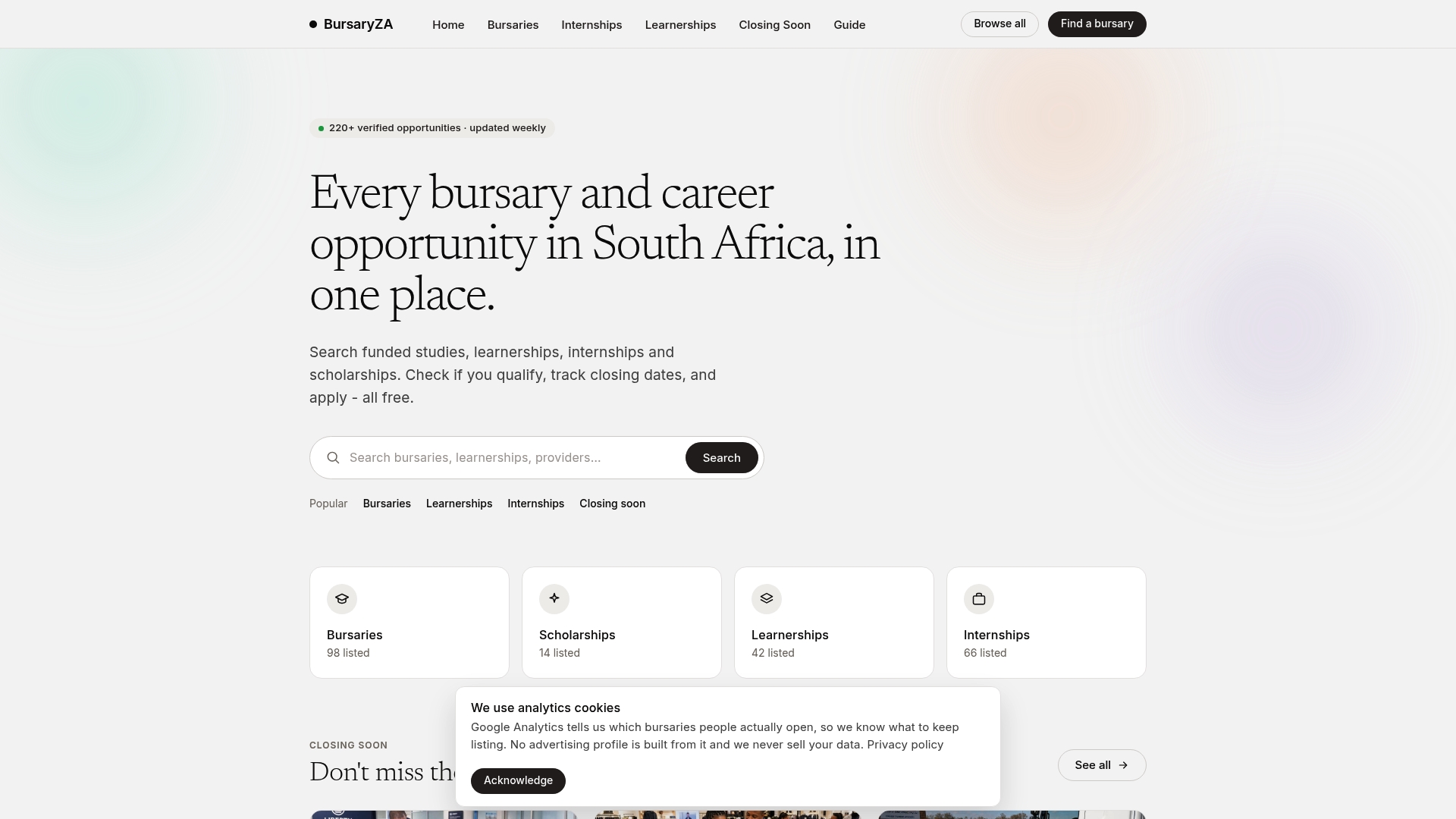
Every listing on the platform links straight to the funder’s own application page, so you’re never guessing whether a bursary is legitimate or three years out of date. Search by field, whether that’s engineering, accounting and finance, or education, narrow by your province, and save the handful that actually match your marks and household income. Pair that with the bursary application calendar to keep every closing date in one place instead of five different tabs.
Head to the full 2027 bursary listings now, shortlist three to five opportunities that fit your profile, and start collecting your certified documents this week.
Sources
- South African Reserve Bank external bursary application 2027 (PDF)
- South African Reserve Bank external bursary scheme (2027) - University of Pretoria funding page
- How to apply for a bursary in South Africa: Step-by-step guide - Jobs in South Africa
- Allan Gray Orbis Fellowship Bursaries 2027: Eligibility, Benefits & Application Guide - South Africa Portal