R350,000 Cutoff: TVET Bursary Requirements for SA Students (2026)

You qualify for the NSFAS TVET bursary if you’re a South African citizen or permanent resident, registered or planning to register for an approved PLP, NC(V), or Report 191 program at a public TVET college, and your household earns within the income thresholds set by NSFAS (R350,000 or less annually, or a higher threshold for students with disabilities). SASSA grant recipients automatically clear the income bar. NSFAS decides your funding; your college decides your allowances, so apply on the NSFAS portal and confirm your status with the bursary office the moment you register.
TL;DR:
- Eligibility depends on valid South African ID or permanent residency, registered or planning to register at a public TVET college, with household income at or below R350,000 annually or R600,000 for students with disabilities.
- NSFAS fully covers tuition and registration fees, but allowances for accommodation, transport, and personal care are limited by program-specific caps and may be reduced if you receive other bursaries.
- Students must pass at least 70% of modules to maintain funding, with progression thresholds varying by qualification type, and funding duration typically extends one term beyond the standard course length.
- Application success relies heavily on certified documents, timely submission, and adherence to college-specific enrollment caps; incomplete or expired paperwork often causes rejections.
- Using verified platforms like BursaryZA streamlines the search for open bursaries, as they cross-check eligibility criteria and provide direct application links to avoid missed opportunities.
Table of Contents
- TVET Bursary Requirements: The Full Eligibility Checklist
- What the TVET Bursary Actually Pays For
- Academic Rules That Keep Your Funding Alive
- Documents You Need Before You Apply
- How to Apply for a TVET Bursary and When
- Why TVET Bursary Applications Get Rejected
- What BursaryZA Sees in TVET Bursary Applications
- Find Verified TVET Bursaries Faster
- Where to Verify TVET Bursary Rules Yourself
- Sources
TVET Bursary Requirements: The Full Eligibility Checklist
The rules sound simple until you hit the fine print. Here’s what actually gets checked before NSFAS approves a cent.
- Citizenship or residency: You need a valid South African ID or permanent residency document. Private colleges don’t qualify, only public TVET institutions do.
- Program type: You must be registered, or intending to register, for a Programme Level Programme (PLP), NC(V), or Report 191 qualification
- Income threshold: Combined gross household income must sit at or below R350,000 annually, or R600,000 if you live with a disability.
- SASSA exemption: If your household already receives a SASSA grant, you’re automatically treated as financially eligible, no extra income proof needed.
- Exclusions: You can’t apply if you’ve already completed a state-funded qualification at the same level, hold a completed degree, or are receiving duplicate government funding for the same course.
Meeting every box above doesn’t guarantee a funded seat. Each college works from a DHET-approved enrollment plan that caps how many bursary slots exist per program, so eligibility and actual placement are two different hurdles.
What the TVET Bursary Actually Pays For

NSFAS covers your tuition and registration fees in full once you’re approved, but the allowances are where most students underestimate the fine print.
Standard allowance caps (per annum):
- Accommodation: R24,000 in urban areas, R18,900 peri-urban, R15,750 rural
- Transport: roughly R7,000 to R7,350 for students living within 40 km of campus
- Personal care and incidentals: about R2,900
- Learning materials: a separate allocation set by your college
Pro Tip: Occupational programs sometimes only qualify for tuition coverage, no accommodation or transport allowance, so check your specific program’s funding category before budgeting around the full package.
One detail that trips people up: if you’re also receiving a partial bursary from another source, NSFAS reduces its own payout to match, rather than stacking the two.
Academic Rules That Keep Your Funding Alive
NSFAS isn’t a loan you repay with interest. It’s contingent funding, and the price of staying funded is performance, not payments.
- Pass rate benchmark: Returning TVET students must pass 70% of enrolled modules in the academic year to keep funding for the next one.
- NC(V) progression: You need to pass at least 5 subjects to move up a level.
- Report 191 progression: The minimum drops to 3 subjects passed.
- The N+ rule: NSFAS funds your qualification for its standard duration plus one extra term. A 3-year qualification typically gets 4 funded terms total, then funding stops even if you’re one module short of finishing.
Pro Tip: Check your specific college’s progression policy alongside the national NSFAS minimums. Some colleges set stricter internal pass requirements, and those override the national floor if they’re higher.
Documents You Need Before You Apply
Certified copies matter more than people realize, an uncertified ID or an expired payslip is enough to stall your whole application.
- Your ID and certified copies of your parent, guardian, or spouse’s ID
- Proof of income: payslips no older than 3 months, IRP5 forms, or pension slips
- A SASSA letter or pension slip, if that’s how you qualify financially
- Death certificates or a sworn affidavit if you’re applying as an orphaned student
- A signed NSFAS consent form authorizing income verification
- Disability Annexure A form, if applicable, plus a Vulnerable Child form where relevant
- A current, certified rental agreement or proof of residence, needed specifically if you’re claiming the accommodation allowance
The NSFAS 2026 bursary guidelines spell out exactly which forms apply to which circumstances, worth a direct read if your situation is anything but straightforward. You can also work through the full NSFAS eligibility breakdown for a longer explanation of how the funding split works.
How to Apply for a TVET Bursary and When
The process runs on two tracks: NSFAS handles your funding decision, and your college handles your allowances. Miss either step, and you can end up funded on paper but broke in practice.
- Apply on the NSFAS portal first and submit consent for income verification. This is the step that determines whether you’re funded at all.
- Apply for allowances at your college’s bursary office during registration. Tuition comes from NSFAS; accommodation, transport, and personal care allowances are administered locally.
- Apply early. DHET-approved enrollment plans cap the number of funded slots per program, and colleges fill them on a rolling basis, not by application deadline alone.
- Track your status through the NSFAS portal and by following up directly with the bursary office, don’t assume silence means approval.
- If your application stalls or gets rejected, request a written reason, correct the specific gap, and resubmit rather than starting over blind.
Colleges like False Bay TVET College publish their own submission checklists alongside the national process, a useful sanity check if your college’s site has one. For a broader view of deadlines across the year, the bursary application calendar is worth bookmarking.
Why TVET Bursary Applications Get Rejected
Most rejections aren’t about eligibility at all, they’re about paperwork and timing.
- Incomplete or uncertified documents, especially expired payslips or unsigned consent forms
- Falling below the academic progression benchmarks after your first funded year
- Undisclosed duplicate funding from another bursary or scholarship covering the same course
- Applying late enough that your college’s funded slots for that program are already full
Pro Tip: Keep a digital backup of every certified document the day you submit it. If NSFAS or your college requests a resubmission, you’ll have it ready instead of queuing for new certifications.
Verified listings and eligibility checklists, the kind BursaryZA builds for every funding opportunity, exist precisely because so many rejections trace back to avoidable formatting errors rather than genuine ineligibility.
What BursaryZA Sees in TVET Bursary Applications
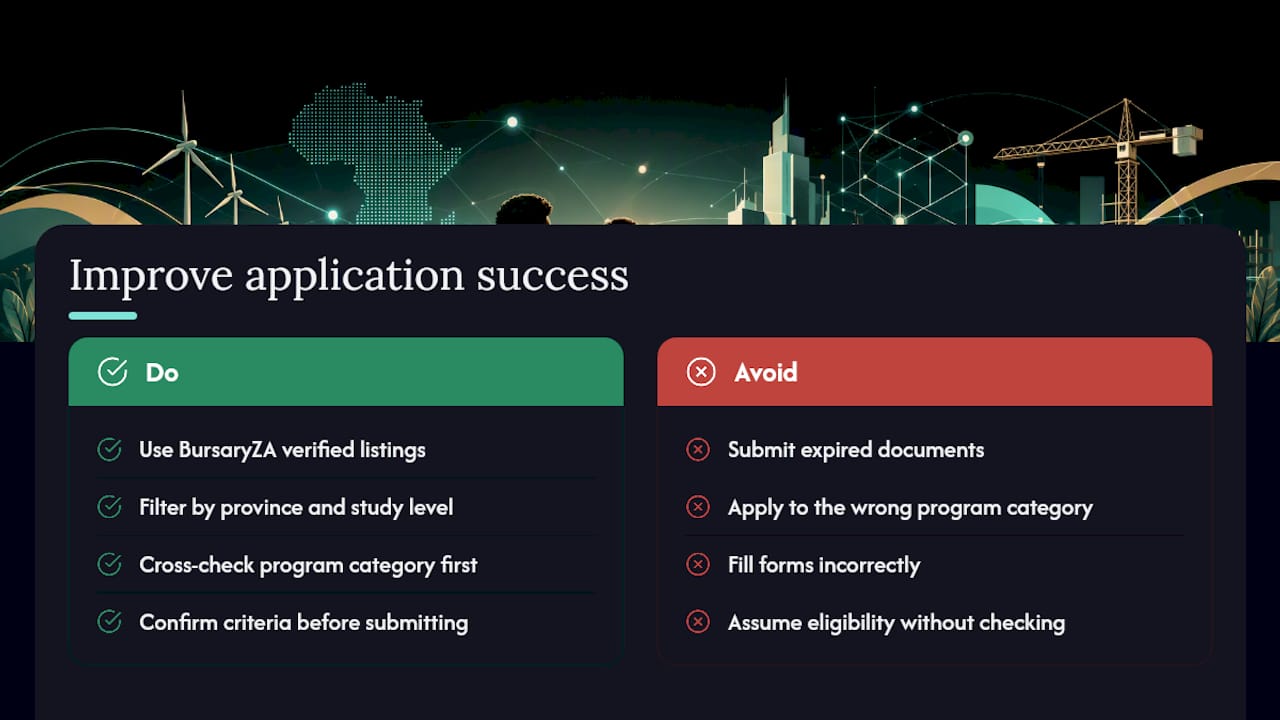
Most funding gaps aren’t about eligibility. They’re about a form filled out wrong, a document that expired between submission and review, or a student who applied to the wrong program category. BursaryZA’s verification process cross-checks each bursary listing against its actual published criteria before it goes live, which is a smaller thing than it sounds but catches a surprising number of the mistakes that sink applications.
If you’re weighing multiple TVET programs, filtering by province and study level on the platform shows which bursaries are still open and which criteria genuinely apply to your situation.
— Nkosi
Find Verified TVET Bursaries Faster
Chasing down funding one college website at a time wastes weeks you don’t have when slots fill on a rolling basis. BursaryZA is the alternative to that scramble: every listing on the platform carries a verified eligibility checklist and a direct application link, so you’re not guessing whether a bursary is still open or reading outdated criteria on a college PDF from two years ago.
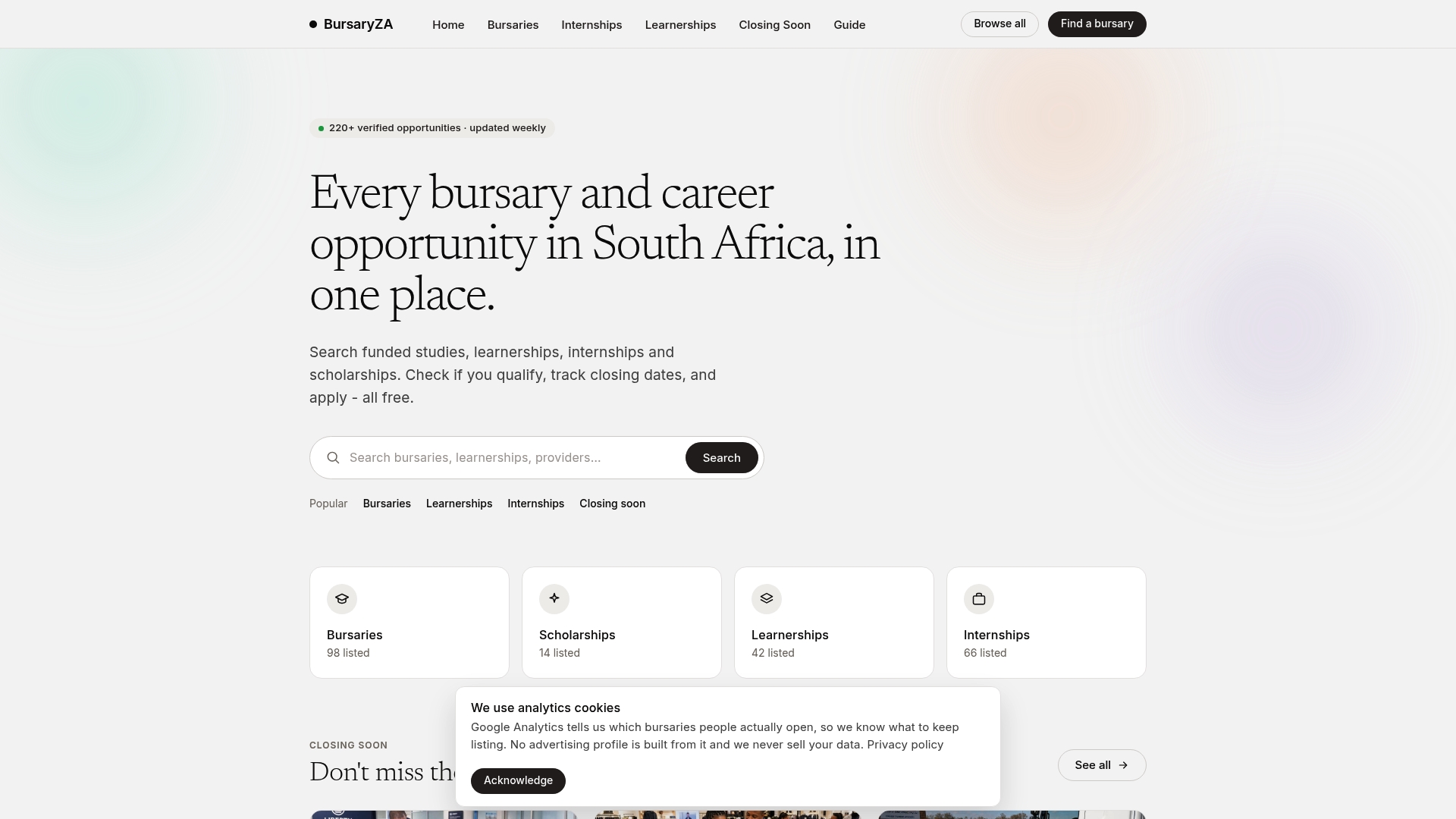
Filter by province, study level, or field to see which TVET-specific bursaries match your situation right now, from Gauteng to the Eastern Cape. Every listing is checked against its official source before publication, so what you see is what’s actually funded this cycle. Start with the full bursary listings and narrow down to the programs that fit your college and your province.
Where to Verify TVET Bursary Rules Yourself
- NSFAS bursary scheme page for allowance caps and coverage details
- NSFAS 2026 guidelines PDF for exact conditions and documents
- Your college’s bursary office for slot confirmations and allowance decisions
This article is general information, not a substitute for advice from a qualified financial advisor. Consult a qualified financial professional about your own circumstances before acting on anything here.
Sources
- NSFAS — The DHET bursary scheme (official page)
- NSFAS 2026 bursary guidelines (Annexure A)
- UNISA student funding: NSFAS loans and bursaries