Journalism Internships in South Africa: Where to Apply

Journalism internships in South Africa come from three places: private media houses, government communication programmes and fellowships linked to journalism schools. Most ask for a degree (not always in journalism), strong English writing and a portfolio of published or sample work. Pay ranges from a modest stipend to a salary for a fixed term. Below you will see what each route involves, what the published figures say, which journalism bursaries fund the study that comes before an internship, and how to handle the interview.
TL;DR
- Media houses such as Broad Media run paid, fixed-term newsroom internships. Their listing asks for excellent English writing and a degree that need not be in journalism.
- Government departments also advertise communication and journalism internships. The Mpumalanga 2026/27 programme pays R8,174.75 per month for 24 months, and applicants must be unemployed South African citizens.
- If you are still studying, journalism bursaries and scholarships exist, including a R170,000 Afrikaans-language bursary and full scholarships at Rhodes University.
- Prepare for the interview with a short portfolio, three or four stories you can talk through, and research on the publication’s audience and recent work.
- Always apply through the official page of the employer, never through anyone who asks you to pay.
Table of Contents
- What a journalism internship involves
- Who qualifies
- Types of programmes to look for
- Journalism bursaries and scholarships
- How to find and verify real opportunities
- Preparing for the interview
- Building a portfolio that gets you shortlisted
- Perspective
- Find your next opportunity
- Timing your applications through the year
- FAQ
- Sources
What a journalism internship involves
A newsroom internship is a working placement, not a shadowing programme. At Broad Media, the journalism internship trains you in covering news, producing articles and features, and sub-editing. It is a full-time, paid position for three months, based at the company’s offices in Centurion, according to the listing that appears in search results.
Expect a mix of tasks across a typical placement:
- Newsgathering: following up press releases, calling sources, attending briefings or court and council meetings.
- Writing: short news items first, then features and explainers once the editor trusts your copy.
- Sub-editing: checking facts, trimming copy, writing headlines and captions, and following a house style.
- Digital work: posting to websites, newsletters and social channels, and learning the content system.
- Events and video: at some outlets you will cover or help produce live events, audio or short video.
The mix depends on the outlet. A large daily gives you structure and an editor on a deadline. A small digital title often gives you more bylines and more responsibility sooner. Both are valid starts. What matters is that you leave with published clips you can show.
Who qualifies
Requirements differ by employer, but the pattern is consistent.
Education. The Broad Media listing asks for a degree, and says it need not be in journalism. If you studied law, politics, science or economics, you can still apply, and your subject knowledge can be an advantage when a newsroom needs someone who can read a budget or a research paper.
Writing. The same listing asks for excellent English writing ability. Editors usually test this directly, with a short writing exercise or by asking for published clips.
Citizenship and work history. Government programmes are stricter. The Mpumalanga Department of Economic Development and Tourism’s 2026/27 Graduate Internship Programme notice says applicants must be unemployed South African citizens. They must also never have taken part in an internship programme in a national or provincial government department or state institution. If you have already done a government internship, check the rules before you apply.
Experience. Most entry-level programmes do not expect newsroom experience, but they do expect evidence of interest: a student newspaper, a campus radio slot, a blog, volunteer reporting or freelance pieces.

Types of programmes to look for
Private media houses
These are advertised on the employer’s careers page and on job boards. Terms are usually short (often around three months), full-time and paid. Competition is high because the number of places is small, so apply early in the cycle and tailor each application to the title.
Government communication and journalism posts
Provincial and national departments hire graduates into communication posts that involve writing, media liaison and content. The Mpumalanga programme is a clear example: it runs for 24 months, and the Communication/Journalism post pays R8,174.75 per month, according to the published notice. This is a different job from newsroom reporting, closer to government communication, but it builds writing, media relations and social media skills. It also gives you a stable income while you build clips elsewhere.
Government applications follow strict formats. Read our guide to Z83 rules and government internships before you submit, because incomplete forms and missing certified documents are a common reason for rejection.
Science, fellowship and sector-specific programmes
Some departments and agencies run programmes for unemployed journalism and communications graduates, including science journalism placements that give workplace exposure. Fellowships also matter in the wider industry: the South African National Editors’ Forum (SANEF) has written about the importance of fellowships to train young journalists. Check the careers pages of research councils, state agencies and universities, as well as the newsrooms themselves.
Freelance and self-started routes
SANEF’s 2024 report on freelance journalists quotes Sarah Chiumbu’s view that most South African journalism schools struggle to prepare graduates for freelance work, leaving them trained mainly for traditional newsrooms. The practical lesson: while you wait for an internship, learn to pitch, invoice and manage your own time, and publish where you can.
Journalism bursaries and scholarships
If you have not finished your qualification, funding for the study itself can lead straight into newsroom work. Three published examples show the range.
| Funding | What it covers | Who it suits |
|---|---|---|
| Netwerk24 bursary | One bursary of R170,000 for a final-year student completing a bachelor’s degree or diploma in 2026 or 2027 | Students who will commit to working in Afrikaans |
| Canon Collins Mail and Guardian Scholarship | Contribution toward a Master’s in journalism, communications or media studies at a South African university, with a 12-month paid Mail & Guardian reporter internship listed for 2024 | Postgraduate students |
| SARB CEJ Scholarship at Rhodes University | Full scholarships for journalism and economics journalism degrees, covering course costs, residence accommodation and meals during term, and a living stipend | Students aiming at economics and business reporting |
The Netwerk24 application asks for a 500-word motivation, a CV, your latest academic information, a one-minute video, and the name of your institution and programme. Funders rarely repeat identical terms every year, so treat the figures above as what was published, and confirm the current intake on each funder’s page.
When you shortlist funding, read the eligibility checklist before you write a word. A bursary that requires a language commitment, a postgraduate level or a specific university will not suit every applicant, and an application that ignores a stated condition is usually discarded.
How to find and verify real opportunities
Internship season attracts scams. Use these checks before you hand over a document.
- Go to the source. Find the advert on the employer’s own site or on the official government vacancy circular, not on a forwarded screenshot.
- Never pay. Legitimate internships, bursaries and learnerships do not charge application or placement fees.
- Check the closing date and the documents. Government posts typically need a completed Z83 form, a CV and certified copies. Missing items disqualify you.
- Match the email domain. Applications should go to an official address, not a free webmail account.
- Save the advert. Keep a copy of the listing and the date you applied, so you can quote the reference number in follow-ups.
Our database is built around these checks: each listing shows eligibility, closing dates, document needs and a link to the official application page. For wider options beyond media, see where to find graduate internships in South Africa.
Preparing for the interview
The interview questions you will face are similar whether the opportunity is a bursary, a learnership or a newsroom internship. The panel wants to know who you are, why you want this, and whether you will finish what you start.
Before the day
- Reread the advert and match each requirement to an example from your life.
- Research the funder or title: its audience, recent big stories or projects, and its values.
- Gather your documents in one folder, with originals and copies.
- Practise aloud, with a friend or in front of a mirror, and keep each answer under two minutes.
Questions that come up often
Bursary and learnership panels commonly ask about your background, motivation and plans. Typical examples:
- Tell us about yourself. Give a short story: where you study, what you have done, where you are heading. Keep it to education, skills and goals.
- Why this field? For journalism, name a specific story, reporter or event that made you want to do this work, and what you did about it.
- Why this bursary, internship or learnership? Show that you know the sponsor and the programme. Generic answers sound like mass applications.
- What are your strengths and weaknesses? Choose a real weakness and describe what you are doing about it.
- Describe a challenge you handled. Use a simple order: the problem, what you did, what you learned.
- Where do you see yourself in five years? Tie your plan to the programme, and say how you will use the funding or experience.
- How will you give back? Panels like concrete answers: mentoring learners in your community, writing for a local paper, or staying in the sector.
Questions specific to journalism
Newsroom editors add their own questions. Be ready for these:
- Which stories from this publication did you read recently, and what would you have done differently?
- Pitch me three story ideas on the spot.
- How do you check that a source is reliable?
- How would you handle a source who asks to withdraw something they said?
The last one deserves care. Guidance for reporters from the Scalabrini-linked migration reporting guide stresses informed consent about publication, storage and boundaries, and compassion when an interviewee may be traumatised. The same guide advises allowing enough time, interviewing in safe pre-approved spaces and letting interviewees bring a support person. Quoting these principles shows an editor that you understand ethical reporting, not just speed.
On the day
Arrive early, dress neatly for the setting, and bring a notebook. Listen to the whole question before answering. If you do not know something, say so and explain how you would find out. Close by asking one real question, such as how interns are mentored, or what a typical first week looks like.

Building a portfolio that gets you shortlisted
Editors skim. A tight portfolio lets them judge you in minutes.
- Three to five pieces, each different: a news report, a feature, and something with a data or explainer angle.
- Published work first. Student papers, community radio and blogs count if the writing is clean.
- A short note on each piece: what you did, what changed or was learnt.
- Clean copy. Typos in an application for a sub-editing role can finish it.
- One link or one PDF. Make it easy to open on a phone.
If you have nothing published, write now. Cover a local council meeting, a school event or a community issue, and pitch it to a community outlet. One accurate, well-sourced article is better than five vague ones.
Perspective
We see the same pattern in many applications: strong candidates lose out because of paperwork, not talent. A graduate misses a certified copy, a school leaver applies to something they are not eligible for, or a student finds a bursary the week after it closed.
That is why we list only verified opportunities and link straight to the official application page. Each listing carries the eligibility checklist, closing date and document needs, so you can decide quickly whether it is worth your time. We never charge fees and we never collect applications.
For journalism, our advice is to build a mixed pipeline. Apply for newsroom internships, government communication posts and funded study at the same time, and use our matching tool to filter by field, study level and location. More well-aimed applications beat a handful of hopeful ones.
Nkosi
Find your next opportunity
BursaryZA is a searchable, regularly updated database of verified South African bursaries, scholarships, internships and learnerships. Filter by field, study level and location, check the requirements, and go to the official page to apply. There is no cost to you.
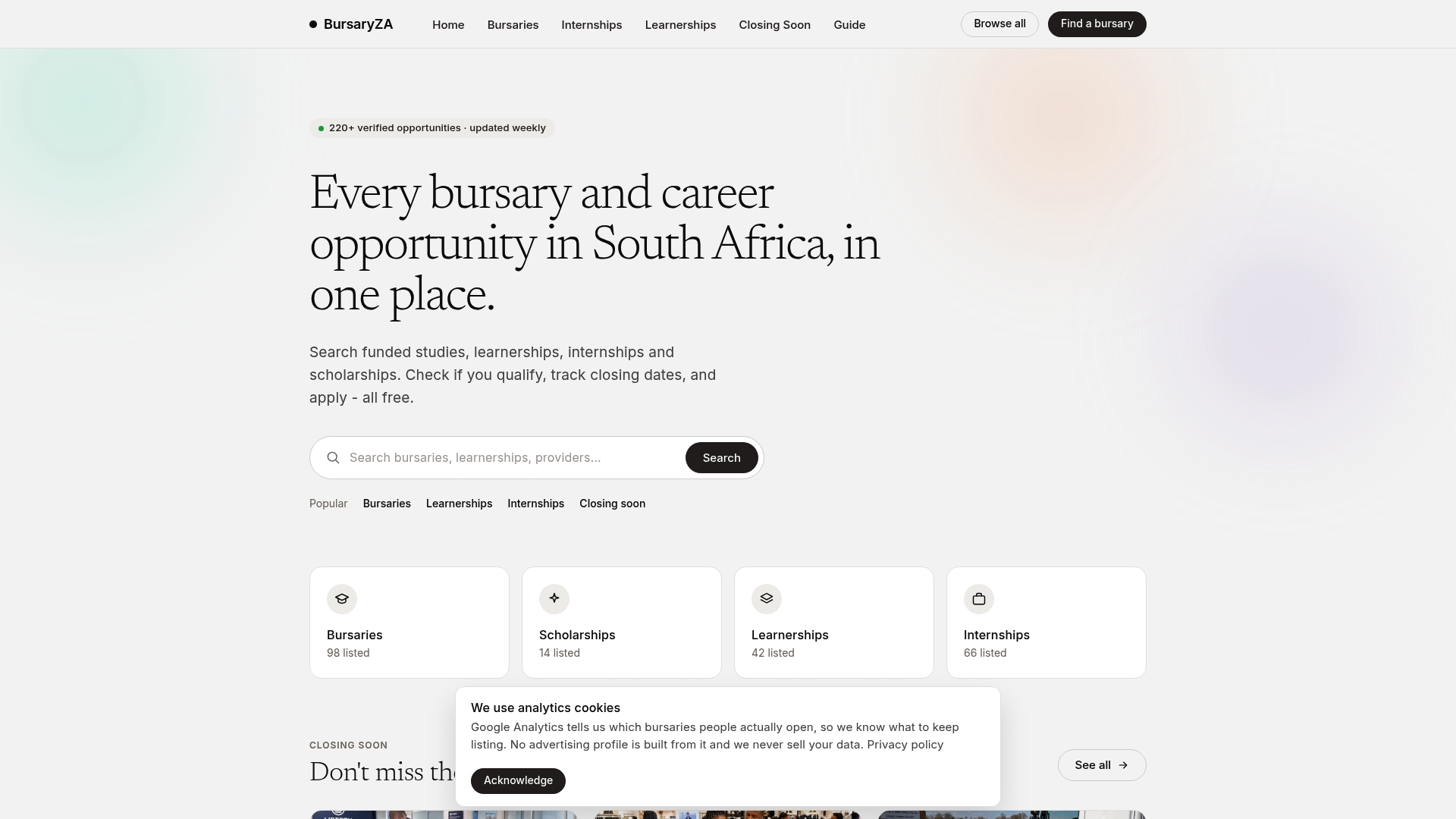
Start on the BursaryZA home page, or browse a provider such as the MISA programmes to see how a full listing, with its checklist and closing date, looks.
Timing your applications through the year
Media internships do not follow one national calendar. Large companies tend to advertise placements around the start or middle of the year, while government programmes publish notices in the public service vacancy circular throughout the year. Bursaries for the following academic year often open in the second half of the year and close before the new intake. Because dates change, keep a simple tracker: the funder, the closing date, the documents needed and the date you applied. Then check each official page for the current schedule instead of relying on last year’s date.
A few habits help. Set a calendar reminder two weeks before a closing date. Ask your referees early, since lecturers and former employers need notice. Keep a master CV and a master motivation letter that you adapt for each application, so you can respond fast when a new listing appears.
FAQ
Do I need a journalism degree to get a journalism internship?
Not always. The Broad Media internship listing asks for a degree and excellent English writing, and says the degree need not be in journalism. Editors care most about your writing and your evidence of interest, such as clips, a student paper or a blog.
Are journalism internships in South Africa paid?
Many are. The Broad Media placement is described as a full-time, paid position for three months, and the Mpumalanga 2026/27 graduate programme lists R8,174.75 per month for its Communication/Journalism post. Pay differs by employer, so read the advert before you apply.
How do I prepare for a bursary interview?
Reread the advert, research the funder, and prepare examples that answer common questions about your background, motivation and plans. Practise aloud, keep answers short and bring your documents. For a journalism bursary, also bring a few pieces of your work.
Can I apply for more than one opportunity at once?
Yes, and you should. Just check each condition. The Mpumalanga programme, for example, excludes people who have already done a government internship, so confirm that previous placements do not disqualify you.
Sources
- Journalism Internship Application, Broad Media Careers
- Annexure T, Mpumalanga Graduate Internship Programme 2026/27, DPSA
- State of Freelance Journalists in South Africa, SANEF (2024)
- Media Sustainability and Universal Access to Public Information, SANEF (2021)
- Netwerk24 studiebeurs for aspirant journalists
- Canon Collins Mail and Guardian Scholarship
- Rhodes University School of Journalism and Media Studies scholarships
- Reporting on Migration in South Africa (2019)