Where to Find Graduate Internships in South Africa Right Now

Your fastest routes into a graduate internship are public-sector 24-month programmes, major job boards, employer graduate schemes, and BursaryZA’s verified listings. Government departments like Employment and Labour, National Treasury, and Health post structured intakes every year with real stipends and contracts. Before you touch a single application, confirm you meet the eligibility rules, build one clean upload with your CV, ID, and certified qualifications, and check whether you need a SAQA evaluation for any foreign qualification.
Do this within the next 24 hours:
- Confirm your age (18 to 35), citizenship, and employment status against the standard eligibility rules.
- Scan the closing dates on at least three current adverts and note the reference numbers.
- Save your CV, ID copy, and certified transcripts as one file, named clearly, ready to upload.
Pro Tip: Set up job alerts using the exact phrase “graduate internship” plus your field and province. Generic searches like “internship” bury you in unrelated learnership and vacation-work listings.
Key Takeaways
Landing a graduate internship in South Africa depends on matching public-sector eligibility rules exactly, submitting complete documents through the correct portal, and applying to multiple programmes instead of waiting on one response.
| Point | Details |
|---|---|
| Check eligibility first | Confirm citizenship, age 18 to 35, unemployed status, and no prior internship participation before applying. |
| Prepare one document set | Certified CV, ID, qualification, and transcripts, plus a SAQA evaluation for foreign qualifications. |
| Follow the advert’s upload rule | Single compressed file, correct form, and submission through the specified e-Recruitment portal only. |
| Expect a 24-month contract | Most government programmes run 24 months, with stipends like R8,174.78 monthly in recent Health Department adverts. |
| Use BursaryZA for verified listings | BursaryZA confirms closing dates and eligibility checklists before you spend time on an application. |
Table of Contents
- Where Should You Search for Graduate Internships in South Africa?
- What Are the Eligibility Rules for Public-Sector Graduate Internships?
- How Do You Apply for a Graduate Internship Step by Step?
- How Long Do Graduate Internships Last and What Do They Pay?
- How Can You Improve Your Chances of Getting Shortlisted?
- What Should You Do While You Wait for a Response?
- How Does BursaryZA Verify Its Internship Listings?
- Skip the Guesswork on Which Internships Are Real
- Sources
Where Should You Search for Graduate Internships in South Africa?
Start with government portals. Public-sector internships dominate the graduate internship space in South Africa because they’re structured, funded from department budgets, and run on fixed 24-month cycles rather than ad hoc availability. The Department of Employment and Labour’s internship page is the first stop, followed by National Treasury’s e-Recruitment advert and the Department of Health’s own graduate adverts. These three alone account for a large share of formally advertised public-sector graduate intakes each cycle, and each one publishes exact reference numbers, closing dates, and post lists you can check against your own qualification.
City and regional platforms matter too. The City of Cape Town runs its own graduate internship database separate from national departments, and other metros run similar local registers. If you’re tied to a specific city for family or cost reasons, check the municipal site directly rather than assuming national adverts cover local government roles.
Job boards work differently. LinkedIn and PNet aggregate thousands of private-sector listings, including corporate graduate programmes from banks, engineering firms, and retailers. They move faster than government portals but carry more noise. You’ll wade through unrelated learnerships, contract roles, and recruitment agency spam to find genuine graduate internship postings, especially for civil engineering internships, electrical engineering internships, and mechanical engineering internships, where large infrastructure employers post directly to their own career pages as often as to job boards.

This is where BursaryZA earns its place in your search rotation. Instead of scrolling ten job board pages hoping to spot a real graduate internship among sponsored ads, BursaryZA’s internships listings are pre-verified, with eligibility checklists and closing dates already extracted. For technical fields specifically, the engineering opportunities page filters out irrelevant results entirely, and the IT and computer science page does the same for tech graduates.
Pro Tip: Build separate saved searches for each channel: one government alert, one job board alert, one BursaryZA filter by field and province. Checking three narrow feeds beats one broad search you’ll eventually stop opening.
What Are the Eligibility Rules for Public-Sector Graduate Internships?
Documentation matters just as much as eligibility. Public-sector applications typically require:
- An updated CV reflecting your actual qualification and any relevant project or vacation work.
- A certified copy of your South African ID.
- Certified copies of your qualification certificate and full academic transcripts.
- A completed Z83 form where the advert specifies it, using the updated version, not an older template.
- A SAQA evaluation certificate if any part of your qualification was earned outside South Africa.
Missing even one of these four or five items is the single most common reason applications get screened out before anyone reads your CV. Departments process hundreds of applications per post and rarely have capacity to follow up on incomplete submissions. An uncertified copy, a scanned document uploaded as the wrong file type, or an outdated Z83 template gets treated the same as a missing document: automatic disqualification, no second chance.
How Do You Apply for a Graduate Internship Step by Step?
The mechanics of applying matter more than most graduates expect, because recruiters disqualify candidates who don’t follow the advert’s exact upload instructions. Here’s the sequence that actually works.
- Read the full advert twice, and note the exact reference number, the required form, and the submission method.
- Write a CV tailored to that specific post, not a generic one, referencing the department’s own language where relevant.
- Draft a short cover letter that names the post and reference number in the first line.
- Gather certified copies of your ID, qualification, and transcripts. Certification must usually be recent, so check the advert for any date limit.
- Compress everything into a single file if the advert requires it, and name the file with your surname and the reference number.
- Complete the online application through the department’s e-Recruitment portal or the specified job platform, filling every mandatory field.
- Submit before the stated closing date and time, and take a screenshot or save a confirmation reference if the portal provides one.
Most public-sector departments run on dedicated e-Recruitment systems rather than accepting email or hand-delivered applications, and treat any submission outside the specified channel as invalid. The CIPC’s graduate internship advert is a good example of how strict single-upload requirements get: one compressed file, correctly labeled, or your application doesn’t get considered at all.
Watch the clock. Closing dates listed as a date alone often mean midnight on that day, but some portals close earlier or require walk-in submission during office hours only. Never assume the department will email you a confirmation. If the portal doesn’t generate one automatically, you have no proof your application went through, so submit at least a day early rather than racing a deadline.
Pro Tip: Keep a template folder with pre-certified copies of your ID, qualification, and transcripts, refreshed every six months. Recertifying documents for every single application wastes hours you could spend on tailoring your CV instead.
How Long Do Graduate Internships Last and What Do They Pay?
Government graduate internships in South Africa run almost universally on a 24-month fixed-term contract, structured to give you two full years of workplace exposure rather than a short-term placement. National Treasury’s Graduate Development Programme follows the same 24-month structure, with preference given to graduates who performed strongly academically.
Stipends vary by department and post level, but the Department of Health’s 2026 to 2028 advert lists R8,174.78 per month for many of its advertised posts. That figure gives you a realistic benchmark for budgeting during a public-sector internship, though private-sector graduate schemes sometimes pay more, especially in engineering and finance.
Selection takes time, and departments receive far more applications than posts. Expect this rough sequence:
- Application and document screening (several weeks after closing).
- Shortlisting based on qualification match and document completeness.
- A pre-entry practical exercise or written assessment for many public-sector posts.
- Interviews for shortlisted candidates.
- Final appointment and contract signing.
National Treasury advises that if you haven’t been contacted within roughly three months of the closing date, treat your application as unsuccessful. Other departments use an eight-week benchmark. Either way, don’t wait on one application. Apply broadly and keep moving.
How Can You Improve Your Chances of Getting Shortlisted?
Your CV needs to work harder than a standard job application CV. Lead with your NQF level, list the specific modules or coursework relevant to the post, and quantify any project work you completed during your degree, even academic projects. “Designed a stormwater drainage model for a final-year civil engineering project, reducing simulated flood risk by X” tells a selection panel more than “completed engineering coursework.”
For posts that include a pre-entry practical exercise or case study assessment, prepare in advance. Build a short portfolio, even two or three pages, showing a project summary, a technical calculation, or a writing sample relevant to the department’s function. Panels increasingly use these exercises to filter candidates who look strong on paper but struggle to apply the material.
Networking still opens doors that adverts don’t. A few tactics worth trying:
- Reach out to graduate-recruitment teams on LinkedIn before a post closes, not after, to ask clarifying questions about the role.
- Contact alumni from your university who completed the same government or corporate programme, and ask what the assessment actually covered.
- Request a short informational conversation with department HR contacts listed on official adverts, where public information officers are often reachable.
- Follow specific employer pages for civil, electrical, and mechanical engineering internships, since many post directly rather than relying solely on job boards.
Pro Tip: If an employer’s employment equity plan asks about community involvement or disadvantaged background, answer in two or three factual sentences: what you did, where, and what changed. Vague statements read as filler, and panels notice.
What Should You Do While You Wait for a Response?
Track every application in one spreadsheet: portal name, reference number, closing date, upload status, and a follow-up date roughly eight weeks out. This sounds tedious until you’ve applied to your sixth post and can’t remember which documents you sent where.
Follow the departments’ own guidance on timing. If National Treasury or Health hasn’t contacted you within their stated window, treat the application as closed and move on rather than repeatedly emailing HR.
While you wait:
- Keep applying to new adverts as they’re posted rather than pausing after one submission.
- Take a short, free online course relevant to your field to fill any visible skills gap.
- Look for volunteer work or short-term contract roles that add a fresh line to your CV.
How Does BursaryZA Verify Its Internship Listings?
Every internship listing on BursaryZA goes through a verification pass before it’s published: confirming the provider is legitimate, checking the closing date is current, verifying stipend and contract duration where the advert states them, and making sure an eligibility checklist is present so you know whether it’s worth your time before you start an application.
That matters because the biggest waste of a graduate’s time isn’t applying and getting rejected. It’s applying to something that was never a real opportunity, or missing a closing date because a job board’s copy of the advert was outdated. BursaryZA links directly to the official application portal for each listing, cutting out the guesswork of hunting for the right e-Recruitment page yourself.
A verified listing with eligibility criteria and a direct link to the official portal removes the two biggest sources of wasted applications: chasing outdated adverts and submitting through the wrong channel.
Specific listings like the Department of Human Settlements graduate internship page and the Competition Commission’s internship listing show exactly how this works: eligibility, closing date, and a direct application link, all in one place.
A candid note on the graduate job market
The market for graduate internship opportunities in South Africa is competitive, and a lot of qualified people won’t hear back from every application they send. That’s not a reflection of your worth. Structured programmes exist precisely because employers know graduates need a real bridge into permanent work, and every application you complete properly is one step closer to landing on the right side of that gap.
Skip the Guesswork on Which Internships Are Real
Job boards mix genuine graduate internships with expired adverts, recruitment agency spam, and listings that never confirm a stipend or closing date. BursaryZA is built to cut through that: every internship on the platform carries a verified closing date, a clear eligibility checklist, and a direct link to the official application portal, so you’re not gambling your time on a dead listing.
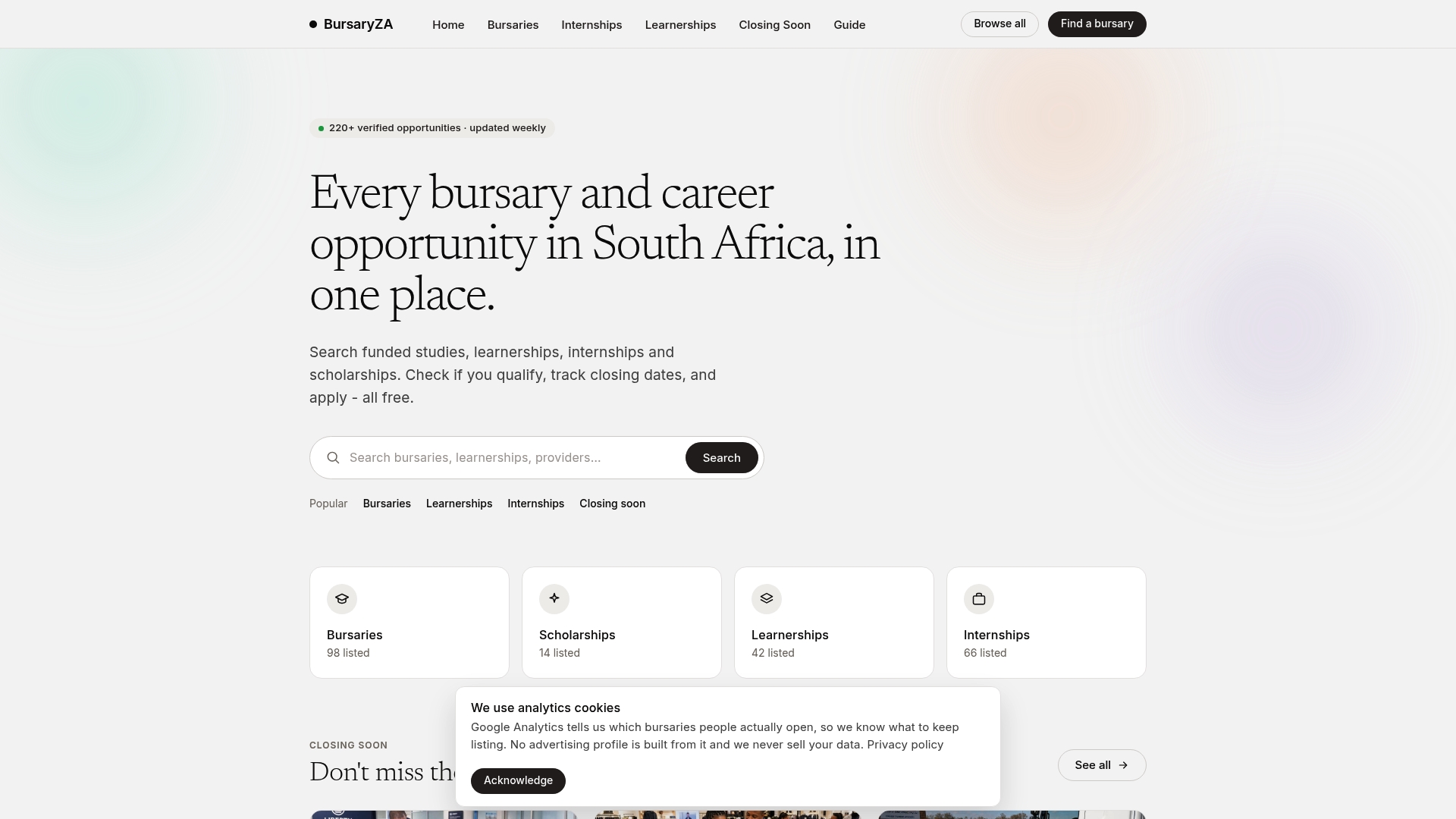
Search “Internships in South Africa 2026” directly on BursaryZA’s internships page, set a field and province filter that matches your qualification, and turn on alerts so new postings reach you before the closing date creeps up. If you’re an engineering graduate, the engineering-specific listings narrow things further, and the general bursaries page is worth a look too, since some funded study options double as a bridge if internship applications stall. Click through to any listing that matches your NQF level and apply directly through the official portal linked on the page.
Sources
- Job advert and application guidance (Gauteng recruitment portal)
- Presidency advice on SAQA evaluation for foreign qualifications
- Graduate Internship Programme for 2025 TO 2027 (24 Months) — Department of Employment and Labour
- Graduate Internship Programme 2026 advert — National Treasury (PDF)
- Graduate Internship Programme 2026–2028 (PDF) — National Department of Health