Diploma Bursaries in South Africa: Who Funds Them and How to Apply

Yes, you can get a bursary for a diploma in South Africa. NSFAS funds approved NQF Level 6 diplomas at public universities and TVET colleges, and government departments, municipalities, water boards and companies fund diplomas in the fields they need to hire from. Advanced diplomas are funded too, but by fewer schemes, so you need to look more carefully. This guide shows who funds what, what they ask for, and how to build an application that does not get thrown out on a technicality.
TL;DR
- NSFAS covers approved Higher Certificates (NQF Level 5) and Diplomas or National Diplomas (NQF Level 6) at eligible public institutions, if you meet its financial, academic and first-qualification rules.
- Employer and government bursaries (water boards, municipalities, provincial departments, disaster management) often name specific diplomas, so match your qualification to the exact wording of the advert.
- Advanced diploma students can find funding, but you usually need a completed diploma or degree first, and the funder must list the programme.
- Most schemes open once a year, many in the second half of the year for the following academic year. Check each official page for the current window.
- A higher certificate is not “worse” than a diploma. It is a level lower, and the bursary you qualify for depends on the funder’s list, not on the label.
Table of Contents
- Diploma, advanced diploma and higher certificate: what the levels mean
- NSFAS: the biggest source of diploma funding
- Government, municipal and public-entity bursaries
- Advanced diploma bursaries
- Company and private bursaries for diploma students
- Requirements that appear again and again
- How to find and apply, step by step
- Perspective
- Find your diploma bursary on BursaryZA
- FAQ
- Sources
Diploma, advanced diploma and higher certificate: what the levels mean
Before you chase funding, be sure you know which level your programme sits at, because bursary adverts are written by level and credit count.

Under the national higher education framework, a Diploma is typically an NQF Level 6 qualification with 240 or 360 credits, while an Advanced Diploma is an NQF Level 7 qualification with 120 credits, according to the Higher Education Qualifications Sub-Framework. The same document sets the entry rule: a Diploma requires a National Senior Certificate with appropriate achievement levels, or a Higher or Advanced Certificate in a related field. An Advanced Diploma requires an appropriate Diploma or a Bachelor’s degree.
NSFAS’s 2026 guidelines describe funded certificate qualifications as NQF Level 5 Higher Certificate or National Higher Certificate programmes, and funded undergraduate qualifications as including NQF Level 6 Advanced Certificates, Diplomas and National Diplomas, subject to approved qualification and institution conditions.
| Higher Certificate | Diploma | Advanced Diploma | |
|---|---|---|---|
| NQF level | 5 | 6 | 7 |
| Typical credits | Set per programme | 240 or 360 | 120 |
| Usual entry | National Senior Certificate | National Senior Certificate, or a related Higher or Advanced Certificate | A Diploma or Bachelor’s degree in a suitable field |
| Main purpose | Entry-level occupational or access qualification | Career-focused qualification | Specialisation on top of a diploma or degree |
The credit numbers matter more than they look. NSFAS expects full-time students to carry a proper load: for distance students studying an equivalent full-time load, at least 120 credits in one academic year is the threshold for the personal care allowance. At that pace, a 240-credit diploma is a two-year load and a 360-credit diploma a three-year load, which is why funders ask for a registration or academic record rather than just a programme name.
Higher certificate or diploma: which is better?
Neither is better in the abstract. A diploma sits one level higher, so it opens more doors in employer adverts that say “NQF 6”. A higher certificate is a shorter, lower-level route that can lead into a diploma, since a Higher Certificate in a related field is one of the accepted entry routes. For funding, the two are not interchangeable. NSFAS can cover both at eligible public institutions, but you must still meet the financial, academic and first-qualification rules, and other bursaries set their own lists. If you are choosing between them, check which one your target funder actually names.
NSFAS: the biggest source of diploma funding
For most students from low-income households, NSFAS is the first stop. It funds university qualifications at NQF Levels 6, 7 and 8, including Level 6 Diplomas with a minimum of 240 or 360 credits and National Diplomas. It does not fund qualifications above NQF Level 8.
What it can pay for, for supported students, includes learning materials, a living allowance (for students not in catered residence), and either an accommodation or a transport allowance. These are subject to the figures in NSFAS’s annual handbook, so always read the current one rather than relying on last year’s amounts.
What can stop you:
- Private institutions and programmes that are not approved are generally not covered.
- A second qualification that the rules disallow may not be funded.
- You must meet the financial need test and the academic progression rules.
On timing: NSFAS’s official page says applications for the 2027 academic year are free and online, and ran from 18 September to 31 October 2026. The pattern to plan around is a window in the second half of the year for the following academic year. Check the page for the current cycle. The process is to create or access your myNSFAS account, complete your personal and household income details, give consent, upload supporting documents, review, submit, and keep your reference number. You never pay to apply. You can read our summary on the NSFAS listing.
Diplomas at TVET colleges
If your diploma-level or occupational programme is at a public TVET college, a different set of NSFAS rules applies. NSFAS states that applicants must be South African citizens, registered or intending to register for a PLP, NC(V) or Report 191 programme at a public TVET college, show financial need, meet progression requirements where they apply, not duplicate previously state-funded learning, and generally fall within a combined gross family income of up to R350,000 per year. You can apply through the college’s bursary office, online via myNSFAS, or through the NSFAS head office. Support can include registration and tuition fees plus personal care, transport and accommodation allowances.
Government, municipal and public-entity bursaries
The next layer is the public sector, which funds diplomas that feed straight into its own workforce. These tend to be narrower, with fewer awards, but also less crowded than the big national schemes.
Teaching: Funza Lushaka. The Department of Basic Education’s bursary is for students training as teachers. Its official application process requires you to register on e-Gov, log in, select the Funza Lushaka scheme, verify with an OTP, accept the terms, choose the application year, complete the form and accept the declaration. The page says first-time applicants must be 30 or younger.

Municipalities. The City of Cape Town’s external financial support form for 2027 asks for registration or provisional acceptance, an account statement if you are registered, a certified matric certificate if you have matriculated, and Grade 12 results averaging 65% or more, along with other supporting documents. Incomplete or late applications are not considered. Other municipalities run their own schemes with their own rules.
Provincial departments. Provinces fund study in fields they need, from agriculture to public administration. On our site you can look at the Free State Government bursary, the Office of the Premier bursary and the LDARD bursary programme. Each lists its own eligibility checklist and closing date.
Water, disaster and technical fields. Water boards and technical agencies often fund diplomas directly. The 2026 Magalies Water bursary advert listed NQF 6 diplomas in engineering, Water Care, chemistry or analytical chemistry, and biotechnology or microbiology, plus an Advanced Diploma in Water Care. Applicants needed a 65% Grade 12 average and a provisional acceptance letter. Our page on Magalies Water bursaries tracks the current listing.
Advanced diploma bursaries
Advanced diploma is one of the most searched versions of this topic, and one of the thinnest on funding. Fewer funders name it, and they often treat it like postgraduate study. Two things help.
First, read the level wording. The National Disaster Management Centre bursary for 2027 was open to students doing undergraduate, postgraduate diploma, advanced diploma or master’s programmes in Disaster Management or Fire Technology and Engineering. Its deadline that cycle was 30 September 2026, so the practical lesson is to check the portal early each year, since such schemes run annually.
Second, apply with your diploma or degree results in hand. Because an advanced diploma needs an appropriate diploma or degree for admission, funders usually assess you on your previous academic record, not on matric. Keep certified copies of your diploma, full academic record and proof of registration or provisional acceptance ready.
NSFAS guidelines list Level 7 qualifications among funded university levels, but it also applies first-qualification rules, so if you already hold a funded qualification, ask your institution’s financial aid office how your situation is treated before you rely on it.
Company and private bursaries for diploma students
Companies in mining, paper and packaging, energy and infrastructure fund diplomas because they need technicians and technologists. Many advertise “degree” prominently, so read the fine print: diploma programmes are often included in the list of fields. Two examples to look at on our site are the Sappi bursary and the Glencore bursary opportunities. Check each page for the qualifications and institutions it names.
A few habits make you stand out in this category:
- Apply for the exact programme named in the advert, at the institution named.
- Send your results, not a promise of results. Where only provisional acceptance is required, attach it.
- Apply to several funders, not one. Bursaries are competitive and not every advert fits your profile.
If you study at a private college, many of the public schemes will not apply, but some funders do. Our guide to bursaries for private colleges explains the options.
Requirements that appear again and again
Funders differ, but the checklists look similar. From the schemes above:
| Requirement | Examples from official pages |
|---|---|
| Citizenship | South African citizen (NSFAS TVET route) |
| Academic average | 65% Grade 12 average (City of Cape Town form, Magalies Water); 70% for the SARB external scheme |
| Age limit | 30 or younger for first-time Funza Lushaka applicants; younger than 30 for the SARB scheme |
| Financial need | Combined family income up to R350,000 a year (NSFAS TVET route) |
| Proof of study | Provisional acceptance letter or proof of registration |
| Documents | Certified ID and matric certificate, account statement, household income proof |
The SARB figures come from its External Bursary Scheme document, which targets undergraduate degree students, so it is a benchmark for what funders ask, not a diploma scheme. Our full bursary requirements guide goes through the documents in detail.
How to find and apply, step by step
The government’s own advice is to consult the Department of Higher Education and Training’s list of government bursaries and NSFAS, and to contact the university of your choice about bursaries and other funding. Banks may offer loans or merit bursaries. Here is a working routine:
- Confirm your programme. Write down its exact name, NQF level, credits and institution. Funders match on these.
- Start with NSFAS if your household income is low and your institution is a public one.
- Ask your institution’s financial aid office which internal bursaries exist for your department.
- List employer and government funders in your field and note each one’s opening month, then set reminders.
- Collect documents once. Certified ID, matric or diploma results, proof of registration or acceptance, household income proof, and a motivation letter you can adapt.
- Apply only through official pages. Legitimate bursaries do not charge application fees.
- Keep reference numbers and check your status regularly. Incomplete or late applications are usually rejected without a second look.
Perspective
Every year we see the same pattern: diploma students assume bursaries are for degrees, and they stop looking. That is the most expensive mistake in this space. Many funders list NQF 6 diplomas by name, and they are often short of good applicants for those programmes.
The second pattern is timing. Closing dates are spread across the year, and a student who finds a scheme in the week it closes has already lost to the student who tracked it for months. That is why every listing we publish carries its eligibility checklist, closing date, document needs and a direct link to the official application page.
We never charge a fee and we never collect your application. We send you to the funder, and we only list opportunities we have verified. Use the filters for your field, study level and province, and apply to more than one.
Nkosi
Find your diploma bursary on BursaryZA
BursaryZA is a searchable, regularly updated database of verified bursaries, scholarships, internships and learnerships in South Africa. Each listing shows the eligibility checklist, closing date, provider information and a direct link to the official application. A matching tool lets you filter by field, study level and location.
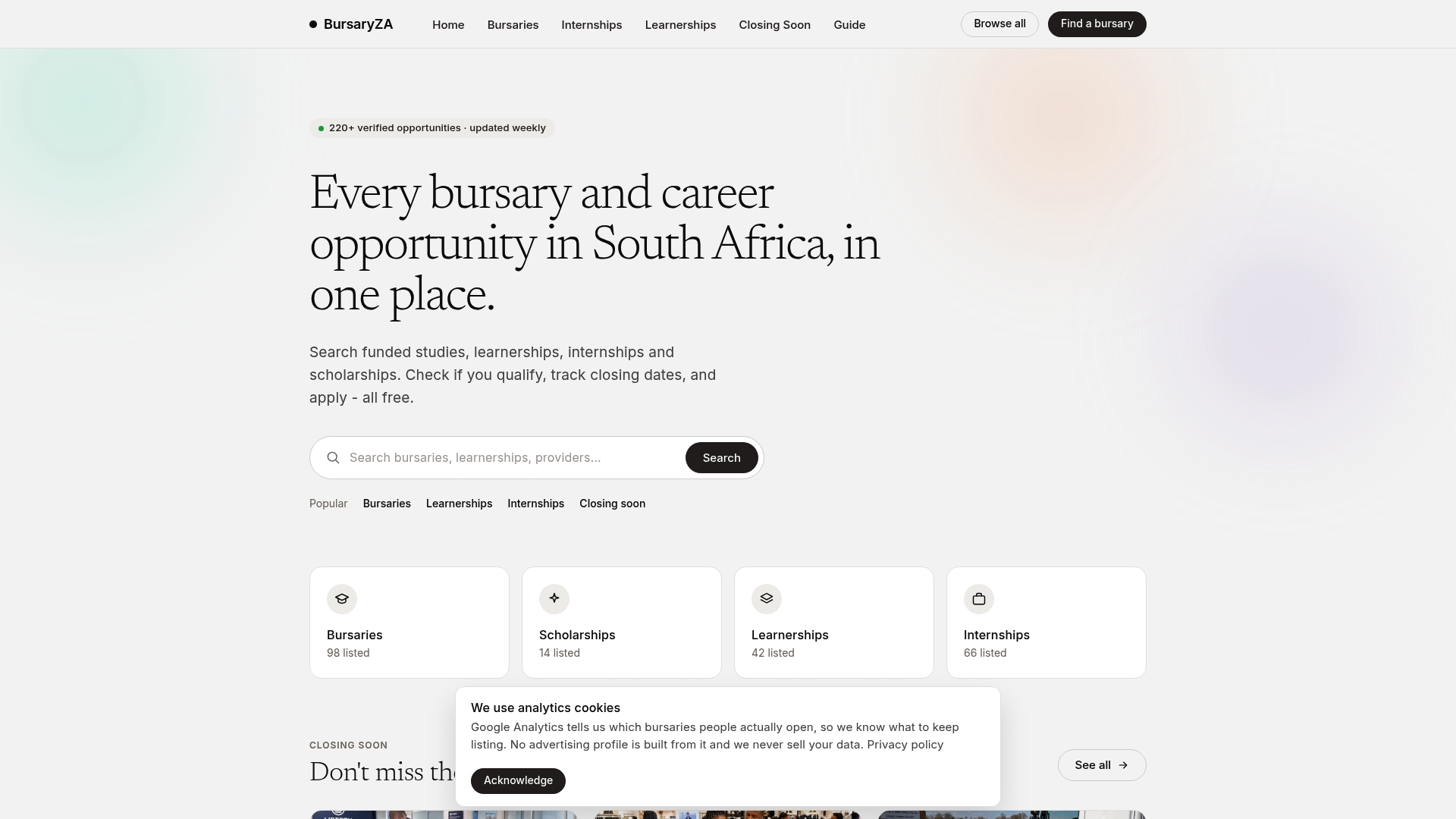
Start on the BursaryZA home page, or see which bursaries are still open right now.
FAQ
Can I get a bursary for a diploma in South Africa?
Yes. NSFAS can fund approved Level 6 diplomas and National Diplomas at eligible public universities and TVET colleges. Government departments, municipalities, water boards and companies also fund diplomas in fields they need. Each sets its own rules, so check the official advert.
Do higher certificate and diploma students qualify for the same bursaries?
Not automatically. NSFAS can cover approved Higher Certificates and Diplomas, but you must meet its financial, academic and first-qualification rules. Other funders list specific qualifications, so a bursary for a diploma may not cover a higher certificate, and the reverse is also true.
Are there bursaries for advanced diplomas?
Yes, but fewer. Some schemes, such as the National Disaster Management Centre bursary, name advanced diplomas in specific fields. Because admission needs a diploma or degree first, funders usually look at that earlier academic record.
When should I apply?
Many schemes open in the second half of the year for the following academic year, but dates vary by funder and change annually. Check each official page for the current opening and closing dates, and apply before the deadline, since late applications are not considered.
Sources
- NSFAS Bursary Guidelines 2025
- NSFAS 2026 Bursary Guidelines, Annexure A
- NSFAS: how to apply
- NSFAS: TVET colleges
- Higher Education Qualifications Sub-Framework, Government Gazette 38116
- Funza Lushaka application process
- City of Cape Town external financial support application
- Magalies Water external bursary advert
- National Disaster Management Centre bursary system
- SARB External Bursary Scheme
- gov.za: where can I get a bursary