Find Live, Verified Bursaries for Private Colleges in South Africa

Yes, bursaries for private colleges exist in South Africa, and the search is worth the effort. The three routes to prioritize are institutional bursaries from the college itself, corporate bursaries tied to shortage skills, and SETA or trust funding aligned to your field. Coverage and eligibility differ by provider and intake, so check closing dates against official pages before you build an application around any single option. Start with a verified search, then lock in every deadline on a calendar.
TL;DR:
- Most private college bursaries are limited to registered students and often require a separate application process with strict deadlines.
- Corporate bursaries tend to target shortage skills fields and usually include a work-back obligation that requires repayment if not fulfilled.
- SETA and industry funding are tied to sector needs, making your chosen field crucial for eligibility, especially at the certification or diploma level.
- To improve success, applicants should verify listings on official platforms, prepare certified documents in advance, and closely follow application deadlines.
- Maintaining awareness of renewal conditions, including minimum grades and attendance, is essential to retaining bursary support throughout your studies.
Table of Contents
- Types of Bursaries That Fund Private-College Study
- Who Qualifies: Eligibility Rules and Documents You Must Prepare
- How to Apply Successfully: Step-by-Step Checklist and Timeline
- Work-Back Obligations and Contract Risks to Check Before You Sign
- How to Find Verified Bursaries: A Search Workflow That Avoids Fraud
- Renewal Conditions: Keeping Your Bursary Through the Full Course
- Author Perspective: The One Habit That Separates Successful Applicants
- Start Your Verified Bursary Search Today
- Sources
- FAQ
Types of Bursaries That Fund Private-College Study
Private-college funding in South Africa breaks into four broad categories, and knowing which one you’re applying to changes how you should prepare.
Institutional bursaries come straight from the college itself, and they’re often the fastest way to secure partial funding once you’ve already been admitted. The catch: they’re generally non-transferable, limited to students already registered at that specific institution, and rarely stretch to cover accommodation or transport. Boston City Campus, for example, publishes its own bursary and financial aid pages that spell out these terms clearly, including a warning that submitting an application never guarantees an award.
Corporate bursaries are the most competitive category, and also the most misunderstood. Companies fund students in fields where they’re short on skilled staff, usually engineering, finance, or technology, and in exchange they expect a work-back commitment once you graduate. The Capitec External Bursary is a useful reference point here. It sets specific age and academic thresholds and is open to students at DHET or CHE-registered institutions, which can include private colleges depending on the qualification level. Treat any corporate bursary as a job offer wrapped in a funding package, because that’s effectively what it is.
SETA and industry funding works differently again. Sector Education and Training Authorities exist to close skills gaps, and they will fund private college qualifications when those qualifications line up with what the sector actually needs. This is where the field you choose matters just as much as the college you choose.
Trusts and foundations round out the list, and they’re the most varied category. Some fund by community, some by field of study, some by demographic group or family circumstance. A trust tied to a religious denomination or a specific geographic region can be worth more to the right applicant than a big-name corporate bursary that has thousands of competing applicants.
A few practical notes on how these interact:
- Fixed or capped bursaries often need to be topped up with a second, smaller award to cover the full cost.
- Many colleges only permit one bursary per semester, so stacking isn’t always possible.
- Faith-based and specialty institutions sometimes run their own scholarship tracks worth checking, including resources like Bible school scholarship listings for students considering that path.
- Institutional awards are usually forfeited if you transfer colleges mid-course.
Who Qualifies: Eligibility Rules and Documents You Must Prepare
Most bursary providers work from a similar eligibility template, even though the specific numbers shift between programs.
Age and citizenship rules are near universal. You’ll typically need to be a South African citizen or permanent resident, and if you’re under 18, providers will ask for written parental or legal guardian consent before they’ll even process your application.
Academic cutoffs vary by whether the award is merit based or need based. Need-based awards care less about your marks and more about your household’s financial position, though most still expect you to be passing your current year of study.
Financial evidence gets requested for anything means-tested. Expect to submit proof of household income, sometimes a parent or guardian’s payslip or an affidavit of unemployment, and occasionally a full breakdown of household expenses if the bursary is large.
- Certified copy of your South African ID or birth certificate
- Latest academic transcript or matric results
- Proof of registration or admission letter from the private college
- A motivation letter explaining your field choice and financial need
- An updated CV, even for first-year applicants
- Proof of household income or an affidavit where income doesn’t apply
- Parental or guardian consent form if you’re under 18
Pro Tip: Scan and save certified copies of your ID and transcript now, even before you find a bursary to apply for. Certification expires and documents get requested with short notice, so having a ready folder saves you from missing a deadline over paperwork.
Deadlines are the one thing that trips up otherwise strong applicants. Private-college bursary pages tend to align their closing dates with semester intakes, and late submissions are almost never accepted, no exceptions for good grades or compelling stories.
How to Apply Successfully: Step-by-Step Checklist and Timeline
A bursary application succeeds or fails on preparation, not luck. Here’s the sequence that works.
- Find verified listings through a database that filters by field, study level, and province rather than relying on random social media posts.
- Verify the listing is current by checking the provider’s own site for a live closing date and an official application link.
- Gather documents early, using the checklist above, and get certifications done before you need them.
- Submit a complete application in one sitting rather than piecemeal. Incomplete submissions are one of the top reasons applications get rejected outright.
- Follow up with the provider two to three weeks after the closing date if you haven’t heard anything.
Timing matters as much as the content of your application. Most private colleges run intakes in January and July, and bursary cycles typically open two to four months ahead of each intake. A calendar-based approach that maps every closing date against your intake period is one of the highest-leverage habits a successful applicant can build. Miss the window and you wait a full semester, sometimes a full year, for the next round.
On formatting: keep your motivation letter under one page. Reviewers read hundreds of these, and a tight, specific paragraph explaining why you chose your field beats three vague pages every time. Name a real referee, not a placeholder, and make sure certified copies actually carry a certification stamp, not just a photocopy.
The mistakes that sink applications are almost always avoidable:
- Submitting after the deadline, even by hours
- Leaving required fields blank because “it didn’t seem to apply”
- Using an uncertified copy where certification was explicitly required
- Applying for a bursary tied to a field you’re not actually registered in
- Failing to disclose an existing bursary when the terms require it
If you get stuck, your private college’s student support or bursary office is the first stop, followed by a verified bursary platform, and finally the provider’s own contact line listed on the official application page.
Work-Back Obligations and Contract Risks to Check Before You Sign

Corporate bursaries come with strings, and those strings are legal, not just moral. A work-back obligation means you agree to work for the sponsoring company for a set period after graduation, often matching the number of years you were funded.
The risk shows up if you don’t fulfil that obligation. Some corporate bursary agreements state plainly that the recipient may need to repay the bursary amount plus interest if the post-graduation work requirement isn’t met. That’s not a hypothetical penalty clause buried in fine print. It’s standard language in external bursary programs, and it applies whether you decline the job offer, get released for poor performance, or simply change your mind about the field.
If a corporate bursary includes a work-back obligation and you fail to fulfil it, you may be required to refund the bursary amount plus interest. Always request the exact refund formula in writing before you sign anything.
Before accepting any corporate bursary, take these steps:
- Ask for the full contract, not just a summary email.
- Get a plain-language explanation of the work-back period and what counts as fulfilling it.
- Confirm exactly what’s covered: tuition only, or tuition plus books, accommodation, and a living allowance.
- Clarify what happens if the company doesn’t have a role available for you when you graduate.
- Ask about probation conditions tied to the eventual employment contract, since some bursaries treat the first year of work as a trial period with different rules.
If any clause is unclear, ask your college’s student support office or a legal advice service to read it with you. A bursary that funds three years of study but locks you into an unclear five-year obligation is not the deal it looks like on the surface.
How to Find Verified Bursaries: A Search Workflow That Avoids Fraud
Fake and expired bursary listings circulate constantly, especially around January and July when demand spikes. A verified search workflow that filters by field, study level, and location, checks eligibility against an actual checklist, and confirms a live closing date cuts your risk of applying to a dead or fraudulent listing significantly.
Here’s what that workflow looks like in practice:
- Filter listings by your field of study, qualification level, and province.
- Read the eligibility checklist line by line before you invest time in the application.
- Confirm the listing carries a direct link to the provider’s official application page, not a third-party form.
- Save the closing date immediately and set a reminder at least a week before it.
- Cross-check the provider’s contact details against their own official site.
Say you’re chasing an engineering diploma bursary at a private college. You’d start by filtering engineering-specific listings, then check whether the provider names a specific diploma level (many corporate bursaries fund degrees only, not diplomas), then confirm the closing date is still in the future before you spend a weekend writing a motivation letter for a bursary that quietly closed two months ago.
Verification isn’t paranoia. It’s the difference between spending your evenings on applications that can actually pay off and applications that were never live in the first place.
Renewal Conditions: Keeping Your Bursary Through the Full Course
Winning a bursary once doesn’t mean you keep it. Most institutional and corporate bursaries attach renewal conditions that get checked every semester or every year, and slipping below them can end funding mid-course.
The most common condition is a minimum academic average, often the same threshold you needed to qualify initially. Drop below it for one semester and some providers issue a warning; drop below it twice and funding often gets pulled. A handful of programs also require minimum attendance or a full course load, so switching to part-time study without checking your bursary terms first can trigger a review you didn’t see coming.
Corporate bursaries add another layer: some require an annual check-in, a progress report, or even a short interview to confirm you’re still on track for the work-back commitment. Missing that check-in, even accidentally, has caused funding to lapse for otherwise strong students.
The safest habit is treating your bursary agreement as a live document, not a one-time form you signed and filed away. Re-read your renewal terms at the start of each year, note any minimum average or attendance rule, and flag anything ambiguous with your college’s bursary office before it becomes a problem. If your circumstances change, whether it’s switching majors, dropping a module, or changing colleges, contact the provider before making the change, not after. Institutional bursaries in particular are often forfeited outright if you transfer institutions mid-course, with no appeal process attached.
Author Perspective: The One Habit That Separates Successful Applicants
The students who land bursaries year after year aren’t smarter or luckier than everyone else. They’re just more organized. They treat closing dates like exam dates, they keep certified documents ready before they need them, and they never apply to a listing without confirming it’s still live on the provider’s own page first.

That combination, prepared documents plus calendar discipline plus verified links, does more for your odds than any single essay technique or interview trick. The application process rewards consistency far more than brilliance.
If you’re starting from zero, don’t try to build a perfect system on day one. Run a verified search this week, save every relevant closing date, and set reminders before you write a single motivation letter.
— Nkosi
Start Your Verified Bursary Search Today
A verified bursary platform is a useful alternative to scrolling through outdated Facebook posts and expired flyers for bursaries for private colleges. Every listing on the platform carries an eligibility checklist, a confirmed closing date, and a direct link to the provider’s own application page, so you’re never guessing whether an opportunity is still live.
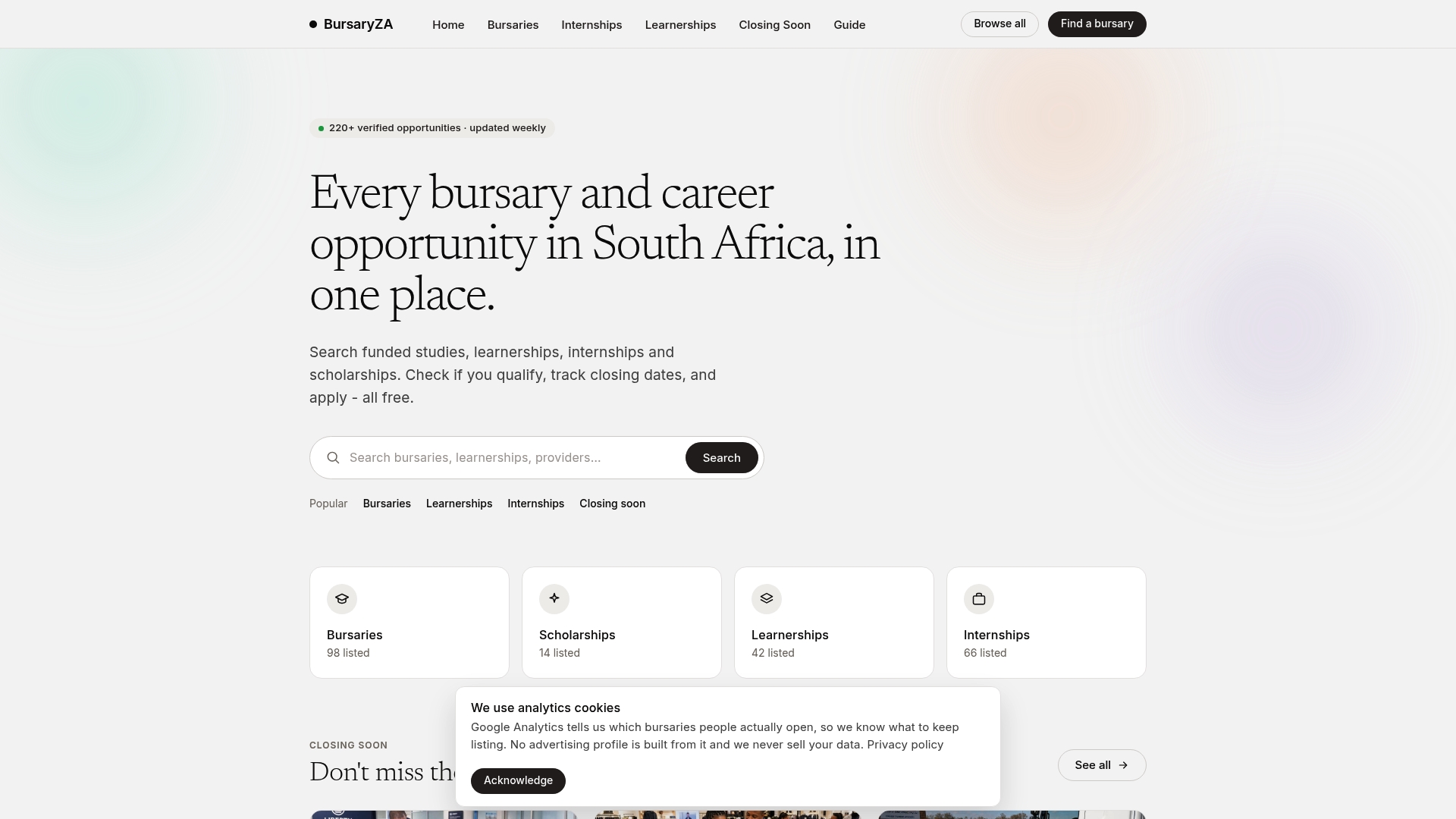
You can filter the full bursary database by field, study level, and province, whether you’re chasing an engineering diploma, a spot in IT and computer science, or provincial funding in Gauteng, the Western Cape, or the Eastern Cape. Save the closing dates that matter to you, and check the bursary application calendar so nothing slips past you between now and the next intake.
Sources
- Study Bursaries And Financial Aid | Boston City Campus South Africa
- Capitec External Bursary 2027 - Home | Aura AMS
- Bursaries for Private Institutions 2026 | Types & Tips (Regenesys)
FAQ
Does Rosebank College offer bursaries for private colleges?
Rosebank College, like most private colleges, publishes its own institutional bursary information on its official site; check its bursary page directly for current eligibility rules and closing dates rather than relying on third-party summaries.
What bursaries are available for private institutions in South Africa?
The main routes are institutional bursaries from the college itself, corporate bursaries in shortage fields like engineering and finance, SETA and industry funding tied to sector skills needs, and trust or foundation awards. A verified database is the fastest way to see current listings across all four categories.
Does the Capitec bursary fund private colleges?
The Capitec External Bursary is open to students registered at DHET or CHE-registered institutions, which can include private colleges depending on the specific qualification and level, so check the current eligibility criteria before applying.
Are there bursaries that fund TVET colleges?
Yes, SETA and industry-linked funding frequently supports TVET qualifications where the trade or skill aligns with sector shortage areas, and some corporate bursaries extend to TVET-level artisan training alongside university-level study.
How do I avoid applying to expired or fake bursary listings?
Filter by field and province through a verified platform, read the eligibility checklist in full, and confirm the listing links directly to the provider’s own official application page before you submit anything.