Stop Rejections: Where to Apply for Verified Bursaries in South Africa

Start with NSFAS if you’re heading to a public university or TVET college, then work through Funza Lushaka (teaching), your institution’s bursary office, corporate programs like those from EY or PwC, and trusts tied to your field of study. Most run through online portals; some still want a downloaded form emailed or posted in. Before you touch any application, confirm you meet the eligibility rules and get your ID, transcripts, and proof of income ready.
TL;DR:
- Most bursaries require applicants to gather and merge multiple documents into a single PDF before submitting through official portals.
- Eligibility thresholds, such as household income limits for NSFAS, and age or study level restrictions, vary significantly between funders.
- Timing is critical, with government schemes opening applications early and closing by January, while corporate bursaries often open mid-year for the following cycle.
- Legitimate bursary listings always link to verified domains and include clear eligibility criteria and fixed deadlines, whereas scams often request payment or vague contact details.
- Using a trusted platform that verifies listings and provides application links, like Bursaryza, helps avoid wasted effort and increases the chances of a successful application.
Table of Contents
- Where to Apply for Bursaries: A Categorized Directory
- How Do You Actually Submit a Bursary Application?
- What Documents and Eligibility Rules Do You Need to Meet?
- When Should You Apply, and How Do You Track Deadlines?
- How Do You Know a Bursary Listing Is Legitimate?
- How Bursaryza Verifies Listings Before You Apply
- What Actually Sinks Most Bursary Applications
- Start Your Search on Bursaryza Today
- Sources
- FAQ
Where to Apply for Bursaries: A Categorized Directory
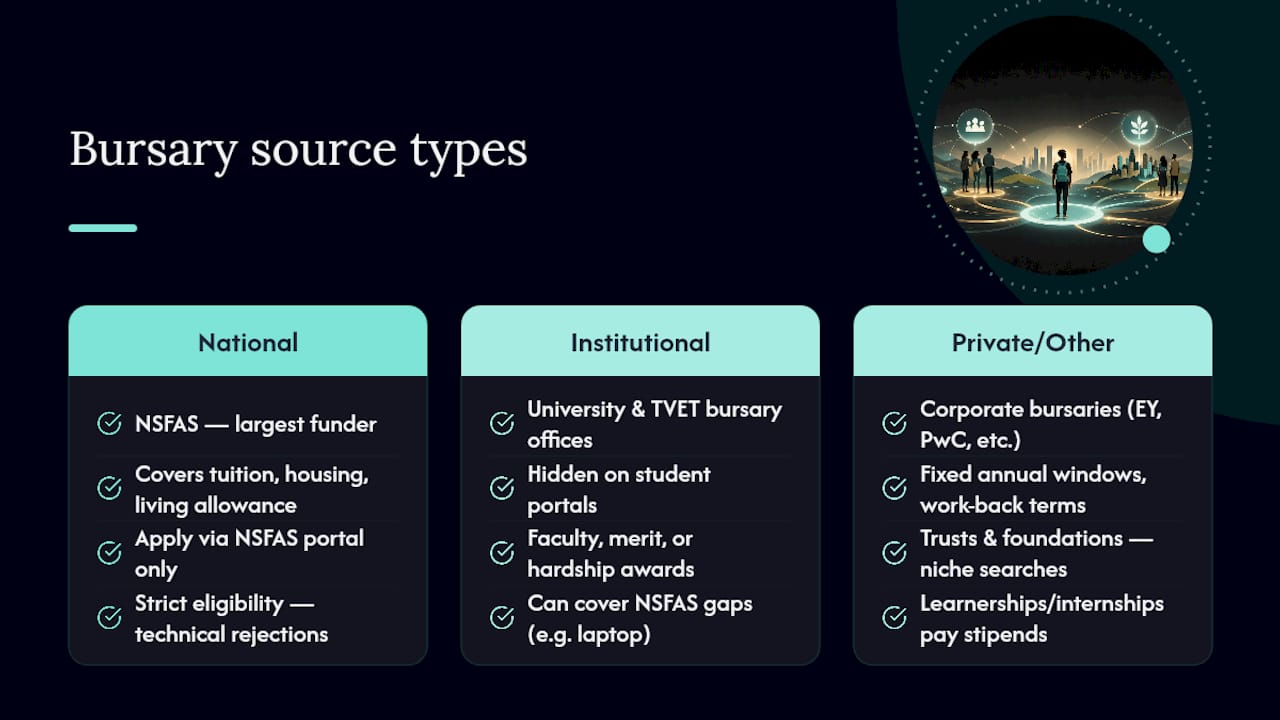
Bursary funding in South Africa doesn’t come from one place. It comes from at least eight distinct channels, each with its own portal, paperwork, and personality. Knowing which one fits your situation saves weeks of wasted effort.
NSFAS is the biggest single funder for students at public universities and TVET colleges. It covers tuition, accommodation, and a living allowance for qualifying households, and everything runs through the official NSFAS portal rather than paper forms. Because it’s a national scheme, its eligibility rules are strict and non-negotiable, which is exactly why so many applications get rejected on technicalities rather than merit.
Funza Lushaka funds future teachers in priority subjects like math, science, and languages, in exchange for a commitment to teach at a public school after graduating. Applicants register through the national e-Gov portal at www.eservices.gov.za, not through a separate Funza Lushaka website, which trips up a surprising number of first-timers who go looking for a standalone site.
University and TVET bursary offices run internal funds that never make it onto major bursary lists. Every public institution has a financial aid or bursary office, often buried a few clicks deep on the student portal, offering scholarships tied to faculty, merit, or hardship.
Corporate bursaries from firms like EY, PwC, and mining or engineering companies target specific degrees, usually accounting, engineering, or actuarial science, in exchange for a work-back period after graduation. These run on fixed annual windows and almost always want documents uploaded as one merged PDF rather than five separate files.
Trusts and foundations tend to be niche. Search by field (“engineering bursary trust South Africa”) rather than by name, since most operate quietly and don’t advertise widely.
Professional bodies and sector funds (SAICA for accounting, ECSA for engineering, HPCSA for health sciences) often list member-linked funding you won’t find on general bursary sites.
Learnerships and internships, run through SETA and employer portals, function as an alternate funding route when a bursary isn’t available. They pay a stipend while you train, sometimes leading to permanent employment.
Bursary aggregators like Bursaryza’s listings pull all of these into one searchable database, filtered by field, province, or closing date, so you’re not hopping between fifteen separate websites.
Pro Tip: Check your university’s bursary office page even if you already have NSFAS. Institutional bursaries often cover gaps NSFAS doesn’t, like laptop allowances or postgraduate funding.
How Do You Actually Submit a Bursary Application?
The process differs depending on whether you’re using a government portal or a downloadable form, but the preparation stage is identical either way.
- Gather your documents first. Certified ID copy, latest academic transcript or matric results, proof of household income (payslips or an affidavit if unemployed), and proof of registration or acceptance at your institution.
- Merge everything into one PDF. Many corporate portals, including EY’s, explicitly require a single merged file rather than separate uploads. Name it clearly (Surname_Bursary_Documents.pdf) so you’re not hunting for the right file at 11:58 PM on closing day.
- Register on the portal. For Funza Lushaka, that means creating an account on the e-Gov portal, verifying your phone number with an OTP, then selecting the Funza Lushaka application from the list of services.
- Fill in every section completely. NSFAS states plainly that incomplete forms will not be accepted into the funding portal. A blank field on page three can sink an otherwise strong application.
- Upload documents, review, and accept the declaration. Read this section instead of skimming it. Declarations often include consent for the funder to verify your information with SARS, your bank, or your institution.
- For downloadable forms, sign physically or digitally, attach certified copies, and send to the verified email or postal address listed on the funder’s own page, never a third-party inbox.
- Confirm receipt. Save the confirmation email, reference number, or system receipt. If nothing arrives within a few days, contact the funder directly rather than assuming it went through.
If you missed a deadline by a day or two, email the institution or funder immediately and ask if late submissions are still being considered. Some do accept them; none will if you never ask.
Pro Tip: Treating your bursary application like a job application, tailored documents, a tracked spreadsheet of what you’ve submitted and when, measurably reduces errors compared to rushing through forms the night before closing.
What Documents and Eligibility Rules Do You Need to Meet?
Most funders ask for a similar core set of paperwork: a certified copy of your ID, your latest academic transcript or certified matric certificate, proof of household income (or a sworn affidavit if a parent or guardian is unemployed), and proof of registration or a conditional acceptance letter from your institution.
NSFAS applies specific financial thresholds: a combined annual household income of R350,000 or less for standard applicants, rising to R600,000 for applicants with a disability. You also need to be registered, or planning to register, at an approved public institution. NSFAS doesn’t fund students at private colleges.
Academic rules vary by year of study. Continuing students generally need to have passed a set percentage of their registered modules the previous year, while first-year applicants are judged mostly on matric results and admission status.
Age and field-specific rules matter too. Funza Lushaka, for instance, only accepts first-time applicants aged 30 or younger, a limit many students discover too late because it’s not mentioned on general bursary roundups.
- Certified ID copy (not older than three months for some funders)
- Latest academic transcript or certified matric certificate
- Proof of household income or a certified affidavit
- Proof of registration or an official acceptance letter
When Should You Apply, and How Do You Track Deadlines?
Timing separates students who get funded from those who miss out on nothing more than a calendar error. Government schemes and NSFAS typically open applications toward the end of the calendar year for the following academic year, closing around January. Corporate bursaries run on a different rhythm entirely, with many major programs opening applications between July and September for the following intake.
That mismatch is the trap. A student who only checks bursary sites in January will miss half the corporate window, because it already closed months earlier.
Build a simple tracking habit instead of relying on memory:
- Set email alerts or saved searches on aggregator sites so new listings in your field reach you automatically.
- Subscribe to your institution’s financial aid newsletter, since many bursary offices announce internal deadlines only through that channel.
- Check field-specific and provincial lists separately from general searches. A Gauteng-based or Western Cape program may never appear in a national roundup.
How Do You Know a Bursary Listing Is Legitimate?
Legitimate bursaries always link back to an official domain, either a gov.za address, a university’s own site, or the funding company’s verified careers page. If a listing sends you to a generic form on a site you’ve never heard of, stop and verify before entering any personal details.
Real bursary programs publish a clear eligibility checklist, a specific closing date, and a named contact person or department. You should be able to cross-check that information against the funder’s own website in under two minutes.
Watch for the classic warning signs:
- A request for payment to “process” or “secure” your application (legitimate bursaries never charge applicants).
- Vague or missing contact details, or a contact email that doesn’t match the organization’s domain.
- Pressure to submit personal banking details before any offer has been confirmed.
- No verifiable closing date, or a date that keeps shifting when you check back.
Pro Tip: Before applying anywhere unfamiliar, search the exact bursary name alongside the word “scam” or “fake.” South African students have flagged fraudulent listings publicly enough that a quick search usually surfaces the warning within seconds.
How Bursaryza Verifies Listings Before You Apply
Every listing on Bursaryza goes through a verification pass before it’s published: confirming the funder’s domain, checking that the closing date is current, and linking directly to the official application page rather than a third-party form. That’s the difference between a database you can trust and a generic list scraped from elsewhere.
Each entry carries an eligibility checklist so you know within seconds whether it’s worth your time, instead of reading three pages of terms only to discover you don’t qualify.
Practical next step: use the matching tool to filter by field of study, study level, and province, then check the application calendar so you know exactly which windows are open this month.
What Actually Sinks Most Bursary Applications
Most rejected applications don’t fail on merit. They fail on avoidable mechanics: an uncertified ID copy, a form signed in the wrong section, documents uploaded as five separate files when the portal wanted one merged PDF, or a submission sent two hours after a portal closed for good.
A short checklist fixes most of it. Merge your documents before you start. Name files clearly. Screenshot or save every confirmation receipt. Keep a simple log of what you submitted and when, so a follow-up email doesn’t turn into guesswork.
One pattern shows up again and again in successful applications: students who prepared their document pack a week in advance, rather than the night before, submitted cleaner forms and caught errors, a mismatched surname, an expired ID copy, before it cost them the application.
— Nkosi
Start Your Search on Bursaryza Today
Bursaryza works differently from scrolling through scattered Facebook posts or outdated PDFs from three years ago. Every listing on the platform carries a verified application link straight to the funder, an eligibility checklist, and a confirmed closing date, so you spend your time applying instead of fact-checking.
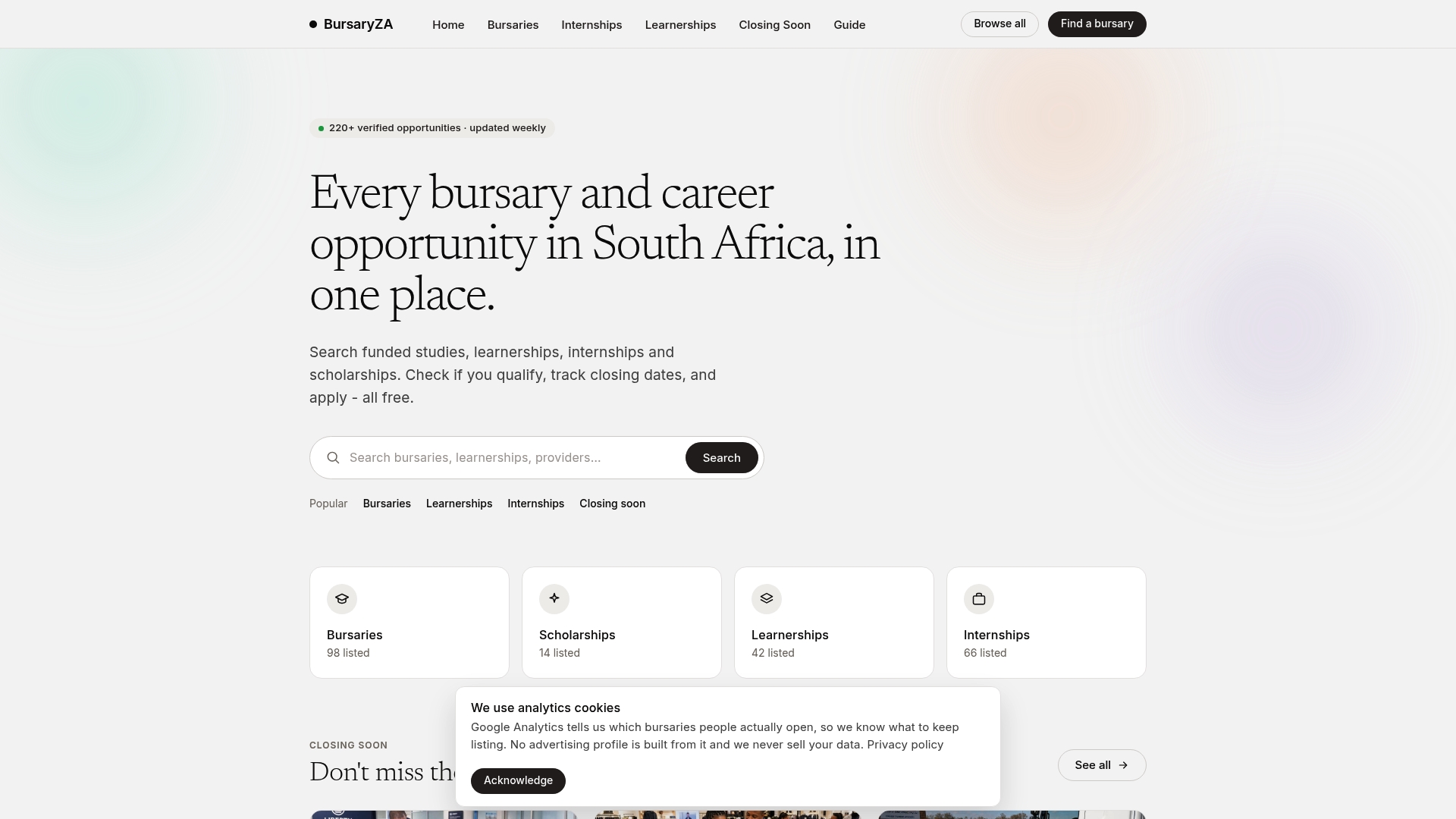
Search the full bursary database by field, province, or deadline, and narrow it down to opportunities you actually qualify for in minutes rather than hours. If you’re studying in a specific field, jump straight to category pages like science bursaries or social sciences funding, or check what’s open in your province right now. Students who need income while they train can also browse current learnerships and internships, including employer-run programs listed alongside partner training resources like Parrillo Air’s student opportunities. Save your favorites, sign up for deadline alerts, and check the application calendar so nothing closes while you’re still gathering documents. Start your search now and apply before the window shuts.
Sources
- NSFAS 2026 bursary guidelines (Annexure A)
- Funza Lushaka first-time applicant instructions
- Apply for our Bursary Program | EY - South Africa
FAQ
Which Companies Give Out Bursaries in South Africa?
Corporate bursaries come from firms like EY, PwC, and major mining, engineering, and telecom companies, usually tied to specific degrees such as accounting, engineering, or IT, in exchange for a work-back commitment after graduation.
How Much Is Bursary Money Per Month?
Amounts vary widely by funder and typically cover tuition, accommodation, and a monthly living allowance rather than a fixed cash sum. NSFAS and most institutional bursaries publish their exact allowance breakdown once an application is approved, since it depends on your institution and living arrangement.
Which Bursaries Are Still Open for 2026?
Openings change constantly, government schemes and NSFAS typically close around January, while many corporate programs run July through September. Check a live bursary application calendar rather than relying on a static list, since closing dates shift year to year.
Who Qualifies for a Bursary in South Africa?
Eligibility depends on the funder, but NSFAS requires South African citizenship or permanent residency, registration at a public institution, and a household income of R350,000 or less (R600,000 for applicants with a disability). Corporate and trust bursaries add their own academic or field-specific requirements on top of that baseline.