South Africa’s Scarce Skills List: The Official Guide for 2026

Two government documents matter here, and they do different jobs. The Department of Higher Education and Training’s 2024 National List of Occupations in High Demand (OIHD) tells you which occupations South Africa’s labor market is actually short on, and it’s built for education planning. The Department of Home Affairs’ Critical Skills List tells you which occupations qualify for a Critical Skills Work Visa. Confuse the two and you’ll waste time.
If you’re picking a course or a career path, start with OIHD. If you’re weighing immigration or a visa-linked job offer, the Critical Skills List is the one that counts.
Demand right now clusters around a handful of sectors:
- Engineering (civil, electrical, mechanical, mining)
- ICT (software development, data, cybersecurity)
- Health (nursing, pharmacy, radiography, medical specialists)
- Finance and accounting (auditors, actuaries, financial analysts)
- Trades and artisans (electricians, welders, millwrights)
Download the DHET technical report first. Check the DHA gazette second, and only if immigration status is part of your plan.
Key Takeaways
Matching a scarce-skill occupation from the DHET OIHD to a verified, funded study path is the single most effective way to turn a government list into a real career outcome.
| Point | Details |
|---|---|
| Use two separate lists | DHET’s OIHD guides study and career choices; DHA’s Critical Skills List governs visa eligibility only. |
| Record OFO codes early | Note the OFO code and NQF level for your target occupation before applying for registration or funding. |
| Engineering, ICT, and health lead | These three sectors dominate both the 2024 OIHD and recent employer demand surveys. |
| Verify locally before committing | Cross-check national list entries against provincial job adverts and OIHD annexures. |
| Search funding by field and province | Bursaryza lets you filter verified bursaries for scarce-skill fields like engineering and health by location. |
Table of Contents
- What Is South Africa’s Scarce Skills List, Really?
- Which Sectors Show Up Most on the Official Lists?
- How Do You Turn a List Into an Actual Career Plan?
- Where Do You Download the Official Documents and Check for Updates?
- Turning a Scarce-Skill Choice Into Funded Study
- What Nkosi Thinks Students Get Wrong About These Lists
- Find Verified Funding for Scarce-Skill Study on Bursaryza
- Sources
What Is South Africa’s Scarce Skills List, Really?
There isn’t one single “scarce skills list south africa” searchers can bookmark. There are two, each with a distinct legal purpose, and mixing them up leads to bad decisions, like choosing a degree based on visa eligibility criteria that have nothing to do with local hiring demand.
The OIHD is compiled using the Organising Framework for Occupations (OFO) codes, a national classification system that assigns every occupation a standard identifier. DHET combines OFO codes with labor-market indicators, including Quarterly Labour Force Survey data, vacancy statistics, and employer survey mentions, to produce a composite demand score.
The Critical Skills List works differently. It exists under the Immigration Act, and its sole function is to determine who qualifies for a Critical Skills Work Visa. An occupation may appear on one list but not the other, and that’s by design, not an oversight.
- Use OIHD when you’re deciding what to study or which sector to target for work.
- Use the Critical Skills List when a visa, work permit, or professional registration is on the table.
- Cross-check professional-body requirements (ECSA for engineers, HPCSA for health professionals) since DHA references these bodies directly for verification.
Pro Tip: If your occupation needs SAQA evaluation or ECSA registration, note the OFO code from the OIHD report before you apply. Both agencies use it to confirm your qualification matches the listed occupation.
Which Sectors Show Up Most on the Official Lists?
Engineering keeps its long-standing spot near the top of both government lists. Civil, electrical, mechanical, mining, and energy engineers and technologists all appear repeatedly across OFO-coded categories, a pattern that has held since the 2014 National Scarce Skills List first flagged the same occupations more than a decade ago.

ICT has grown the fastest. Software developers, data scientists, network engineers, and cybersecurity specialists now dominate the digital category, and industry surveys point to accelerating demand for AI, data, and cybersecurity roles heading into 2026, on top of shortages that were already severe.
Health remains structurally short-staffed. Nursing professionals, medical specialists, pharmacists, and radiographers show up across both provincial and national data, and most of these roles require HPCSA registration before you can practice.
Trades and artisan work rarely gets the same attention as engineering or ICT, but the numbers tell a different story:
- Electricians, plumbers, millwrights, welders, and toolmakers appear consistently on the OIHD
- Many require a recognized trade test and NQF Level 4 or 5 qualification
- TVET colleges are the primary training route for most of these occupations
Finance and accounting round out the list, with accountants, auditors, actuaries, and financial analysts flagged nationally. Teaching (particularly maths, science, and technical subjects) and environmental science occupations also appear, though with lower demand scores than engineering or health.
One detail catches people off guard: occupation order on the OIHD doesn’t signal priority. DHET lists occupations that cleared a demand threshold, not a ranked top ten, so an occupation near the bottom of the report can still carry genuine scarcity.
How Do You Turn a List Into an Actual Career Plan?
Start with the OIHD and work through it methodically rather than skimming for job titles that sound promising.
- Shortlist occupations from the OIHD. Record the OFO code and the typical NQF level for each one, since you’ll need both later for course selection and professional registration.
- Check the Critical Skills List if immigration matters to you, or if the occupation requires formal registration with a body like ECSA or HPCSA. Not every OIHD occupation appears there, and that’s expected.
- Verify local demand before committing. National lists smooth over regional variation, so cross-reference job adverts in your target province and, where available, provincial OIHD annexures.
- Start your bursary search early. Scarce-skill fields attract targeted funding, and application windows close fast, often six to nine months before the academic year starts.
Pro Tip: Keep a simple document with three columns as you go through the DHET report: OFO code, NQF level, and which annexure mentioned the occupation. It turns a 200-page PDF into a two-minute reference the next time you’re filling out an application.
Where Do You Download the Official Documents and Check for Updates?
Go straight to the primary sources rather than relying on summaries, since amendments happen and secondhand lists go stale.
- OIHD (2024): the DHET technical report contains the methodology, OFO codes, and full occupation list in its annexures. DHET reviews this biennially.
- Critical Skills List: the DHA gazette PDF reflects the 2022 gazette with 2024 amendments, still the operative version for visa applications.
- Check the publication date and gazette notice number on any list you find online. Older lists, including the 2014 National Scarce Skills List, still circulate on third-party sites and get mistaken for current data.
- Watch for new gazette notices and DHET labor-market intelligence updates, since amendments to either list happen outside the main biennial review cycle.
Turning a Scarce-Skill Choice Into Funded Study
Picking an occupation from the OIHD only gets you halfway. The next question is how you pay for the qualification, and this is where the scarce-skills framing actually works in your favor. Public and municipal funders build their bursary criteria around the same shortage areas the government lists flag, which means a strong OIHD match often lines up with a real, fundable opportunity.

Most bursaries in scarce-skill fields cover tuition, registration, and prescribed textbooks, and a good number extend to accommodation and structured mentorship. In exchange, most carry a return-of-service clause, typically requiring you to work for the funder or in the public sector for a period matching your years of funded study. The National Skills Fund channels money specifically into scarce and priority skills areas, supporting both TVET training and workplace learning aligned with national labor-market priorities. Municipal programs work the same way at a smaller scale. The City of Cape Town’s external bursary scheme targets scarce-skill fields directly and comes with similar post-study obligations.
Bursaryza’s field pages let you filter by discipline and province, so if the OIHD points you toward engineering, health, or IT, you can go straight to the engineering bursaries page, health sciences page, or IT and computer science page instead of searching blind. Before applying anywhere, gather your ID, academic transcripts, proof of household income, and a motivational letter, since most scarce-skill bursaries request all four upfront. Every listing on Bursaryza carries an eligibility checklist and closing date, so you can confirm you qualify before spending time on an application.
What Nkosi Thinks Students Get Wrong About These Lists
Most students treat the OIHD like a job guarantee, and that’s the biggest misread I see. A skills list tells you where national demand sits in aggregate. It doesn’t promise you a job in your specific town the month you graduate, and it doesn’t account for how saturated a single employer’s applicant pool might already be for a “scarce” role in a major city.
The bigger issue is that people chase the Critical Skills List for career decisions when it was never built for that purpose. It exists to regulate immigration, not to guide South African school-leavers toward a degree. If you’re not thinking about a visa, that document should barely factor into your planning.
What actually works is treating OIHD as a starting filter, then doing the unglamorous verification work: checking provincial job adverts, confirming NQF and registration requirements, and lining up funding before you commit years of study to a field. The students who do well out of scarce-skill fields aren’t the ones who found the flashiest occupation on a government PDF. They’re the ones who matched a genuine, verifiable shortage to a funded, realistic study plan.
— Nkosi
Find Verified Funding for Scarce-Skill Study on Bursaryza
Bursaryza gives you a faster route from “this occupation is in demand” to “this is how I’ll pay for it” than digging through provider websites one at a time. Search by field and province together, engineering in Gauteng, health sciences in the Western Cape, and you get listings with the closing date, eligibility checklist, and direct application link already laid out, instead of hunting for that information across a dozen separate bursary pages.
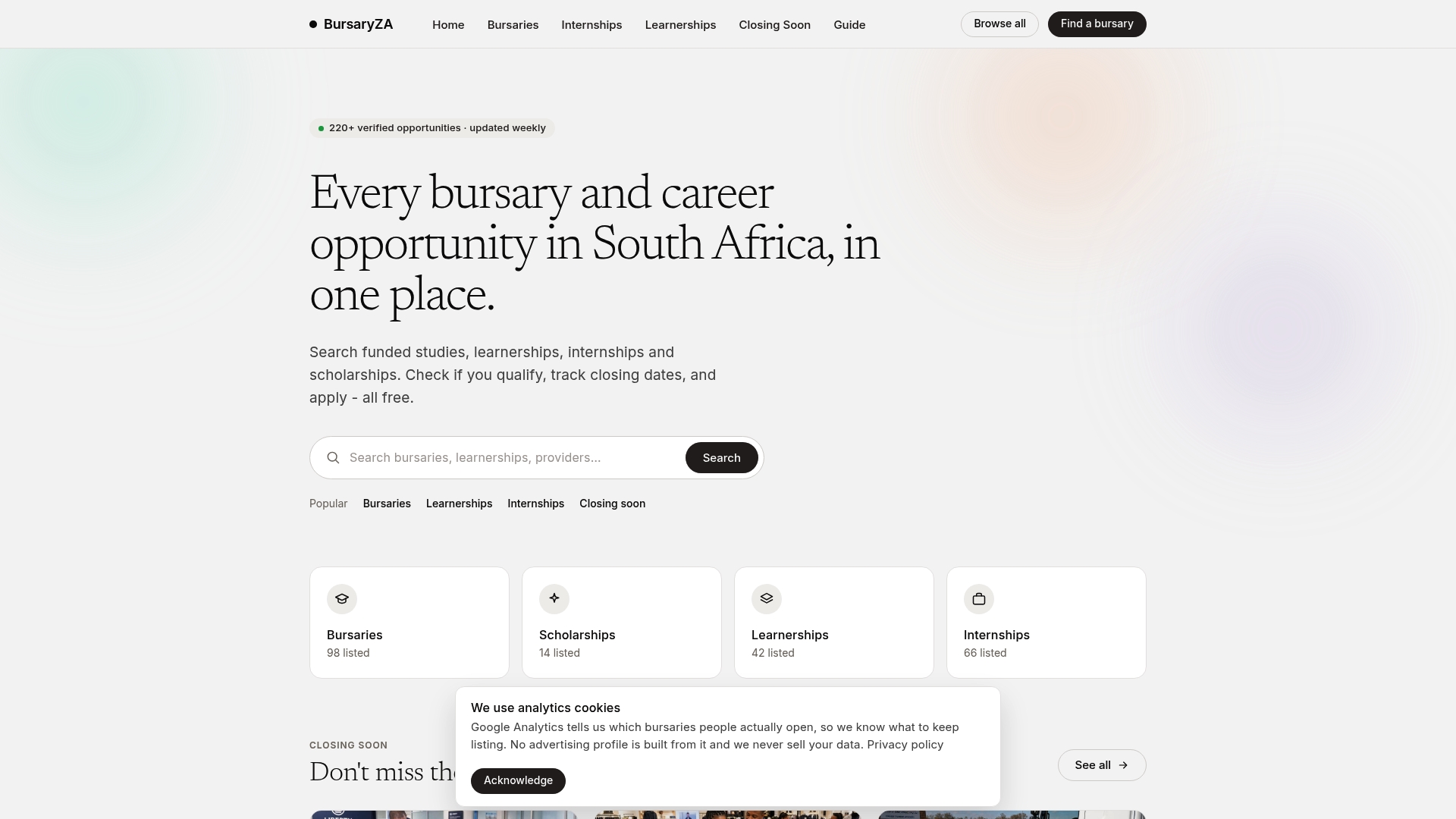
Every listing on Bursaryza goes through a verification process before it’s published, so you’re not gambling on an expired scholarship or a scam application form. If the OIHD flagged an engineering or health occupation for you, start with the engineering bursaries page or browse the full bursaries search page to filter by your field and province. Set aside twenty minutes today to run that search and shortlist two or three closing dates before they pass.
Sources
- South Africa’s National List of Occupations in High Demand (DHET technical report)
- Immigration Act: Critical Skills List (Department of Home Affairs PDF)
- National Scarce Skills List: Top 100 Occupations in Demand (Government Gazette / Notice 2014)
- National Skills Fund (NSF)
- These are the critical skills South Africa desperately needs in 2026 (BusinessTech)