14 Days to Pass Internship Psychometric Tests in South Africa

Psychometric tests for internships are timed, standardized assessments that measure how you reason, solve problems, and behave under pressure. Employers use them to compare hundreds of applicants fairly and quickly. The single best move you can make is to identify the exact test type named in your invitation email and drill that format using official samples or your university’s careers resources, rather than practicing generic tests at random.
TL;DR:
- Focus your practice on the specific test publisher and format listed in the invitation email to avoid wasting time on irrelevant question styles.
- Prioritize diagnosing your weaknesses with an untimed sample test before engaging in targeted drill sessions, especially in the two weeks leading up to the test.
- Confirm technical requirements, test timing, and rules before starting, and set pacing strategies during the exam to prevent rushing or leaving questions unanswered.
- Seek official practice materials directly from the publisher or university resources instead of unreliable third-party sites promising guaranteed scores or leaked questions.
- Use your test performance to identify which skills need improvement, creating a targeted plan for future tests rather than viewing a score as final.
Table of Contents
- What Types of Psychometric Tests Do Internship Applicants Face?
- What Should You Check Before You Sit an Internship Assessment?
- How Should You Prepare for a Psychometric Test With Limited Time?
- Test-Day Checklist and Time-Management Tactics
- What if You Need Accommodations or the Test Fails Midway?
- Where Can You Find Reliable Practice Materials?
- Common Mistakes to Avoid During Internship Psychometric Tests
- How to Use Your Test Results for Future Applications
- A Fairer Way to Think About These Tests
- Find Verified Internships While You Prepare
- Sources
What Types of Psychometric Tests Do Internship Applicants Face?
Internship recruiters typically pull from five test families, and each one checks a different skill. Knowing which one you’re facing changes how you should spend your practice time.
- Numerical reasoning tests your ability to work with charts, ratios, and percentages under time pressure. A typical question shows a sales table and asks you to calculate a percentage change. Finance, banking, and analyst internships lean on this heavily.
- Verbal reasoning checks whether you can judge a written passage as true, false, or “cannot say” based only on the text given. Consulting and legal internships use this to test how carefully you read.
- Abstract reasoning presents shape or pattern sequences and asks you to spot the rule and pick what comes next. Engineering and technical internships favor this because it strips out language and math bias.
- Situational judgment tests (SJTs) describe a workplace scenario, such as a colleague missing a deadline, and ask you to rank your likely responses. Graduate programs at large corporates use SJTs to screen for judgment and teamwork.
- Personality questionnaires ask you to rate statements about your own working style and have no right or wrong answer, though they do flag inconsistent responses.
The ACCA Jobs guide to psychometric and personality tests breaks these categories down further and matches them to common graduate roles.
What Should You Check Before You Sit an Internship Assessment?
Read the invitation email twice before you touch a practice test. It usually names the test publisher, the time limit, and the rules, and each of those details changes how you prepare.
Look for:
- The publisher’s name (so you can find that company’s own practice format instead of a generic one)
- The exact duration and number of questions, since pacing differs by publisher
- Whether the test uses negative marking for wrong answers
- Allowed devices and browser requirements, including whether a webcam or lockdown browser is required
- Whether calculators or scratch paper are permitted
Most internship-level numerical and verbal tests run for a short, timed period and cover a moderate number of questions, though exact numbers vary by publisher and role level. Career advisers consistently point to one detail candidates skip: the National Careers Service guidance on psychometric tests stresses checking the invitation and practicing the specific format before test day, not a random one. Practicing the wrong publisher’s style wastes hours and builds false confidence.
How Should You Prepare for a Psychometric Test With Limited Time?
Start with a diagnostic, not a study guide. Sit one untimed sample test from the correct publisher or category first, and mark every question you got wrong or guessed on. That single sample usually reveals the two error patterns costing you the most points, whether that’s misreading data tables or running out of time on the last third of the test.
If you have two weeks before your test, follow this staged plan:
- Day 1 to 2: Run the diagnostic and log your error types by category.
- Day 3 to 8: Drill your two weakest skills daily in short 20 to 30 minute sessions, using targeted question sets rather than mixed practice.
- Day 9 to 11: Switch to timed mixed practice that blends question types, matching the real test’s pace.
- Day 12 to 13: Review every mistake from your timed sets and note why you got it wrong, not just that you did.
- Day 14: Simulate full test conditions once, at the same time of day as your real test, with no notes and no pauses.
If you only have 48 hours, cut the drilling and go straight to one timed mock focused purely on pacing. Career guidance from UTS Careers recommends this diagnostic-first approach specifically because it stops candidates from wasting scarce time on skills they’ve already mastered.
Pro Tip: Track your errors in a simple two-column list: “careless” versus “didn’t know how.” Most candidates discover careless mistakes outnumber knowledge gaps two to one, which means slowing down by even a few seconds per question often beats another hour of drilling.
Test-Day Checklist and Time-Management Tactics
Technical failures and rushed pacing sink more candidates than difficult questions do. A few minutes of setup on test day prevents both.
Before you start, confirm:
- A charged laptop or desktop (avoid tablets and phones unless the invitation permits them)
- A stable internet connection, tested at least ten minutes beforehand
- A quiet, well-lit room with no interruptions for the full test window
- Any permitted materials nearby (calculator, scratch paper, water)
Once the test begins, never click your browser’s back button. It can discard your progress and lock you out of the question entirely. Read each instruction screen fully, since publishers sometimes change scoring rules between question sets.
For pacing, set a mental stopping point per question (roughly one minute for numerical or verbal items) and move on if you exceed it. Guess based on elimination rather than leaving answers blank, unless the test explicitly penalizes wrong guesses more than blanks.
Pro Tip: Work through easier questions first if the platform allows skipping. Banking early points reduces panic later, when harder questions eat your remaining time.
What if You Need Accommodations or the Test Fails Midway?
Reasonable adjustments exist for documented conditions like dyslexia or ADHD, but you need to request them early, usually when you first receive the invitation. Prepare any existing diagnostic documentation from a doctor or university disability office in advance, since most publishers need a few days to process requests.
If your test freezes or disconnects:
- Take a screenshot of the error immediately
- Note the exact time and question number where it happened
- Email the recruiter or testing coordinator the same day, not days later
Retake policies vary by employer. Some allow a second attempt automatically after a technical failure; others require a formal request. If you score poorly, ask the recruiter politely whether feedback is available. Many companies will tell you which section brought your score down, which is useful information even if you don’t move forward this round.
Where Can You Find Reliable Practice Materials?
Start with the source, not a search engine. Official publisher samples match the real interface and question style far more closely than third-party imitations.
- Official test publisher samples, often linked directly in your invitation email
- University careers services, which frequently offer free professional-grade practice platforms and workshops, sometimes with the same tools employers actually use, as outlined by Careers UCT’s psychometric assessment guidance
- Free practice libraries like Psychometrictests, which cover numerical, verbal, abstract, and situational judgment formats with worked answers
- BursaryZA’s internship listings, which help you find verified opportunities and see application requirements, including when a psychometric assessment forms part of the process, through the internships database
Avoid any site promising a guaranteed score or leaked questions. Those claims are red flags, not shortcuts, and the National Careers Service guidance mentioned earlier makes the same point about sticking to legitimate sources.
Common Mistakes to Avoid During Internship Psychometric Tests
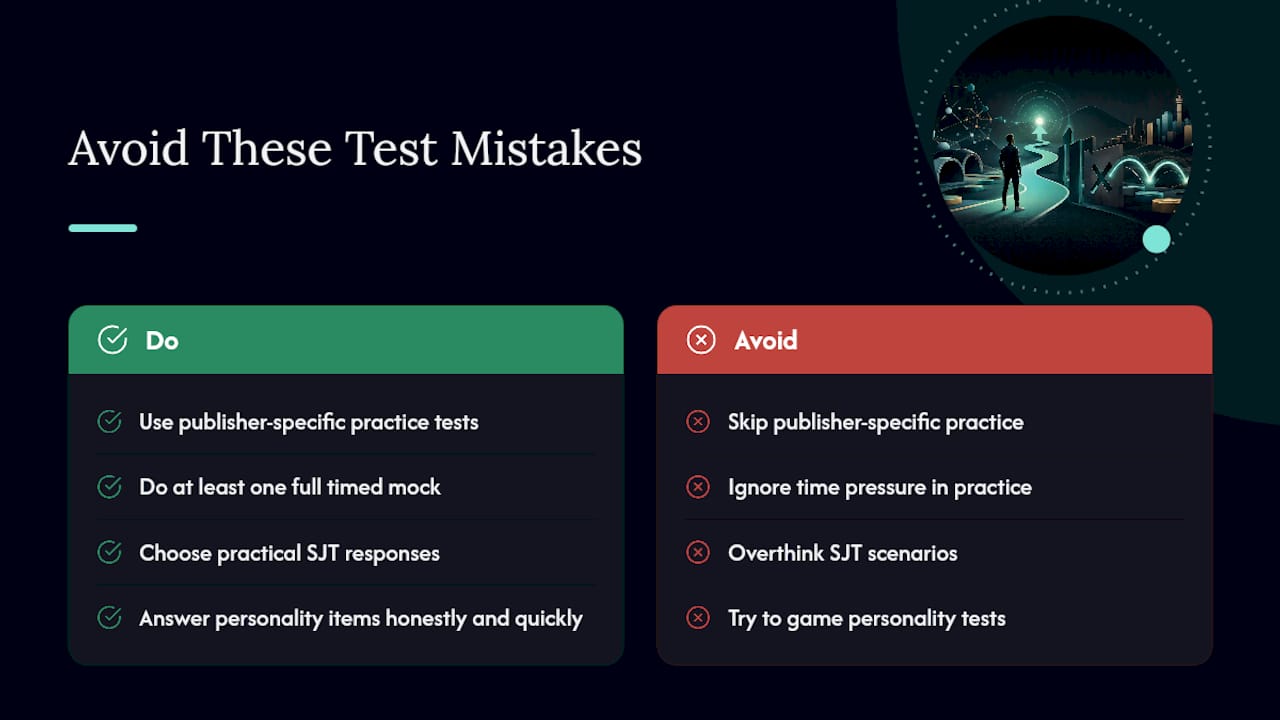
The biggest mistake is practicing the wrong test type entirely. If your invitation names a specific publisher and you skip straight to a generic online quiz, you’re training for a different exam than the one you’ll actually sit.
The second mistake is ignoring time pressure until test day. Untimed practice builds accuracy but not speed, and most internship tests fail candidates on pacing, not knowledge. Always run at least one full timed mock before the real thing.
Overthinking SJT scenarios trips up plenty of strong candidates too. These tests usually reward the response that reflects sound workplace judgment and cooperation, not the most clever or unconventional answer. Second-guessing yourself into an unusual choice rarely helps.
On personality questionnaires, trying to guess the “ideal employee” profile backfires. Publishers build in consistency checks, and answers that contradict each other across similar questions get flagged. Answer honestly and quickly instead of overanalyzing each statement.
Finally, don’t skip the instructions screen. Scoring rules, calculator permissions, and time limits sometimes shift between sections, and missing a rule change costs more points than a genuinely hard question ever will. Rushing past setup to “save time” is exactly the mistake that costs candidates the most of it.
How to Use Your Test Results for Future Applications
A single test score is a data point, not a verdict on your ability. If you score well, note which practice habits worked so you can repeat them for the next employer’s test. If you score poorly, treat it as diagnostic information rather than a rejection.
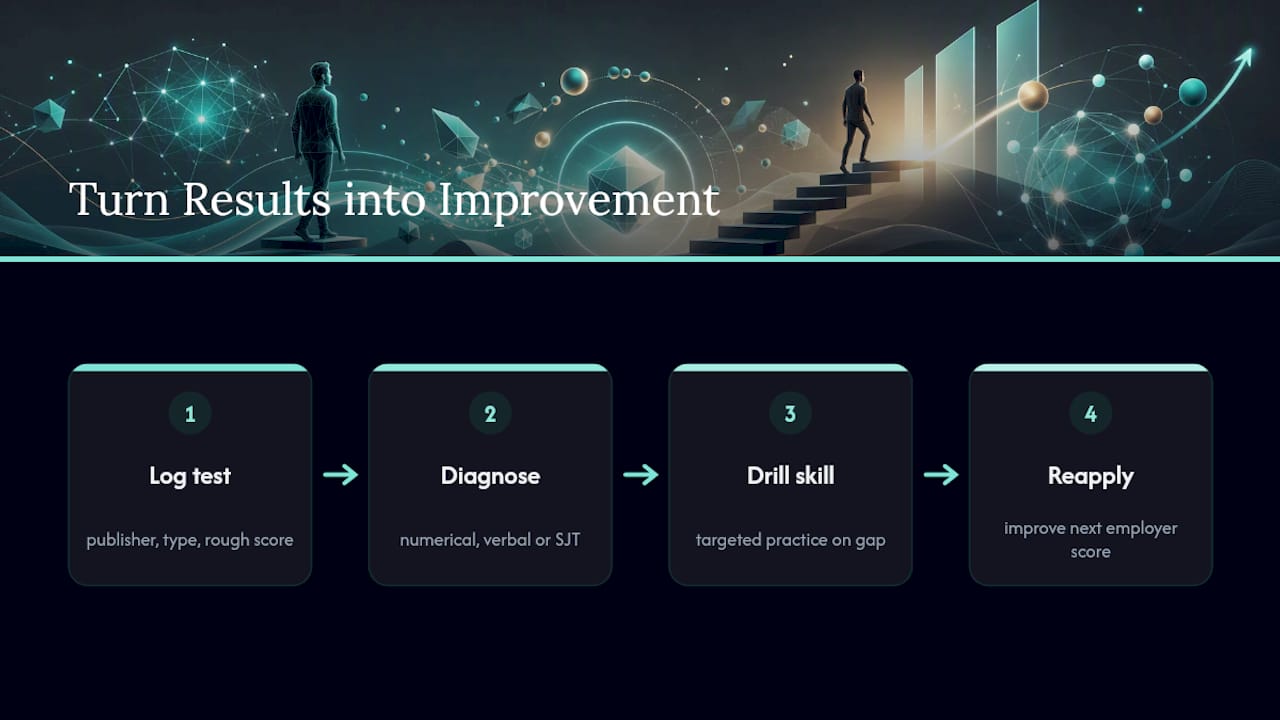
Ask yourself which category dragged your score down: was it numerical speed, verbal comprehension under time pressure, or SJT judgment calls? That answer tells you exactly what to drill before your next application, instead of re-practicing everything from scratch.
Keep a simple log across every test you take: publisher name, test type, your rough score, and what error pattern showed up. Over two or three applications, that log becomes a genuinely useful map of your strengths, and it turns each test into practice for the next one rather than an isolated pass or fail moment. Many candidates who fail one employer’s numerical test pass another’s a month later, purely because they fixed the specific gap the first test revealed.
A Fairer Way to Think About These Tests
Psychometric tests exist to standardize comparisons across hundreds of applicants who can’t all get face time with a hiring manager. That’s not a trap. It’s a leveling mechanism, and preparation genuinely moves the needle more than talent alone. Lean on university careers services and verified free resources before you consider anything that promises a shortcut, since the honest work of practicing the right format still beats any guarantee.
— Nkosi
Find Verified Internships While You Prepare
One can find verified internship listings on platforms that provide eligibility checklists, closing dates, and direct application links, so you understand what each internship requires, including whether a psychometric assessment is involved, before spending hours preparing.

That clarity matters more than it sounds. Instead of scrolling job boards full of expired postings, you can filter by field, study level, and location, and move straight to the application. If funding for further study is part of your plan alongside internship hunting, the bursary listings and funding guides cover that ground too. Start by browsing the internships database and shortlist two or three roles that match your field, then check each listing’s requirements before your next test invitation lands in your inbox.
Sources
- Psychometric Assessments & Assessment Centres — Careers UCT
- Psychometric tests: prepare and practise — National Careers Service
- Psychometrictests
- A guide to performing well in psychometric and personality tests — ACCA Jobs