What the NQF Levels Mean for Your Studies and Career

The National Qualifications Framework ranks every South African qualification on a scale from Level 1 to Level 10, from basic schooling to doctoral degrees. It exists so that students, employers, and universities can compare qualifications on equal footing. Knowing your current level and your target level tells you exactly which programs you qualify for and what you still need to get there.
TL;DR:
- A Level 4 qualification, like Matric, is the minimum entry point for Level 5 higher certificates, diplomas, and degrees in South Africa.
- Recognition of prior learning can shortcut progression if you can provide solid evidence of existing skills and knowledge, but formal assessment is necessary.
- Credits typically represent about ten hours of learning each, with 360 credits needed for a three-year diploma or degree, and progression cannot be skipped without meeting prerequisites.
- Employers and institutions trust NQF levels for capability assessment based on learning outcomes, not just duration or institution reputation.
- Filtering study and funding options by your current NQF level increases the chances of matching opportunities and avoids wasting effort on incompatible programs.
Table of Contents
- NQF Levels Explained: Who Runs the Framework and Why
- Understanding NQF Levels 1 Through 10
- Common NQF Equivalence Questions, Answered
- How Credits and Recognition of Prior Learning Move You Up
- Turning Your NQF Level Into a Study or Career Plan
- What Learners Get Wrong About Matching Their Level to Funding
- Find Bursaries and Learnerships That Match Your NQF Level
- Where to Verify NQF Levels and Qualifications
- Sources
NQF Levels Explained: Who Runs the Framework and Why
The NQF isn’t a loose guideline. It runs on legislation, and one body answers for how it works: the South African Qualifications Authority (SAQA), the custodian and coordinating body of the framework, which also keeps the National Learners’ Records Database (NLRD) where your qualifications get formally recorded.
SAQA doesn’t manage the whole system alone. The NQF Act splits the framework into three sub-frameworks, each covering a different slice of education:
- The General and Further Education and Training Qualifications Sub-Framework (GFETQSF) covers Levels 1 to 4, the school and basic adult education space.
- The Higher Education Qualifications Sub-Framework (HEQSF) covers Levels 5 to 10, everything from higher certificates through doctorates, and falls under the Council on Higher Education (CHE).
- The Occupational Qualifications Sub-Framework (OQSF) covers Levels 1 to 6 on its own, with Levels 7 and 8 occupational qualifications needing coordination between the Quality Council for Trades and Occupations (QCTO), CHE, and relevant professional bodies.
That overlap matters more than it looks. A Level 6 qualification could sit under HEQSF as a diploma or under OQSF as an occupational certificate, and the distinction changes who accredits it and how employers read it.
Underneath all three sub-frameworks sit CHE’s level descriptors, which spell out what a learner at each level should actually be able to do: the scope of knowledge expected, how independently they can solve problems, and how they’re expected to communicate and manage their own learning. This is a learning-outcomes approach. A Level 6 descriptor isn’t about how many months you sat in a classroom; it’s about demonstrated capability. That’s why recognition of prior learning can work at all, and it’s why employers trust an NQF level even when they’ve never heard of the specific institution that issued it.
Understanding NQF Levels 1 Through 10
Each level represents a jump in complexity, independence, and the kind of problem-solving you’re expected to handle. Here’s the level-by-level breakdown most learners actually need.
This maps out into the three bands most guidance documents refer to: Levels 1 to 4 (general education), Levels 5 to 7 (mid-tier higher education), and Levels 8 to 10 (postgraduate study). Each band has its own logic.
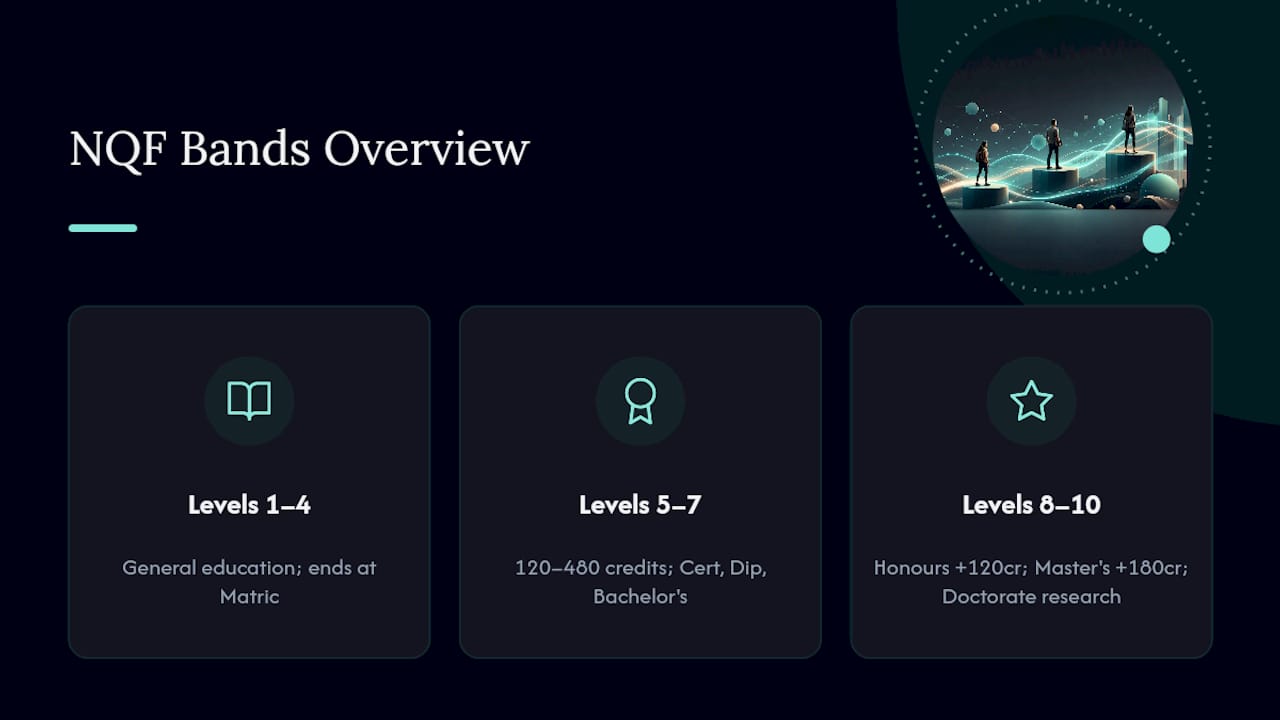
Levels 1 to 4 get you through school or an equivalent adult basic education path. This band ends at Matric, and that’s the gateway most further study depends on.
Levels 5 to 7 open once you’ve cleared that gateway. A higher certificate at Level 5 typically runs on 120 credits for a single year of study. A national diploma at Level 6 usually needs around 360 credits across three years. A bachelor’s degree at Level 7 generally requires a similar 360 to 480 credit range depending on the field, with engineering and some professional degrees running longer.
Levels 8 to 10 are where specialization deepens. Honours and postgraduate diplomas sit at Level 8, typically adding 120 credits on top of a bachelor’s. A master’s degree at Level 9 usually runs another 180 credits minimum, often involving a dissertation or thesis component. A doctorate at Level 10 has no fixed credit ceiling in the same way. It’s assessed on original research contribution, not just accumulated study hours.
If you want a sense of what “capability” looks like at the higher end, CHE’s own descriptors note that a Level 8 graduate should be able to operate with limited supervision and take responsibility for their own learning and performance, while Level 6 and 7 descriptors focus more on applying known methods to defined problems.
Common NQF Equivalence Questions, Answered
A few questions come up constantly, so here are direct answers.
- Is Matric NQF Level 4? Yes. The National Senior Certificate sits at Level 4, which is why it’s the standard entry requirement for Level 5 and higher study.
- Is N6 the same as Matric? No, and this trips up a lot of TVET students. N6 sits closer to Level 6 territory once combined with the required work experience for a National N Diploma, well above Matric’s Level 4.
- Is Level 5 good? It depends entirely on your goal. A Level 5 higher certificate is a solid, fast entry point into employment or a stepping stone into a Level 6 diploma, but it’s not equivalent to a full degree.
- Is Level 7 a degree or a diploma? Level 7 covers both bachelor’s degrees and advanced diplomas. The qualification type, not just the level, determines which doors it opens.
How Credits and Recognition of Prior Learning Move You Up
Credits work like currency inside the NQF. One credit generally represents around ten hours of learning, and qualifications are built from set credit totals: roughly 120 credits for a certificate year, 360 for a three-year diploma or degree, and 480 for some longer bachelor’s programs.

Progression is sequential by design. You can’t skip from Level 4 straight to Level 7 without meeting the entry requirements in between, because each level’s unit standards and outcomes build on what came before. That said, recognition of prior learning (RPL) can shortcut part of that climb if you can prove you already have the knowledge or skill, even without a formal certificate for it.
If you think RPL applies to you, here’s the practical sequence:
- Gather your evidence. Transcripts, workplace assessments, certificates of attendance, or unit-standard proof of competence all count.
- Contact the relevant provider or SAQA directly. Providers assess RPL claims against their own program’s entry requirements; SAQA handles broader qualification verification.
- Request a formal assessment. This usually involves a portfolio review or a practical skills test, not just a document check.
- Get the outcome in writing. Keep the letter or certificate confirming your recognized level. You’ll need it for future applications.
Pro Tip: Keep a running folder of every certificate, unit-standard result, and training completion letter you ever receive, even from short courses. RPL claims live or die on paper evidence, and scrambling to find a 2019 training certificate the week before a diploma application deadline is a bad place to be.
Turning Your NQF Level Into a Study or Career Plan
Knowing the framework is only useful once you apply it to your own next move. Three steps get you there.
- Identify your current level. If you’ve completed Matric, you’re at Level 4. If you’ve finished a national diploma, you’re likely at Level 6.
- Set your target level. Want to become a chartered accountant? You’re looking at Level 8 or higher eventually. Want a technical trade qualification fast? Level 5 or 6 through a learnership might get you working sooner.
- Map the credits and prerequisites between the two. This tells you whether you need a bridging program, a foundation year, or can apply directly.
Checking entry requirements works differently depending on the route. Universities publish minimum APS scores tied to Matric subjects at Level 4. TVET colleges often accept N-level or Level 3 to 4 qualifications directly into N4 programs. Learnerships, meanwhile, frequently target a specific level as the entry point, whether that’s Level 4 for entry-level learnerships or Level 5 for something like Liberty’s wealth management learnership.
This is where BursaryZA’s database earns its keep alongside SAQA’s own verification tools: filtering opportunities by study level saves you from applying to programs you don’t yet qualify for, or worse, missing ones you already do.
Pro Tip: If you’re moving from a TVET diploma into a university degree, ask the receiving institution about articulation agreements before you assume your credits transfer. Some do, some don’t, and finding out after enrollment is expensive.
What Learners Get Wrong About Matching Their Level to Funding
The biggest mistake I see is learners applying broadly instead of by level. Someone with a Level 4 Matric certificate applies to a Level 7 bursary meant for third-year engineering students, gets an automatic rejection, and assumes the whole funding system is rigged against them. It isn’t. It’s just mismatched.
A better habit: check the qualification level attached to a bursary or learnership before anything else, not the funding amount or the company name. When learners start filtering by level first, their application-to-response ratio improves noticeably, simply because they stop wasting effort on programs that were never going to accept them.
— Nkosi
Find Bursaries and Learnerships That Match Your NQF Level
Once you know your level, the harder part is finding funding that actually fits it instead of scrolling through hundreds of listings you don’t qualify for. Bursaryza’s database is built around exactly that problem: every listing shows eligibility checklists and study-level details up front, so you can filter by field, level, and province instead of guessing.
Whether you’re at Level 4 hunting for a first learnership or at Level 7 chasing a fully funded degree, the bursaries listings let you narrow results fast, and the scholarships page covers higher-level academic funding if you’re aiming for postgraduate study. Learners in specific provinces can also check funding available closer to home, like opportunities in Gauteng or Western Cape. If you’re weighing a short course or additional certification alongside your bursary search, training partners like GetVoucher cover certification pathways worth exploring too. Start by checking your current NQF level against the eligibility checklist on any listing that catches your eye. That single step saves you from applying to programs that were never going to say yes.
Where to Verify NQF Levels and Qualifications
For anything level-specific, go straight to the primary sources rather than relying on secondhand summaries.
- SAQA verifies individual qualifications and maintains the NLRD as the official record of registered qualifications.
- CHE’s level descriptors PDF spells out exactly what each level requires in terms of knowledge and skill.
- Gov.za hosts the NQF Act text itself, useful if you need the legal wording rather than a summary.
- Provincial education department pages, like the Western Cape’s NQF guidance, explain credits and unit standards in plainer terms for learners navigating TVET pathways.
Sources
- SAQA (official site)
- Level descriptors for the South African National Qualifications Framework (CHE PDF)
- NQF Levels 1-10: A Quick Breakdown of South Africa’s Educational Ladder (Regent Business School)
- National Qualifications Framework (Western Cape Government)