Avoid Fake Listings: Find 2026 IT Learnerships in South Africa

The fastest route into an accredited IT learnership in South Africa is to check verified listings such as BursaryZA’s learnership page, MICT SETA, and provider adverts, then have your certified ID, matric certificate, and CV ready before you apply. Most programs run 12 months, combine classroom training with workplace placement, and pay a stipend between R2,500 and R6,500 a month. Apply early. Closing dates fill fast, and late documents disqualify strong candidates every intake.
TL;DR:
- Verify that the training provider is registered with SAQA and the program is accredited through the relevant SETA or QCTO before applying.
- Focus on accredited sources like MICT SETA, verified employer pages, and BursaryZA listings to avoid outdated or fake opportunities.
- Be prepared with certified documents, a tailored CV highlighting relevant subjects and experiences, and apply early within a two to three-week window.
- Most learnerships last 12 months and lead to an NQF Level 3 to 5 qualification, with workplace exposure often more valuable than the stipend amount.
- After completion, graduates typically move into entry-level support roles and should continue building certifications and practical experience to advance.
Table of Contents
- What Is an IT Learnership in South Africa?
- Where Do You Find Legitimate IT Learnership Openings?
- Who Qualifies for an IT Learnership?
- What Skills Do IT Learnership Graduates Actually Gain?
- How to Apply for an IT Learnership Step by Step
- How Do You Choose the Right IT Learnership?
- What Happens After You Complete an IT Learnership?
- Weighing the Benefits and Challenges of an IT Learnership
- How Do You Balance Work and Study During a Learnership?
- Why IT Learnerships Matter for South Africa’s Skills Pipeline
- Find Verified IT Learnerships Faster With BursaryZA
- A Note on Why Verification Matters More Than Ever
- Sources
What Is an IT Learnership in South Africa?
An IT learnership pairs classroom instruction with real workplace experience, and it leads to a registered qualification rather than just a certificate of attendance. MICT SETA, the sector body overseeing information and communications technology training, defines learnerships as work-based education linked to an NQF qualification, structured around three parties: the learner, a training provider, and a host employer.
Most IT learnerships sit at NQF Levels 3 to 5, covering qualifications like Information Technology: Systems Support, Systems Development, and Software Testing. The number matters more than it looks. NQF 5 sits roughly at the level of a higher certificate, which means a learnership graduate walks away with something a recruiter can verify against the National Qualifications Framework, not a vague “training completed” letter.
Duration typically runs 12 months. Learning 4 Life’s IT System Support learnership, for example, splits that year into 4 months of classroom theory followed by 8 months of workplace placement, ending in an NQF Level 5 outcome.
Before applying anywhere, confirm accreditation. Check that the training provider is registered with SAQA (the South African Qualifications Authority) and that the specific program is accredited through the relevant SETA or the QCTO (Quality Council for Trades and Occupations). A provider that can’t point you to a SAQA ID number for its qualification is not one worth your time.
Where Do You Find Legitimate IT Learnership Openings?
Verified sources beat random Facebook shares every single time. Start with these, in order of reliability:
- MICT SETA itself, which lists accredited providers and funded learnership cycles directly.
- Provider and employer pages, including SITA’s provincial internship adverts, Vodacom Foundation’s Youth Academy, and Learning 4 Life’s published intakes.
- Verified aggregators like BursaryZA, which cross-check eligibility criteria and closing dates before listing an opportunity, so you don’t waste hours chasing a program that closed weeks ago.
- General job boards such as PNet, LinkedIn, and Indeed, which carry a high volume of listings under “IT learnership” but vary widely in how well they’re vetted.
That last point deserves a caveat. Job portals sometimes duplicate the same SETA or provider advert across multiple postings, or leave expired listings live for weeks. Treat them as a supplementary search, not your primary one.
Provincial residence often matters more than applicants expect. SITA and similar community-based programs give preference to candidates living within the province where the training venue sits, which makes sense once you consider the logistics of daily attendance over a full year.
Pro Tip: Set a recurring weekly reminder to check BursaryZA’s IT and computer science listings and your chosen SETA’s page. Learnership adverts often stay open for only two to three weeks, and the strongest applicant pool applies in the first few days.
Who Qualifies for an IT Learnership?
Eligibility rules vary slightly by provider, but a consistent pattern shows up across MICT SETA, SITA, and private training providers. Run through this checklist before you invest time in an application:
- Age: Most programs target applicants generally between young adult age ranges, though some, including certain SITA internships, allow older applicants up to mid-thirties.
- Citizenship: South African citizenship with a valid, certified ID copy is close to a universal requirement.
- Education: A matric certificate (NQF Level 4) is the baseline for most IT learnerships, occasionally with specific subject requirements like Mathematics or Mathematical Literacy.
- Employment status: You generally need to be unemployed and not currently enrolled in full-time study.
- Documents on hand: Certified ID, certified matric certificate, proof of residence, an updated CV, a SARS tax number if you have one, and banking details for stipend payment.
Some providers also request affidavits confirming unemployment status, and disability inclusion is explicitly encouraged on most SETA-funded intakes, with people living with disabilities welcomed to apply.
One detail trips people up constantly: the stipend is classified as a training allowance, not a salary. MICT SETA is clear that learnerships don’t automatically carry the same benefits as standard employment, so don’t assume UIF contributions or PAYE deductions apply unless the provider confirms it in writing.
What Skills Do IT Learnership Graduates Actually Gain?
Employers hiring learnership graduates aren’t just checking for a certificate. They’re looking for someone who can troubleshoot a printer issue on day one without hand-holding. The specializations on offer typically fall into a few buckets: systems support and end-user computing, software development, cybersecurity fundamentals, and data support roles.
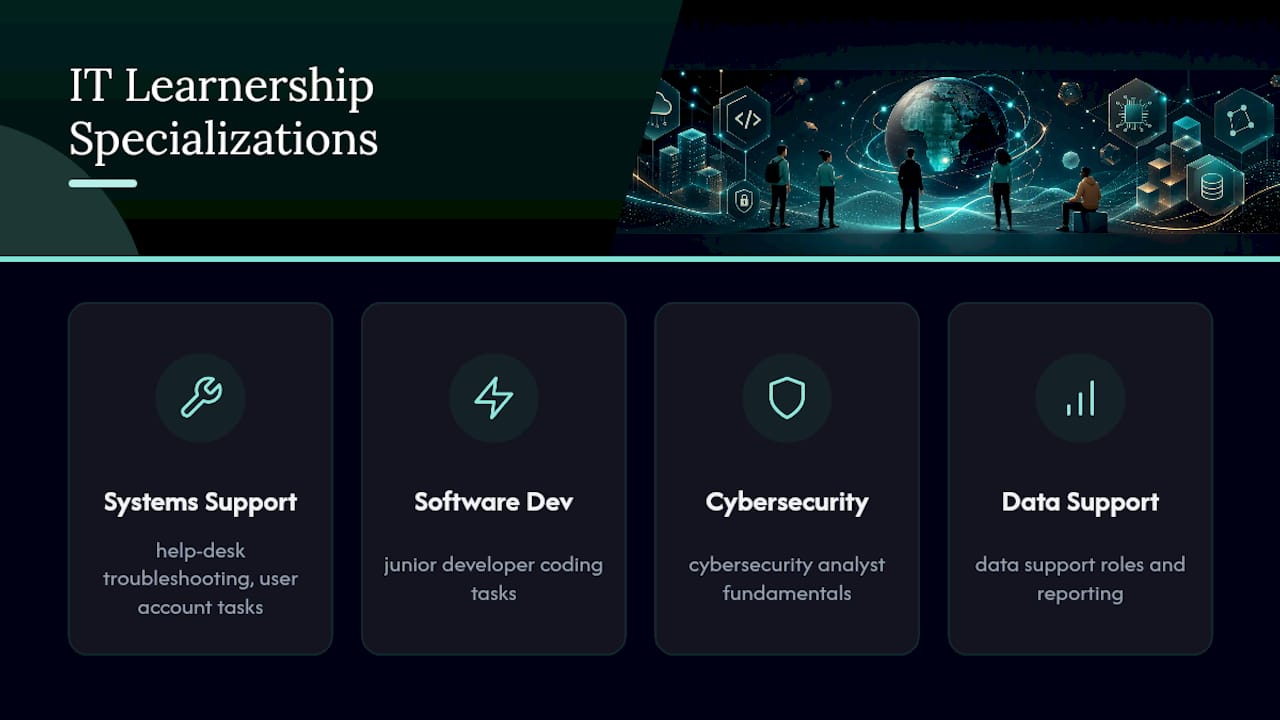
Practically, that translates into help-desk troubleshooting, basic networking concepts (think IP addressing and connecting a workstation to a network), system administration tasks like managing user accounts, and increasingly, cloud fundamentals as more South African businesses shift infrastructure off-site. Soft skills matter just as much. Workplace professionalism, clear written communication for logging support tickets, and the ability to explain a technical fix to a non-technical colleague are exactly what separates a learnership graduate who gets absorbed into permanent employment from one who doesn’t.
When it comes time to apply for your next role, document the learnership properly on your CV. List the specific NQF qualification, the workplace tasks you handled (not just “attended training”), and any systems or software you used day to day. In an interview, be ready to walk through one real troubleshooting scenario you handled during your placement. That single concrete story usually beats a page of buzzwords.
How to Apply for an IT Learnership Step by Step
Follow this sequence and you’ll avoid the mistakes that knock out most first-time applicants before they even reach an interview.
- Gather and certify your documents first. Certified copies of your ID and matric certificate, proof of residence, and your CV need to be ready before a closing date appears, not scrambled together the night before. Many providers, including Learning 4 Life, require documents to carry a SAPS stamp confirming certification.
- Tailor your CV to the program. Highlight relevant school subjects (Mathematics, Computer Applications Technology, Information Technology as a subject if you took it), plus any informal IT experience, from fixing a family member’s laptop to running a school’s social media page.
- Apply through the right channel. Register directly on the SETA or provider’s portal, or apply via a verified listing on BursaryZA’s learnership page. Note the closing date the moment you find the advert. SETA-funded intakes are frequently posted through individual provider pages rather than one central portal, so you may need to check several sources for the same intake cycle.
- Follow up and prepare for assessment. After submitting, a shortlisting call or email typically follows within a few weeks. Expect a practical component, sometimes a basic troubleshooting scenario or a short written assessment, alongside a standard interview.
Pro Tip: Keep a simple spreadsheet logging where you applied, the closing date, and the exact documents you submitted. When five different providers ask for slightly different document formats, that log saves you from resubmitting the wrong version.
Once accepted, expect an onboarding period where your stipend payment details, banking information, and program schedule get finalized, usually within the first two to four weeks before formal training starts.
How Do You Choose the Right IT Learnership?
Not every learnership advert deserves your time. Weigh each opportunity against a short list of criteria before committing:
- Accreditation clarity: Can the provider name the SAQA qualification ID and SETA registration? If not, walk away.
- Workplace exposure: How many months of actual hands-on placement does the program include, versus classroom-only time?
- Stipend and payment method: Is the amount specified, and is it paid via bank transfer with a clear schedule?
- Delivery mode: On-site, blended, or fully remote, and does that match your access to data and a reliable device?
- Named employer or host organization: Vague listings that never name the actual training venue are a warning sign.
Red flags to walk away from immediately: any request for an upfront application fee, stipend figures that sound too generous for the sector, or a provider that can’t produce a physical address or verifiable contact number.
One insight worth weighing heavily: the depth of practical workplace exposure often matters more for landing a permanent job afterward than a marginally higher stipend. A learnership offering eight months of hands-on help-desk work will usually serve your career better than one offering ten months of classroom lectures and two months of placement, even if the second pays slightly more.
What Happens After You Complete an IT Learnership?
Completion opens a specific, realistic set of entry-level doors, not a guaranteed leap into a senior role. Graduates of systems support learnerships typically move into IT support technician, help-desk agent, or desktop support roles. Those who came through a software development track often land junior developer or software testing positions. Systems support and networking graduates sometimes move into junior network administrator roles within a year or two.
The progression pattern that shows up most often looks like this: entry-level support or junior technical role, followed by two to three years building experience and possibly a further certification (CompTIA A+, Network+, or a vendor-specific certificate like Microsoft or AWS fundamentals), then a move into a specialized or senior technical role.
Absorption into the host employer isn’t automatic. Some employers, particularly larger corporates and government-linked bodies, do retain a portion of learnership graduates into permanent roles, but plenty of graduates need to job-hunt actively once their contract ends. That’s exactly why documenting your learnership experience precisely, rather than vaguely, matters so much when you start applying externally. A hiring manager wants to see specific systems you worked on, ticket volumes you handled, or a project you contributed to, not just “completed IT learnership.”
The realistic takeaway: treat the learnership as your foundation year, not your finish line. Keep building certifications and practical projects even while you’re still enrolled.
Weighing the Benefits and Challenges of an IT Learnership
The upside is substantial for someone starting from zero. You gain a recognized NQF qualification, a full year of workplace experience most graduates your age don’t have, a stipend that covers transport and basic costs while you train, and a direct line into the sector’s professional network through your host employer and fellow learners.
The challenges are real too, and worth naming honestly rather than glossing over. The stipend covers survival costs, not luxury, and is usually designed to cover transport and data expenses during training. It won’t stretch to rent, transport, and data with much left over in most metro areas. Competition for spots is intense, particularly for well-known providers like Vodacom’s Youth Academy, so rejection on a first or second attempt is common and not a reflection of your ability. Some placements involve repetitive administrative tasks early on rather than immediate hands-on technical work, which can feel discouraging if you expected to be coding from week one.
There’s also the uncertainty around what happens after the 12 months end. Without a guaranteed absorption clause, some graduates finish their learnership facing the same job search they started with, just now armed with a qualification and a year of references instead of nothing.
None of that makes a learnership a bad move. It just means going in with accurate expectations beats going in disappointed.
How Do You Balance Work and Study During a Learnership?
Managing a learnership successfully comes down to treating it like a real job from day one, even during the classroom months. Show up on time, every time. Attendance records get checked, and providers do report absenteeism to funders.
Build a weekly study rhythm rather than cramming before assessments. Learnership theory blocks move fast, often compressing a semester’s worth of content into a few weeks, so falling one week behind compounds quickly. Block out two or three evenings a week specifically for reviewing coursework, even if that means turning down social plans during the theory phase.
During the workplace placement months, ask questions early and often. Supervisors expect learners to ask rather than guess, and a wrong guess on a live system carries more consequence than a wrong guess in a classroom exercise. Keep a running log of tasks you complete and problems you solve. That log becomes your CV material later and doubles as evidence if your performance is ever questioned.
Financially, budget the stipend tightly from month one. Since it’s classified as a training allowance rather than a salary, treat it as covering transport and data, and build a small buffer where you can. If your provider offers any additional support, mentorship sessions, wellness check-ins, or peer study groups, use them. Learners who isolate themselves during the program tend to struggle more with both the coursework and the workplace adjustment.

Why IT Learnerships Matter for South Africa’s Skills Pipeline
South Africa’s technology sector faces a persistent gap between the digital skills employers need and the pipeline of qualified entry-level candidates coming through. IT learnerships exist specifically to close that gap, funded through the SETA levy system that requires companies to contribute toward accredited skills development rather than treating training as optional.
For an unemployed young person without a degree, a learnership offers something a university pathway often can’t: a paid route into the sector that doesn’t require years of tuition debt before you earn a cent. That structural role matters beyond individual outcomes. Every cohort that completes an accredited program adds to a national pool of certified IT support technicians, junior developers, and systems administrators feeding into both large corporates and the small businesses digitizing their operations across the country.
The programs also spread opportunity geographically in a way pure market hiring doesn’t always manage. Provincial preference clauses on programs like SITA’s internships push training investment toward applicants outside the usual Johannesburg and Cape Town concentration, giving learners in smaller centers a genuine shot at sector entry without relocating first.
It’s an imperfect system. Funding cycles fluctuate, and not every graduate gets absorbed. But measured against the alternative, a generation of young people locked out of the tech economy entirely, the learnership model does real, measurable work toward narrowing South Africa’s digital skills divide.

Find Verified IT Learnerships Faster With BursaryZA
Chasing down legitimate learnership adverts across a dozen provider websites eats time you could be spending on your application itself. Bursaryza built its learnerships page to solve exactly that problem: every listing runs through a verification process before it’s published, so you’re not gambling on whether a closing date is real or an employer even exists.

Each listing on Bursaryza comes with an eligibility checklist spelled out upfront, so you know within thirty seconds whether you meet the age, citizenship, and education requirements before you spend an hour on an application. Direct application links cut out the guesswork of hunting for the right portal, and the filtering tool lets you narrow searches specifically to IT and computer science opportunities, by province, by qualification level, or by provider.
Set an alert on the IT and computer science field page today, and you’ll see new verified IT learnership listings the moment they go live, ahead of the general job board rush.
A Note on Why Verification Matters More Than Ever
The stipend numbers on offer, generally R2,500 to R6,500 a month, will never look like a full graduate salary, and treating a learnership as anything other than a paid training year sets you up for disappointment. What it actually buys you is a recognized qualification and twelve months of documented workplace experience that a CV with no experience simply can’t compete with.
The bigger risk isn’t a low stipend. It’s wasting weeks on a listing that turns out to be outdated, duplicated, or outright fake, chasing a provider that never responds because the intake closed months ago. Verified sources exist precisely to prevent that. Use them, apply early, and treat every rejection as data rather than a verdict on your ability. Persistence, paired with a genuinely verified opportunity, is what gets learners across the line.
— Nkosi
Sources
- Learnerships | MICT SETA
- SITA Internship advert 2026-27
- Learning 4 Life IT System Support Learnership 2026 – Apply by 13 July - SETA SA