How to Write an Internship Cover Letter That Gets Read

An effective internship cover letter is a concise pitch that opens with a specific project or result, then spends three more short paragraphs proving that you fit the role. Skip the apology for lacking “real” work experience. Lead with proof of capability instead.
The standard structure runs four paragraphs: an opening hook, evidence tied to the posting, a company-fit paragraph, and a close. Here’s the fast version:
- Paragraph 1: Name the role, where you saw it, and one concrete result or project.
- Paragraph 2: Match two skills from the posting to coursework, tools, or a personal project.
- Paragraph 3: Name one specific reason this team or company, not a generic compliment.
- Paragraph 4: State availability, mention attachments, and close politely.
Pro Tip: Pull three exact phrases straight from the internship posting and use them in your letter. Recruiters skim for language that mirrors the job ad, and generic templates get filtered out fast.
Key Takeaways
A strong internship cover letter is concise, opens with a specific project or result, and matches two posting keywords with real evidence.
| Point | Details |
|---|---|
| Structure | Four paragraphs: hook, evidence, company fit, close, in that order. |
| Length | Stay between 150 and 250 words on a single page. |
| Replace experience | Use coursework, projects, or clubs and quantify outcomes with real numbers. |
| Fix the top mistakes | Skip generic greetings, apologies, and unproofread attachments before you send. |
| Find real roles fast | Bursaryza’s verified internship listings give you posting language to personalize your letter immediately. |
Where This Advice Comes From
This guide draws on practical, step-by-step formatting from CUT’s cover letter guide, structural advice from UNISA’s career development resources, and tips from Handshake’s student career guide, alongside verified listings from Bursaryza.
Table of Contents
- What Makes a Strong Cover Letter for an Internship Application
- How to Write Each Paragraph, Step by Step
- Three Short Cover Letter Examples You Can Adapt
- Common Internship Cover Letter Mistakes to Fix Before You Hit Submit
- Sources
What Makes a Strong Cover Letter for an Internship Application
The elements that separate a forgettable letter from one that gets a callback aren’t complicated, but most students skip at least two of them.
Start with the greeting. Search the internship posting, the company’s “our team” page, or LinkedIn for the hiring manager’s name. If none turns up, address the department directly: “Dear Data Analytics Hiring Team” beats “To Whom It May Concern” every time. Career-service guidance from UNISA consistently points to naming a real person or team wherever possible.
The hook comes next, and it carries the most weight. Don’t open with “I am writing to apply for…” Open with the result: “After building a inventory-tracking app that cut manual entry errors by 40% for a class project, I want to bring that same instinct for automation to your operations team.” That single line reframes you from beginner to contributor.

Then prove it. Pick two skills straight from the job posting and match each to something real: a course project, a tool you’ve used, a club you ran. If the listing mentions Excel modeling, cite the budget spreadsheet you built for a student society, not a vague claim that you’re “proficient.”
Company fit needs a name, not a compliment. “I admire your innovative culture” says nothing. “I followed your team’s recent expansion into renewable energy audits and want to contribute to that work” says everything.
Close with a clear ask: your availability, a reference to your attached résumé, and a thank you. Here’s the order that works:
- Header and greeting
- Hook (project or result)
- Evidence matched to posting keywords
- Company-specific fit
- Close with availability and attachments
How to Write Each Paragraph, Step by Step
Here’s the paragraph-by-paragraph recipe, written the way you’d actually type it.
Paragraph 1: State the role and hook immediately. Something like: “I’m applying for the Marketing Internship posted on [company career page], and I’m bringing the same campaign-planning skills that grew our student newspaper’s Instagram following by 65% in one semester.” Name where you found the posting. It shows you did more than mass-apply.
Paragraph 2: Present your evidence with numbers. This is where coursework, tools, and metrics do the heavy lifting. Robert Walters Africa’s cover letter guidance recommends quantifying results wherever you can, whether that’s a percentage, a budget size, a team size, or a competition placement. “Led a five-person team” is stronger than “worked in a team.” “Managed a $2,000 event budget” beats “helped with events.”
Paragraph 3: Connect to a specific team or project. Research the company’s recent work, a product launch, a case study on their site, a press mention, and tie it to your own goals. This is the paragraph that signals genuine interest rather than a mass-mailed application, and it’s often the one students skip entirely.

Paragraph 4: Close with action. Offer a portfolio link if you have one, state your availability clearly (“available to start in June and can work full-time through August”), and sign off with a simple thank you.
Formatting matters as much as content:
- Keep the letter to 150 to 250 words, matching the length guidance career-service pages consistently give.
- Fit it on a single page with a readable font like Calibri or Arial at 11 or 12 point.
- Include a contact header: name, phone, email, LinkedIn if relevant.
- Name your file clearly: “FirstName_LastName_CoverLetter_CompanyName.pdf.”
- Save as PDF unless the application portal specifically requests a Word document. PDFs hold formatting across devices; DOCX files sometimes shift.
Three Short Cover Letter Examples You Can Adapt
Each of these follows the four-paragraph structure and is concise. Swap the bracketed details for your own.
Technical internship example: “I’m applying for the Software Engineering Internship at [Company]. Last semester, I built a class project that automated grade tracking for a 40-student cohort, cutting manual entry time by half. I’m proficient in Python and SQL, both listed in your posting, and I’ve used Git for every project I’ve shipped through my university’s coding club. I noticed [Company] recently launched a mobile app redesign, and I’d like to bring my debugging and testing experience to that kind of work. I’m available to start in [month] and have attached my résumé and GitHub portfolio.”
Swap: the language/tool names, the specific product or launch you reference, your availability date.
Marketing internship example: “I’m writing to apply for the Marketing Internship posted on your careers page. Your posting calls for experience with content calendars and analytics, both skills I built running that account. I’ve followed [Company]'s recent rebrand and want to contribute fresh ideas to that campaign. I’m available immediately and have attached my résumé and a short portfolio of past campaigns.”
Swap: the metric, the platform, the campaign or rebrand you reference.
Business or administration internship example: “I’m applying for the Operations Internship at [Company]. Your posting emphasizes process improvement, which matches the workflow audit I completed for our council last term. I’d welcome the chance to bring that same attention to detail to your team’s upcoming expansion. I’m available to start [month] and have attached my résumé for review.”
Pro Tip: Never copy these word for word. Career-center sample letters from schools like Columbia exist to show structure, not to hand you finished text. A recruiter who’s read 200 letters will spot a template instantly.
Common Internship Cover Letter Mistakes to Fix Before You Hit Submit
Most rejected letters fail for the same handful of reasons, and every one of them is fixable in five minutes.
- Generic greetings and generic praise. “To Whom It May Concern” and “I love your innovative company” tell a recruiter nothing. Find a name or a specific project instead.
- Opening with an apology. “Although I lack formal experience…” kills momentum in the first sentence. Lead with what you can do, not what you haven’t done yet.
- Writing too much. Hiring managers skim. Anything past 250 words risks getting skipped entirely.
- Skipping proofread and attachment checks. A misspelled company name or a missing résumé attachment is an instant pass in many hiring pipelines.
- Adding GPA or portfolio links that don’t help. Include your GPA only if it’s strong and relevant; include portfolio links only when the work is polished enough to withstand a click.
- Fix generic openers by naming a real hook.
- Fix length by cutting adjectives, not evidence.
- Fix proofreading gaps by reading the letter aloud before sending.
- Fix formatting slips by saving as PDF and naming the file clearly.
Copy-Ready Checklist for a Fast Draft
Use this when you’re filling out an application box and need to move quickly.
- Header: full name, phone, email, LinkedIn (if active).
- Greeting prompt: “Dear [Name/Team],”
- Paragraph 1 prompt: “I’m applying for [role] at [company], and I recently [specific result/project].”
- Paragraph 2 prompt: “My experience with [skill from posting] comes from [course/project/tool], where I [quantified outcome].”
- Paragraph 3 prompt: “I’m drawn to [company]'s work on [specific team/project/news item] because [your goal].”
- Paragraph 4 prompt: “I’m available to start [date] and have attached my résumé and [portfolio link, if applicable].”
Before you submit: check the filename, confirm your résumé is attached, and if you haven’t heard back in two weeks, send a brief, polite follow-up email.
Where BursaryZA Fits Into Your Search
Bursaryza maintains verified internship listings so you’re not guessing which programs are real or still open. Three current examples worth a look:
- Vox Telecommunications Technical Internships 2026/2027: reference specific technical tools or systems from the listing in your evidence paragraph.
- Competition Commission Internships 2026: name the regulatory focus area in your company-fit paragraph.
- Department of Human Settlements Graduate Internships 2026: tie your close to public-sector goals if that’s a genuine interest.
| Point | Details |
|---|---|
| Listing type | Verified internship postings with eligibility details and direct application links |
| Personalization source | Each listing’s requirements section for keyword matching |
| Author affiliation | Written for Bursaryza by Nkosi, drawing on published career-service guidance |
What I’d Tell a Friend Drafting This Tonight
Write the hook last, not first. Draft the evidence and fit paragraphs, then go back and write one sentence that captures your best result. Read current listings on Bursaryza before you draft anything. Borrow their exact phrasing.
— Nkosi
Skip the Guesswork on Which Internships Are Real
There are other ways to hunt for internships: cold-emailing companies, scrolling job boards, asking your university’s career office for leads. Each takes real time before you even know if a role is legitimate or still accepting applications. Bursaryza cuts that step out entirely with a database of verified internship postings that shows eligibility requirements, closing dates, and a direct application link on every listing.
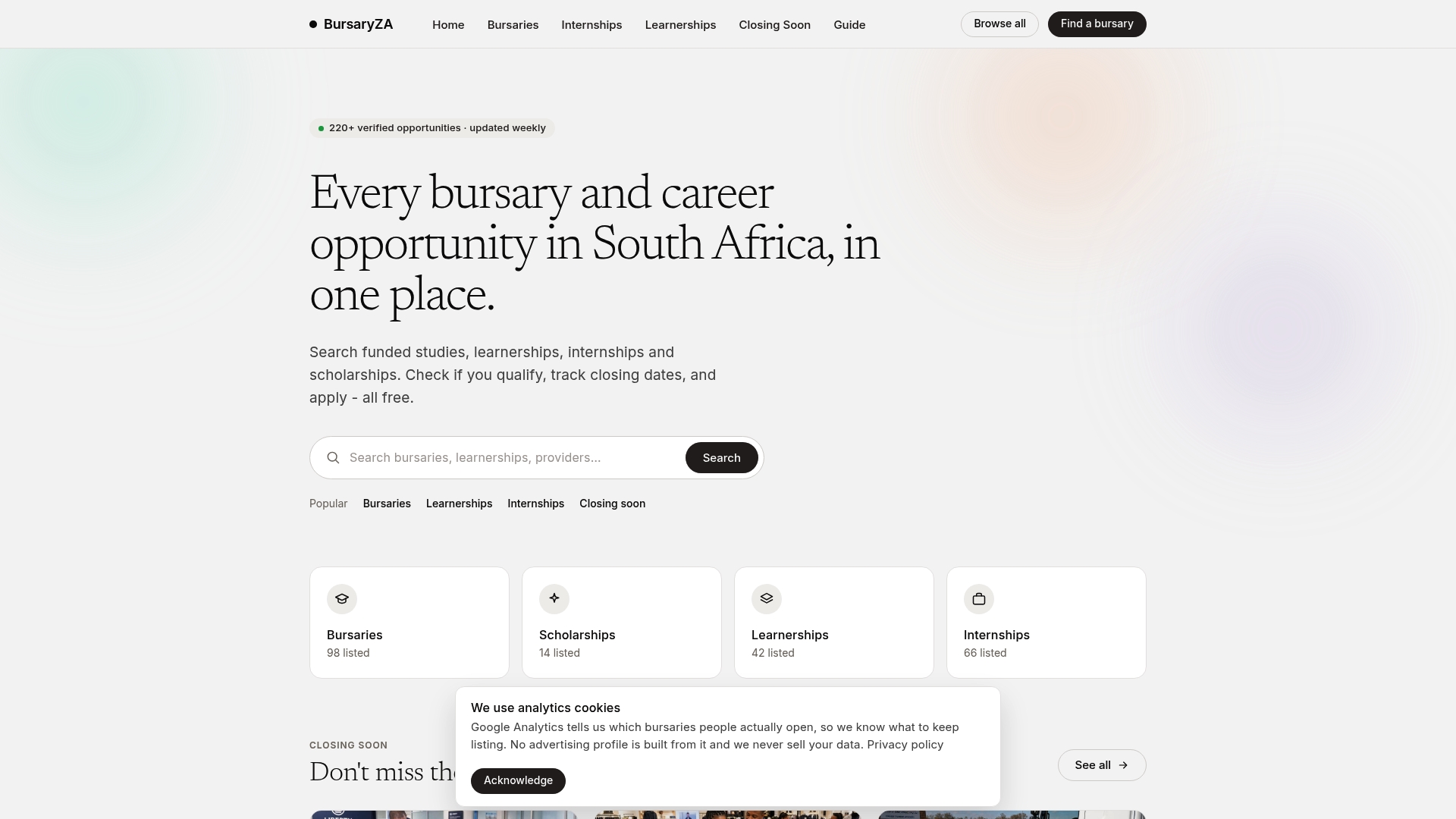
That verification matters more than it sounds. A posting listed on Bursaryza has already been checked, so the hour you’d spend confirming a company is real and still hiring goes straight into writing your letter instead. Open a listing that matches your field, pull two or three phrases from its requirements section, and drop them into your evidence paragraph exactly as the recipe above describes. If you’re also chasing funding for your studies alongside internship experience, the bursaries section runs on the same verified model. Start by browsing internships in South Africa and shortlist three postings tonight.
Sources
- CUT: Step-by-step guide for to write your cover letter
- Robert Walters Africa: How to write a cover letter
- UNISA: Cover letters and forms
- Handshake: How to write an internship cover letter: 7 tips & an example