How to Find Internships in South Africa: A Practical Guide

The fastest way to find an internship in South Africa is to combine three channels: a verified database or official youth platform for advertised posts, the careers pages of employers and government departments you want to work for, and direct emails to organisations that have not advertised anything. Decide what you are looking for first (field, province, start date), then search all three channels every week and keep a record of what you send.
This guide walks you through each step, from defining your search to checking that a listing is real, with the documents you will usually need.
TL;DR
- Define your field, location, start date and stipend needs before you search, so you can skip posts that do not fit.
- Search advertised posts through a verified database such as BursaryZA, official youth platforms, government vacancy circulars and company careers pages.
- For unadvertised roles, email a named person with a short, specific message and follow up after 7 to 10 days.
- Prepare a CV, certified ID, qualification copies and a short motivation text before closing dates arrive.
- Never pay to apply. Check the provider, the closing date and the application route on every listing.
Table of Contents
- What an internship is, and what it is not
- Step 1: Define what you are looking for
- Step 2: Search the places where internships are actually advertised
- Step 3: Approach employers who have not advertised
- Step 4: Check that a listing is genuine, current and right for you
- Step 5: Prepare your documents before closing dates
- Step 6: Manage your applications over time
- Perspective
- Find verified opportunities on BursaryZA
- Common mistakes to avoid
- FAQ
- Sources
What an internship is, and what it is not
An internship is a time-limited work-experience placement. In the public service, the Department of Public Service and Administration describes it as a structured programme for unemployed graduates that runs for a period of three to twelve months, often with a mentor. Private companies run their own versions, usually with a similar length and a monthly stipend.
When you search, you will meet several related terms. They are not the same thing:
| Programme | Who it is usually for | What you get |
|---|---|---|
| Internship | Graduates or final-year students | Work experience in your field, usually 3 to 12 months |
| Learnership | School leavers and unemployed youth | Structured learning plus workplace experience, leading to a qualification |
| Apprenticeship | People entering a trade | Practical training toward a trade qualification |
| Graduate programme | Recent graduates | A longer, structured entry route into a company, often with rotations |
| Bursary | Students who need study funding | Fees and sometimes living costs, sometimes with work-back conditions |
The official SA Youth platform lists jobs, learnerships, apprenticeships and volunteer opportunities side by side, so it pays to read the title and requirements carefully. A post called “programme” may be a learnership that asks for a matric certificate and no degree, while an “internship” may want a completed diploma.
If you are not yet sure which route suits you, our database separates bursaries, learnerships, internships and scholarships, so you can filter by the type you want.
Step 1: Define what you are looking for
Most people start by typing “internship” into a search engine and scrolling. That gives you hundreds of results and no way to judge them. Spend twenty minutes on criteria first.
Boston University’s career centre suggests deciding on the industry, role, skills, location, work arrangement, commute limits, pay priorities and start date before you begin, because clear criteria make the search more efficient. The advice comes from a US university, but the logic carries over to South Africa. Here is how to apply it locally.
- Field and role. Write down two or three job titles you could accept, such as “finance intern”, “civil engineering intern” or “administration intern”.
- Province and city. Be honest about where you can live. A placement in another province may mean rent, transport and a deposit you cannot cover on a stipend.
- Start date. Many programmes recruit once a year for a fixed intake. Knowing when you are free tells you which cycles to target.
- Pay and costs. Stipends vary widely by employer. One example: a programme based in George advertises a monthly travel allowance of up to R1,000, and expects two to five days in the office each week. Figures like that tell you whether you can afford the placement.
- Eligibility. Note your age, citizenship, qualification level and whether you are currently employed. Many public programmes target unemployed graduates.
Keep these five answers in a note on your phone. Every listing you open should be checked against them in under a minute.
Step 2: Search the places where internships are actually advertised
There is no single list that contains every internship. A good search uses several channels, and each one catches posts the others miss.
Verified databases
A database that checks providers and links straight to the official application page saves you from fake posts and broken links. On BursaryZA, each listing shows eligibility requirements, closing dates, the provider and a direct link to the official application page. We never charge a fee and never collect applications ourselves. You can filter by field, study level and location, which matches the criteria you set in step 1.
Official youth platforms
The National Youth Development Agency runs SA Youth, where young people can find jobs, volunteer roles, learnerships, bursaries and work-experience opportunities in their area. NYDA says joining is free, the mobi-site is data-free, and support is available on 0800 727272. People aged 15 to 34 can join if they are South African or can provide a Refugee ID number. You register with your ID and complete the profile questions, and nearby opportunities appear.
The platform’s FAQ explains that you can search by opportunity type and location, and that a complete profile (location, contact details, education, volunteering) helps the system recommend matching opportunities. It also says new opportunities are added daily, so logging in regularly pays off.
Government vacancy circulars and department pages
National and provincial departments advertise internships through the Public Service vacancy circular and on their own sites. Each advert tells you how to apply and which documents to send. For example, one provincial advert on the government e-recruitment portal asks applicants to quote the post and reference number and follow the prescribed route, and states that only shortlisted candidates may be asked for certified copies.
Because the public service internship is aimed at unemployed graduates, check whether an advert requires proof that you have no prior government internship. Another advert on the same portal lists, among its requirements, an affidavit confirming unemployment and no prior government internship. Read the document list for each post, because it differs from advert to advert.

Employer careers pages
Large banks, mining houses, telecoms companies, auditing firms, retailers and state-owned entities usually advertise internships and graduate programmes on their own careers pages. Make a list of ten employers you would like to work for and bookmark their careers pages. Check them on a set day each week.
Smaller organisations also run structured programmes. The GRIT Hub, for example, offers an annual internship for which applications must be submitted online during a stated window, with an email confirmation on submission. Its page also notes that the programme is offered once a year, which is typical: if you miss the window, the next chance is a year away.
Your university or TVET college
Career offices, faculty notice boards, WIL (work-integrated learning) coordinators and lecturers often hear about placements before they are posted online. If you are still studying, email your careers office and ask for the list of employers who recruit your discipline. If you have graduated, most offices still help alumni.
People you already know
Family, former employers, community leaders and classmates are a real channel. Tell them clearly what you are looking for: “I am a BCom accounting graduate looking for a 12-month internship in Gauteng” works far better than “I need a job”.
Step 3: Approach employers who have not advertised
Many organisations, especially small and medium ones, take interns without ever posting a vacancy. A speculative application is an email or letter to an employer that is not currently advertising.
Imperial College London’s careers service recommends that you research the organisation and the relevant department, find a named contact, and send a concise email explaining what attracted you, the type and timing of placement you want and how you could add value, with your CV attached and a request for a conversation. The same guidance suggests keeping a record and sending a friendly follow-up after 7 to 10 days if you hear nothing. That process works just as well for a South African firm.
A simple method
- Pick targets. Choose 15 to 20 organisations in your field and province: engineering consultancies, municipalities, NGOs, clinics, law firms, schools, accounting practices, tech start-ups.
- Find a person. Look for the head of the department, the HR officer or the manager of the team you would join. A named contact beats a general info address.
- Write four to six sentences. Say who you are, what you studied, what placement you want, when you are available and one concrete thing you can do for them.
- Attach one CV. Keep it to two pages. Name the file with your name and surname.
- Record it. Use a simple spreadsheet with the organisation, contact, date sent, follow-up date and result.
- Follow up once. After 7 to 10 days, send a short, polite reminder.
A sample message
Subject: Internship enquiry: BCom Accounting graduate, available from January
Dear Ms Dlamini,
I completed my BCom Accounting degree this year and am looking for a 12-month internship in a finance team. I am drawn to your department because of your work on municipal reporting. I am confident I can help with reconciliations and data capturing from day one. My CV is attached. May I call you this week for a short conversation?
Kind regards, Thabo Mokoena
Change the details to your own situation, and never send the same text to everyone without adjusting the organisation name and the reason for choosing it.
Step 4: Check that a listing is genuine, current and right for you
A good search finds posts. A careful search filters them. Run each one through these checks.
- No fees. Genuine youth programmes do not charge to apply. NYDA states that young people will never be asked to pay to access SA Youth features or benefits. If someone asks you for money to “secure” a placement, walk away.
- A named provider. You should be able to see the company, department or institution behind the post, and find the same post on its own website.
- A clear application route. The SA Youth FAQ advises applying through the platform or through the external application route specified by the listing. If a post asks you to send documents to a personal email address or a messaging app number, treat it with suspicion.
- A closing date and a reference. Official adverts carry both. Missing details are a warning sign.
- Realistic eligibility. Check age, citizenship, qualification and any equity requirement. The Yes4Youth FAQ explains that a programme designed around B-BBEE requires candidates to be Black as defined in the B-BBEE framework, aged 18 to 34 and South African citizens, whereas programmes outside that framework can have different age and race requirements. Apply where you meet the stated criteria.
- Programme-specific terms. Payment, schedule, location and timing differ by programme. The GRIT Hub, for instance, requires a National Senior Certificate or equivalent, prefers undergraduate or TVET study and sets no age limit, while asking non-South African applicants for a valid Student or Work visa or residency with the right to work.
On BursaryZA, we list the eligibility checklist, closing dates and document needs on every opportunity, so you can see in one place whether you qualify before you spend an evening on an application.
Step 5: Prepare your documents before closing dates
Internship windows can be short. If you gather your documents in advance, you can apply the day you see a post.
Documents that adverts commonly ask for include:
- A current CV, usually comprehensive and up to date.
- A certified copy of your ID (or passport, or Refugee ID where applicable).
- Copies of your matric certificate and tertiary qualifications.
- An original or certified statement of results, if your qualification is recent.
- A short motivation letter or statement of interest.
- For some public programmes, an affidavit confirming that you are unemployed and have not done a government internship before.
The GRIT Hub’s programme, for example, asks for a CV, a statement of interest, an ID or passport copy and a senior certificate or diploma copy. A provincial government advert may ask for more. The list is controlled by each advert, so read it fully every time. Many adverts only ask shortlisted candidates for certified copies, so do not spend money on certification until the advert requires it.
Build a document folder
Scan everything into one folder on your phone and in cloud storage. Use clear names such as “ID_Surname” and “Degree_Certificate_Surname”. Keep your CV in both Word and PDF form. Having these ready means you can attach them in minutes.
Write a CV that fits an internship
You do not need years of experience. Lead with your qualification, then include relevant modules, projects, volunteer work, part-time jobs and skills such as software you use. Add your province and a working phone number and email address. Use a professional email address, ideally a variation of your name.
Step 6: Manage your applications over time
Finding an internship is usually a numbers game with a learning curve. You will apply to several places before you hear back, so keep your process organised.
- Apply to many suitable posts, not just a few dream posts.
- Track every application in a spreadsheet: provider, date, documents sent, closing date, status.
- Keep your online profiles, including SA Youth, up to date. The platform says that opportunities are added daily, so logging in regularly and keeping your profile updated helps.
- Tailor your motivation to each post, using the wording of the advert.
How many applications you should expect to send before an offer is a common worry. This analysis of how many job applications it takes to get hired is a good way to set realistic expectations and plan your weekly application target.
A weekly routine that works
| Day | Task | Time |
|---|---|---|
| Monday | Check your database and platform alerts, shortlist new posts | 30 minutes |
| Tuesday | Apply to one or two posts with tailored motivation | 1 to 2 hours |
| Wednesday | Send three speculative emails | 1 hour |
| Thursday | Check employer careers pages and government adverts | 45 minutes |
| Friday | Follow up on emails sent 7 to 10 days ago and update your tracker | 30 minutes |
This adds up to about five hours a week. It is realistic if you are job hunting full time or studying, and it keeps your search moving.
Perspective
Every week we hear from young people who have applied to ten posts and heard nothing. In most cases the problem is not the candidate. It is the search: posts that were already closed, listings that did not match the applicant’s qualifications, or documents missing at the last minute.
That is why we built BursaryZA around verification and clarity. Each listing shows the provider, the closing date, the eligibility checklist and the documents needed, and links directly to the official application page. We never charge a fee and never collect applications. You can filter by field, study level and location, so your time goes to opportunities you can actually win.
Our advice is simple: build a routine, use one trusted database as your anchor, add direct approaches to employers, and keep every document ready. The candidates who succeed are rarely the luckiest. They are the ones who apply early, to the right posts, with complete files.
Nkosi
Find verified opportunities on BursaryZA
If you want a shortlist of opportunities that match your field, level and province, start on BursaryZA. You will find verified internships, learnerships, bursaries and scholarships, each with an eligibility checklist, closing dates, provider information and a direct link to the official application page.
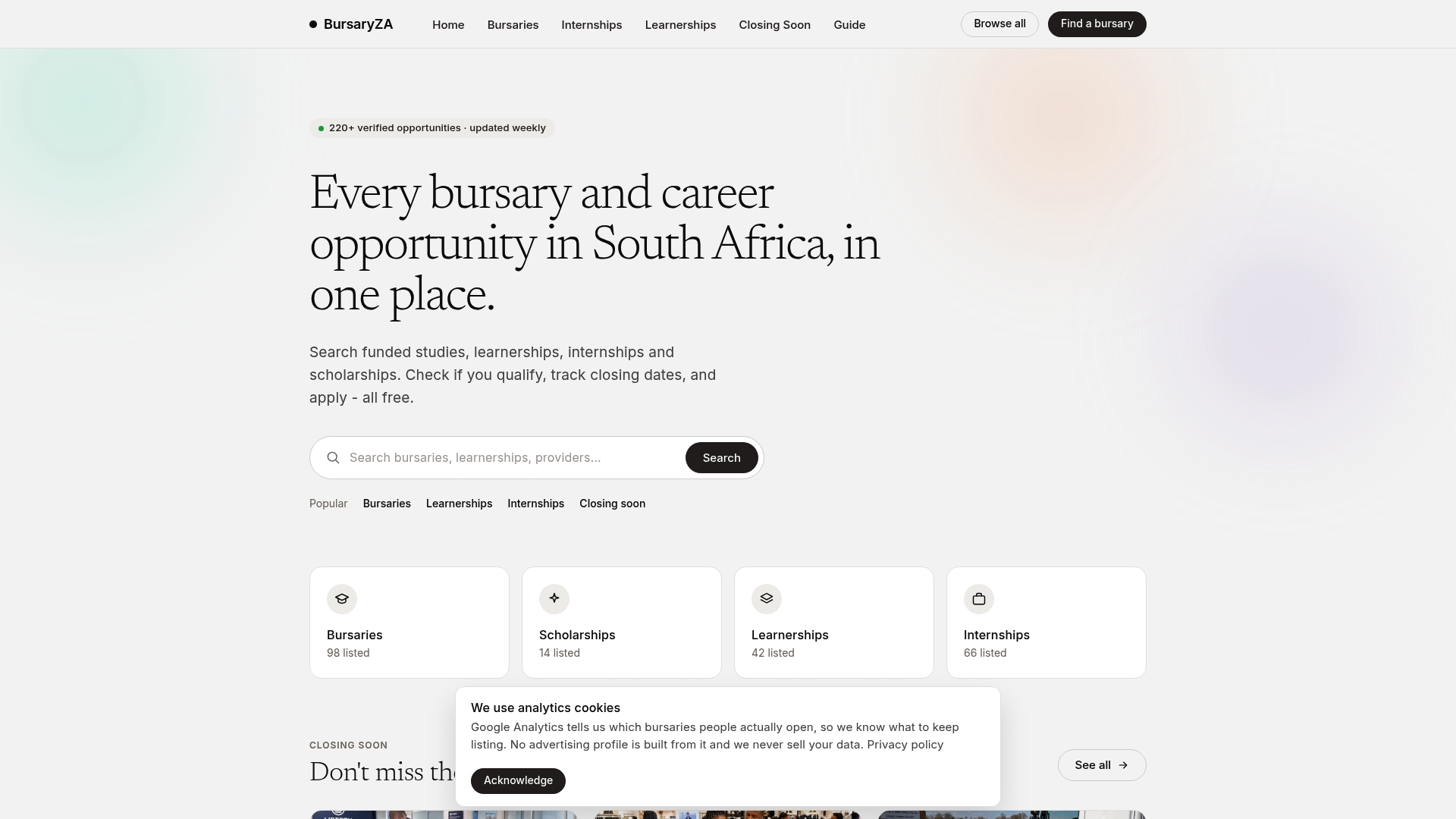
Use the matching tool to filter by what you set out in step 1, then check the document list before you apply. If you are still studying, browse the bursaries too: funded study now can lead to better internship options later.
Common mistakes to avoid
- Waiting until you graduate. Many programmes recruit months ahead, and some accept final-year students. Start looking in your final year.
- Using one CV for everything. Adjust the top third of your CV and your motivation to match each role.
- Ignoring small employers. Municipal offices, NGOs, clinics and local firms often have the least competition.
- Missing instructions. Adverts that ask for a reference number in the subject line or a specific file format are often screened by those rules.
- Paying for access. Legitimate listings do not require payment. Report posts that do.
- Giving up after silence. Employers get hundreds of applications. A polite follow-up after 7 to 10 days is normal.
FAQ
Can I find an internship without a degree?
Yes, though the route often differs. Many internships are aimed at graduates, but learnerships and some programmes accept school leavers or students at TVET level. For example, one annual internship prefers undergraduate or TVET study and asks for a senior certificate or equivalent. Filter your search by study level and read the requirements.
Where should I look first?
Start with one verified database and the official SA Youth platform, then add the careers pages of employers in your field and provincial government adverts. Together these cover most advertised posts. Add speculative emails for organisations that have not advertised.
How early should I start applying?
Start in your final year if you can. Many programmes run once a year with a fixed application window, so missing it can mean waiting twelve months. Check each provider’s official page for the current schedule rather than relying on last year’s dates.
Do I have to pay to apply for an internship?
No. NYDA states that young people are never asked to pay to use SA Youth, and genuine employers do not charge application fees. If a post asks for money, a deposit or a payment for a “placement”, do not continue.
What if an employer does not reply?
Send one friendly follow-up after 7 to 10 days, restating your interest and attaching your CV again. If there is still no answer, move on and keep applying elsewhere. Record each attempt in your tracker.
Sources
- SA Youth Network, National Youth Development Agency
- Youth FAQs, Yes4Youth
- The Public Service Internship Programme, DPSA
- How to Search for an Internship, Boston University Center for Career Development
- Speculative applications, Imperial College London
- Government vacancy advertisement (post and reference route)
- Government vacancy advertisement (unemployment affidavit)
- The GRIT Internship, GRIT Hub