3 Month Rule Could Reject Your Bursary Affidavit in South Africa
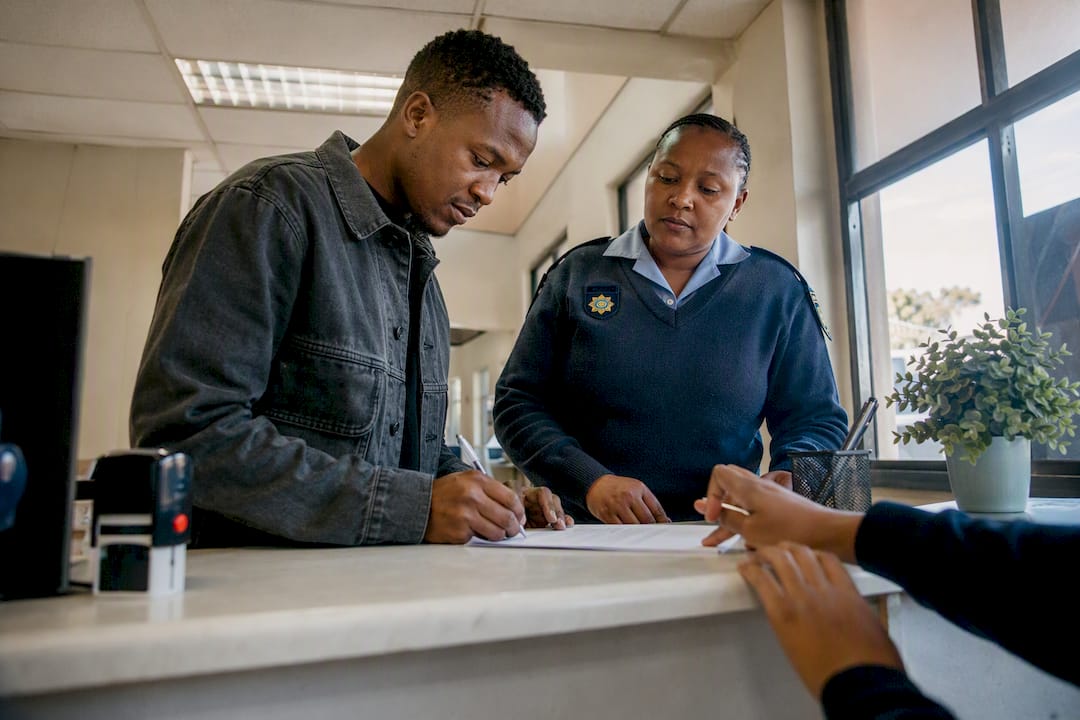
An affidavit for bursary applications only carries weight when it’s a genuine last resort: no bank statement, no retrenchment letter, no formal proof exists to back your claim. It must be sworn by the parent or guardian, not the student, before a Commissioner of Oaths, and most institutions reject one older than three months. Get those three things wrong and even a well-written affidavit gets bounced back.
TL;DR:
- An affidavit for bursary applications is only credible if it is recent, sworn by the parent or guardian in front of a Commissioner of Oaths, and free of errors or omissions.
- Most bursary providers and NSFAS prioritize official documents like bank statements, retrenchment letters, or court orders over affidavits, which are considered weak evidence.
- The affidavit must include full legal names, relationship, date, place, specific financial details, income estimates, contribution statements, and a proper sworn declaration with signatures and official stamps.
- NSFAS rejects affidavits older than three months, signed by the wrong person, or used to replace official documents, especially in guardianship or legal custody cases.
- Pair affidavits with any corroborating evidence available and check each provider’s specific requirements to prevent delays or rejections.
Table of Contents
- What Is an Affidavit for Bursary Applications and When Do You Need One?
- Why Bursaries and NSFAS Treat Affidavits Cautiously
- What Must a Bursary Affidavit Include?
- How to Swear or Affirm an Affidavit in South Africa
- NSFAS Rules and the Mistakes That Get Applications Rejected
- Submitting Your Affidavit: Certification, Scanning, and Follow-Up
- Sample Affidavit Templates for Common Bursary Situations
- BursaryZA’s Verification Checklist for Applicants
- Do’s and Don’ts From a Bursary Adviser
- Find Bursaries That Match Your Documentation Situation
- Sources
What Is an Affidavit for Bursary Applications and When Do You Need One?
An affidavit is a written statement of fact that someone swears or affirms is true, under oath, in front of a legal official authorized to witness it. Once signed and stamped, it carries the same legal weight as testimony given in court, which is exactly why lying on one is a criminal offense, not just an application hiccup.
Bursary providers and university financial aid offices ask for an affidavit for bursary situations when a household’s financial circumstances can’t be proven with a standard document. That covers a narrower list than most applicants assume.
You’ll typically need one for:
- An unemployed parent or guardian with no UIF payments, no retrenchment letter, and no other formal record of their status.
- Informal income, such as a parent who trades at a taxi rank, runs a small spaza shop, or does casual domestic or construction work with no payslips.
- A non-cohabiting parent, where the applicant lives with one parent and needs to explain why the other parent’s income isn’t part of the household picture.
- Caretaker or informal guardianship support, where a grandmother, aunt, or family friend is the one actually paying for the applicant’s needs, even without formal legal guardianship.
Here’s the part applicants miss most often: an affidavit is never meant to replace a document that already exists. If your parent has a payslip, a UIF letter, a SASSA card, or a bank statement, the bursary provider wants that, not a sworn statement describing the same facts in prose. Financial aid offices consistently rank bank statements, retrenchment letters, and court orders above affidavits because those documents come from an independent source and can’t be shaped to fit the applicant’s needs. An affidavit is what you reach for when the paper trail genuinely doesn’t exist, not a shortcut around gathering it.
This matters for how you frame the whole application. Treat the affidavit as a gap-filler for one specific fact your family can’t otherwise document, not a general summary of your household’s finances.
Why Bursaries and NSFAS Treat Affidavits Cautiously
Verification teams see affidavits as the weakest tier of evidence in the entire document pile, and they’re upfront about why: an affidavit is self-reported. There’s no independent party confirming the numbers, so a financial aid office has to take the deponent’s word for it, backed only by the legal consequence of perjury if it later proves false.
That caution shows up clearly in how NSFAS structures its own requirements. For situations like guardianship, NSFAS requires its own declaration forms and, in many cases, court-issued documentation rather than accepting a sworn statement from a family member. A guardian affidavit alone usually isn’t enough to settle a funding decision when legal custody is the actual question at hand.
Why this catches applicants off guard: many assume any signed, stamped affidavit satisfies any documentation gap. It doesn’t. The specific claim matters. An affidavit describing informal income tends to be accepted readily. An affidavit claiming legal guardianship over a court order gets flagged almost every time.
The practical risks of leaning too hard on an affidavit are:
- Processing delays while the verification team requests additional proof.
- A formal request for a supporting document you could have submitted the first time.
- Outright rejection of that specific claim if the institution’s policy explicitly excludes affidavits for it.
One pattern worth knowing before you submit anything: applicants who pair an affidavit with even partial corroborating evidence, like a blank bank statement showing zero income or a SASSA letter, get through verification noticeably faster than those who submit the affidavit alone. The sworn statement becomes context for the document, not the entire case.
What Must a Bursary Affidavit Include?
A bursary affidavit fails for one of two reasons almost every time: a missing mandatory field, or wording that’s vague where it needs to be specific. Here’s what to check off before anyone signs anything.
- Full legal names and ID numbers of both the deponent (the person swearing the affidavit) and the applicant, spelled exactly as they appear on official ID documents.
- The relationship between deponent and applicant, stated plainly: “biological mother of,” “legal guardian of,” “grandmother and primary caregiver of.”
- Date and place the affidavit is made, which becomes the anchor point for the three-month validity window most institutions apply.
- An explicit statement of the financial situation, not a vague reference to it. Say “I am currently unemployed and receive no UIF benefits, government grant, or formal salary” rather than “I don’t have a job right now.”
- Approximate income figures where any income exists. If the deponent earns something informally, state a realistic monthly range rather than omitting the number entirely. Silence on income reads as evasive to a verification officer.
- A statement of what portion of that income supports the student. This is the line most templates skip, and it’s often the line the bursary provider actually cares about. Something like: “Of this income, I contribute approximately $R1,500 per month toward [applicant name]'s living and study expenses.”
- A closing declaration of truth, the standard line confirming the deponent understands the statement is true and made freely, without duress.
- A blank space for the signature, left unsigned until the deponent is standing in front of the Commissioner of Oaths.
- The Commissioner of Oaths block, including their name, designation, stamp, and the date and place the oath was administered.
The single biggest formatting mistake applicants make is signing the affidavit before arriving at the police station or attorney’s office. An affidavit is only valid if the deponent signs it in the presence of the commissioner, after swearing or affirming that its contents are true. A pre-signed affidavit isn’t a sworn statement. It’s just a signed piece of paper, and most institutions will reject it on sight if the commissioner’s date doesn’t line up with a signature made earlier.
Plain language matters more than legal-sounding phrasing. Financial aid officers read hundreds of these. An affidavit stuffed with “hereinafter” and “the aforementioned party” doesn’t read as more credible, it just takes longer to parse. Write it the way you’d explain the situation to a person, then let the sworn format carry the legal weight.
Pro Tip: Attach a one-paragraph cover note alongside the affidavit explaining, in your own words, why no formal document exists (“my mother sells vegetables at the local market and has never received a payslip”). Verification officers process applications faster when the gap in evidence is explained upfront instead of left for them to question.
How to Swear or Affirm an Affidavit in South Africa
Swearing an affidavit is a short, formal process, and it costs nothing at most locations; for students curious about funding their religious education, our guide on using FAFSA for Bible school explains available federal aid options. Here’s where South Africans actually go to get it done.
- SAPS police stations are the most common route. Any police station has an officer authorized to act as Commissioner of Oaths, and most keep a standard affidavit template on hand if you don’t bring your own.
- Attorneys and law firms can administer oaths too, and many will do so for a small fee or even free for a simple affidavit.
- Notaries public handle affidavits alongside other sworn documents, though this route is less common for bursary purposes and typically costs more.
- Commissioners of Oaths at government offices, such as some Home Affairs branches, magistrate’s courts, and certain municipal offices, can also administer the oath.
What to bring with you: the deponent’s original, valid South African ID document (not a photocopy), the unsigned affidavit printed and ready, and any supporting documents referenced in the text, like a SASSA card or an old payslip, in case the commissioner wants to see what’s being described.
Pro Tip: Many police stations will swear a simple affidavit for free, but times can vary station to station, and a busy station on a Monday morning can mean a long wait. Go early, and call ahead if you can to confirm the commissioning officer is on duty. Some attorneys also offer discounted or free affidavit swearing specifically for students, so it’s worth asking around your area before defaulting to SAPS.
The commissioner will ask the deponent to confirm the contents are true, watch them sign, then sign, stamp, and date the document themselves. The whole process usually takes ten to fifteen minutes once you’re at the front of the queue.
NSFAS Rules and the Mistakes That Get Applications Rejected
NSFAS runs one of the strictest verification processes in the country’s bursary landscape, and its rules on affidavits are more specific than most applicants realize. NSFAS maintains its own checklist of supporting documents, and for several categories, an affidavit simply isn’t on that list.
Guardianship is the clearest example. Where an applicant’s guardian situation is anything other than straightforward, NSFAS generally requires a court order or a social worker’s declaration, not a family member’s sworn statement. Orphaned or vulnerable applicants face a similar rule: NSFAS asks for a formal orphan or vulnerable child declaration, often completed by a school principal or social worker, rather than an affidavit describing the same circumstances.
More broadly, guidance circulating ahead of recent NSFAS application periods has explicitly warned applicants that affidavits are not accepted as substitutes for the official forms NSFAS specifies. That’s a shift worth internalizing: what worked as a fallback document a few years ago may now get flagged as insufficient at the first review stage.
The most common mistakes that trip up NSFAS applicants:
- Submitting an affidavit older than three months. NSFAS and most universities calculate the window from the date the commissioner stamped it, not the date you eventually upload it. An affidavit sworn in March and submitted in August is stale, no exceptions.
- Having the student sign instead of the parent or guardian. The applicant is not a credible witness to their own household’s finances in the eyes of most verification teams. The deponent needs to be the person actually experiencing the circumstance described.
- Using a guardian affidavit where a court order was required. This is the single biggest source of NSFAS rejections tied to affidavits, and it usually forces a resubmission cycle that eats weeks.
- Leaving out income figures entirely. A blanket claim of “unemployed” without any detail on other household income reads as incomplete rather than honest.
So when does NSFAS accept an affidavit? Mainly for informal income situations, like a self-employed parent with no formal payslips, or a parent who lives elsewhere and contributes nothing documented to the household. In both cases, NSFAS still expects the affidavit to be paired with whatever secondary evidence exists, even something as thin as a blank bank statement or a SASSA confirmation letter. Check the NSFAS eligibility and document guide for your specific circumstance before assuming an affidavit will suffice.
Submitting Your Affidavit: Certification, Scanning, and Follow-Up
Once the affidavit is sworn and stamped, how you submit it matters almost as much as what it says. A poorly scanned document can stall an otherwise solid application for days.
- Certify a copy if the portal requires it. Some bursary providers want a certified copy rather than the sworn original. Take the original to a police station or attorney and ask for certification, a separate, quick process from swearing the oath itself.
- Scan in PDF format at a readable resolution. Aim for a scan clear enough that the commissioner’s stamp and signature are legible, not just the typed text. A phone photo taken at an angle, with half the page in shadow, is the single most common reason a document gets rejected on upload.
- Combine multi-page documents into one file where the portal allows it. Separate files for page one and page two of the same affidavit create confusion for whoever reviews the application.
- Name the file clearly, something like “Affidavit_Unemployment_[Surname].pdf” rather than “Scan001.pdf.” Reviewers handling hundreds of applications appreciate a file name that tells them what they’re opening before they click it.
- Follow up politely if verification stalls. If a provider requests additional evidence after you’ve submitted the affidavit, respond quickly with whatever corroborating document you can find, even a partial one. A prompt, complete response to a verification query moves an application back to the front of the queue far faster than silence.
Applicants who track their submission deadlines against a bursary application calendar tend to have more breathing room to fix a rejected document instead of scrambling the night before a deadline closes.
Sample Affidavit Templates for Common Bursary Situations
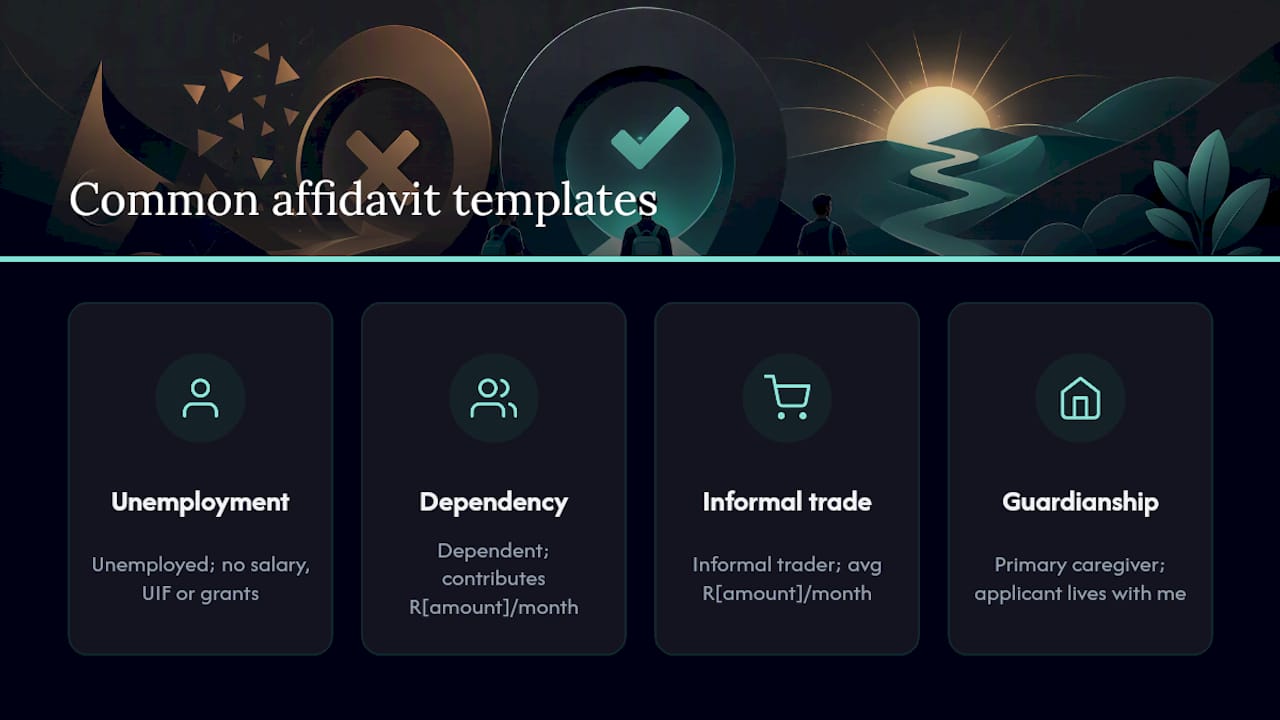
These four templates cover the scenarios that come up most often. Treat every bracket as a placeholder to fill in with your own details, and never copy one word for word without adjusting it to your actual circumstances, since a generic-sounding affidavit is easier for a reviewer to question.
1. Unemployment affidavit (parent or guardian)
I, [full name], ID number [ID number], residing at [address], do hereby make oath and state that I am the [mother/father/legal guardian] of [applicant’s full name], ID number [applicant ID number], a student who has applied for a bursary. I am currently unemployed and have been since [month/year]. I receive no salary, UIF benefit, or government grant. I support [applicant’s name] through [describe support, e.g., “occasional casual work and assistance from extended family”]. This statement is true and correct to the best of my knowledge.
Customize the middle section to reflect exactly how the household gets by, since a blank space there is what triggers follow-up questions.
2. Financial dependency affidavit
This version works when a student is financially dependent on someone other than a formal breadwinner, such as an older sibling or a grandparent without a fixed income.
I, [full name], ID number [ID number], do hereby make oath and state that [applicant’s full name] is financially dependent on me. I currently support this dependency through [source, e.g., “a monthly pension of $R[amount]” or “informal income from [describe]”]. Of this income, I contribute approximately $R[amount] per month toward [applicant’s name]'s study and living expenses. No other person contributes financially to this student’s education.
3. Informal trader income affidavit
This is the template for a parent running a spaza shop, selling produce at a market, or doing informal trade work with no formal payslip.
I, [full name], ID number [ID number], do hereby make oath and state that I earn my living through informal trading, specifically [describe trade, e.g., “selling fruit and vegetables at [location]”]. My average monthly income from this trade is approximately $R[amount], which fluctuates depending on [season/demand/other factor]. I have no formal payslip, UIF record, or tax certificate related to this income. I contribute approximately $R[amount] per month toward the study expenses of [applicant’s name].
4. Guardianship note (with an important caveat)
I, [full name], ID number [ID number], do hereby make oath and state that I am the primary caregiver of [applicant’s full name], ID number [applicant ID number], and have acted in this capacity since [date/year]. [Applicant’s name] resides with me and I am responsible for their day to day care and, where possible, their financial support toward their education.
The caveat here matters more than the template itself: for NSFAS specifically, a guardianship affidavit like this one usually isn’t sufficient on its own. If legal custody or guardianship is central to the funding decision, NSFAS typically wants a court order or a social worker’s declaration instead. Use this affidavit as a supporting document alongside that official paperwork, not as a replacement for it, and check the specific bursary or NSFAS category’s checklist before assuming the affidavit alone will close the gap.
BursaryZA’s Verification Checklist for Applicants
Every bursary listing on BursaryZA carries its own document checklist, and verification failures almost always trace back to one of three fixable issues: an expired affidavit, a signature from the wrong person, or a missing income figure that leaves the household’s situation vague.

The fastest fixes, in order of impact: swear a new affidavit if yours is approaching the three-month mark rather than risk submitting a stale one; confirm the parent or guardian, not the applicant, is the one signing; and add an actual number, even an estimate, wherever the affidavit references income.
Before applying, open the specific bursary’s listing on BursaryZA and check its document requirements against what you have on hand. The bursary application calendar is worth cross-referencing here too, since it flags closing dates far enough in advance to get an affidavit sworn, certified, and uploaded without a last-minute scramble.
Do’s and Don’ts From a Bursary Adviser
Do write your affidavit in your own words, then have someone else read it back to you before you go to the commissioner. If a sentence sounds vague to a stranger, it will read as vague to a verification officer too. Do attach whatever partial evidence exists, even something as thin as an old bank statement showing a zero balance, because an affidavit standing entirely alone is the version most likely to trigger a follow-up request.
Don’t let the student sign in place of the parent or guardian, even when it feels faster. And don’t assume one affidavit format works for every provider. NSFAS’s expectations and a private bursary’s expectations aren’t identical, and treating them as interchangeable is how applications stall.
One pattern comes up often enough to be worth naming: an applicant whose mother traded informally at a local market submitted an affidavit describing her monthly earnings, paired with a short note explaining the absence of any payslip. Paired with a SASSA letter for a younger sibling in the household, the application cleared verification in one pass, no follow-up requests, no delay. The affidavit wasn’t the whole case. It was one piece filling one specific, unavoidable gap.
— Nkosi
Find Bursaries That Match Your Documentation Situation
Bursaryza is the alternative to scrolling dozens of provider websites hoping to spot which ones accept affidavits for informal income or an absent parent. Every listing on the platform shows its eligibility checklist and required documents upfront, so you know before you start an application whether your situation, and your paperwork, actually fits.
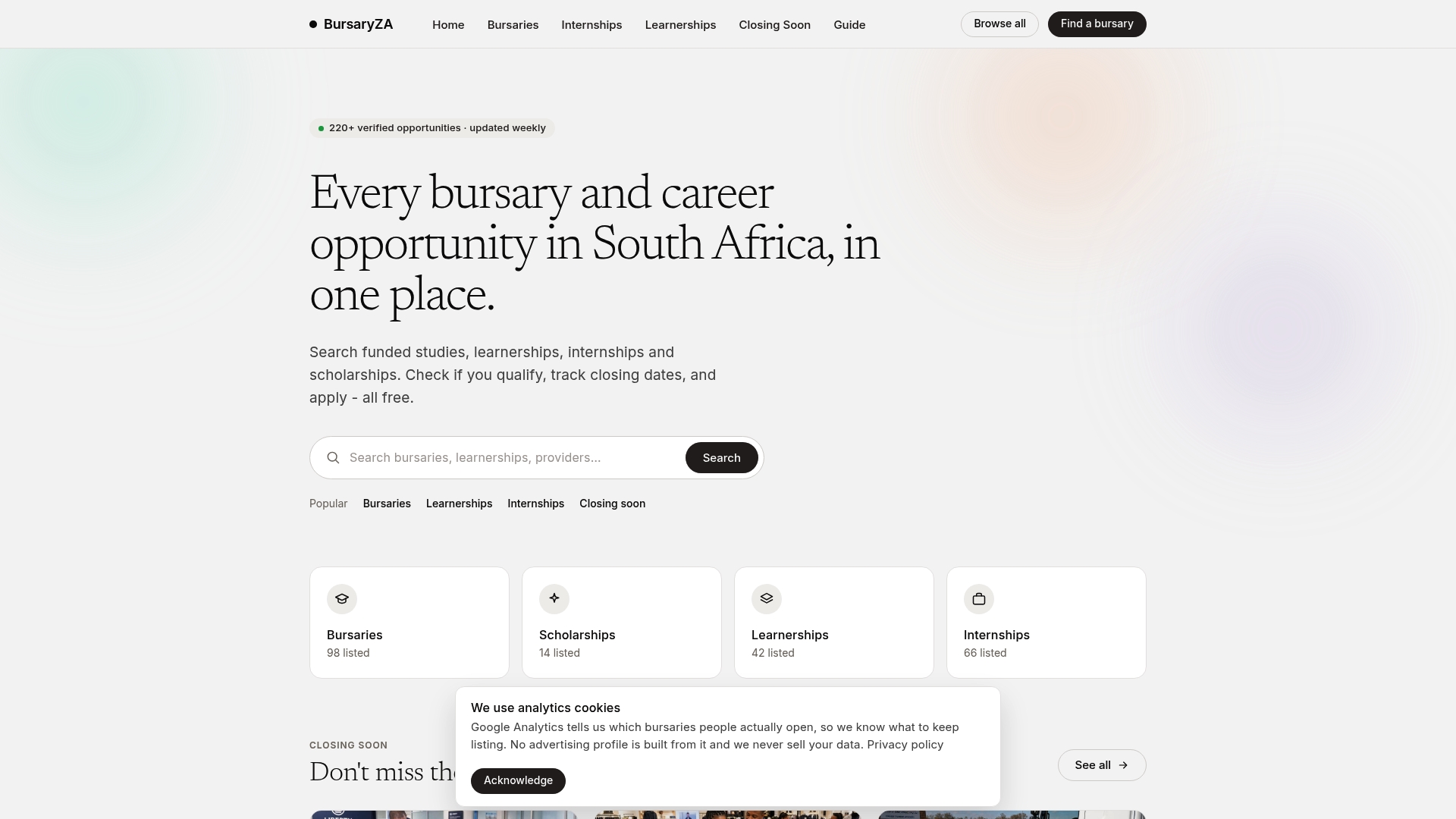
That means no wasted afternoons filling in an application only to discover on page four that the provider demands a formal payslip you don’t have. Use the filters to narrow results by field of study, study level, and province, and check each listing’s document list against what your family can realistically produce, whether that’s a sworn affidavit, a SASSA letter, or both. Pair that with the bursary application calendar to track closing dates while you’re getting an affidavit sworn and certified.
Start by browsing the full list of verified bursaries in South Africa and shortlist the ones whose requirements match your documentation on hand today.
Sources
- GUIDELINES FOR AFFIDAVITS & PROOF OF INCOME | University Of Pretoria
- NSFAS FAQs
- Download SAPS Affidavit Template - FormFactory
- NSFAS Supporting Documents: Affidavits Not Accepted – What To Submit Instead - Status Check